EASE and Delta-ee are pleased to announce the publication of the fourth edition of the European Market Monitor on Energy Storage (EMMES).
EMMES 4.0 shows that:
The European energy storage market contracted in 2019 to 1 GWh, with a cumulative installed base of 3.4 GWh across all segments.
In 2019 saturated FCR markets in the UK and Germany slowed growth in the Front of Meter segment. We expect a rebound in 2020 as the demand for system flexibility rises and value streams open.
The residential segment continues to grow steadily, driven by growth in Germany that accounted for 76% of the annual market in 2019.
The C&I segment saw a small contraction in the leading markets (Germany and the UK) in 2019. Regulatory uncertainty and long payback periods are hindering growth.
However, the future of energy storage in 2020 in Europe remains positive as the energy transition progresses.
Regulators and grid operators are increasingly recognising the value that storage adds to electricity systems. Consumers in both the residential and C&I segments show growing interest in storage as technology costs fall and Feed in Tariffs are phased out. And the storage industry continues to innovate around products and propositions.
The EU’s Clean Energy Package is already opening doors for storage, and this process will only accelerate over the coming years as regulations stabilise.
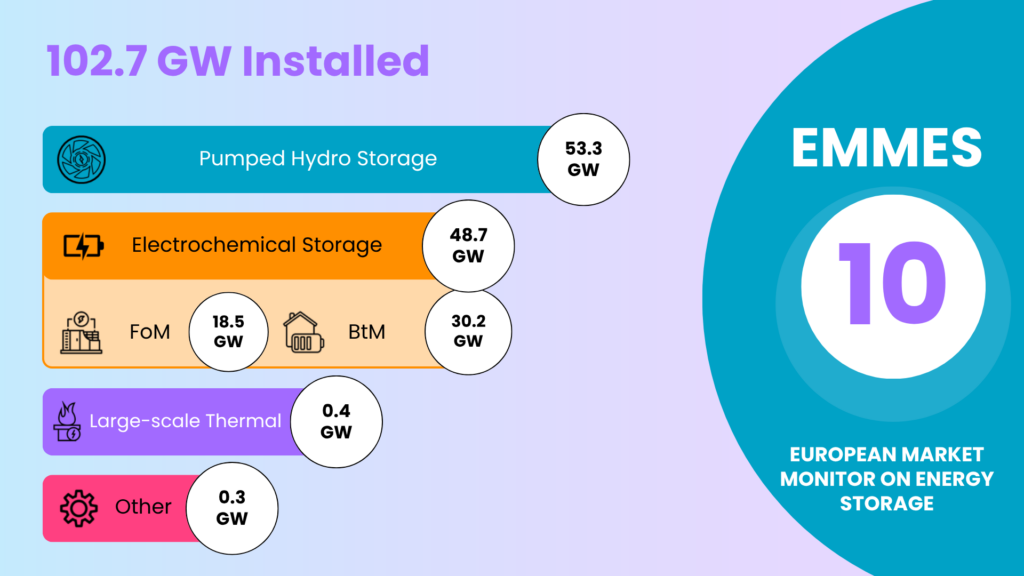
In 2025, Europe surpassed 100 GW of installed storage capacity for the first time, and by Q2 2026 storage overtook nuclear as a source of installed power capacity. With electrochemical storage forecast to grow by a further 153 GW by 2030, energy storage is becoming a core pillar of Europe's future electricity system.
In 2025, Europe surpassed 100 GW of installed storage capacity for the first time, and by Q2 2026 storage overtook nuclear as a source of installed power capacity. With electrochemical storage forecast to grow by a further 153 GW by 2030, energy storage is becoming a core pillar of Europe's future electricity system.
Thermal Energy Storage can help European industry decarbonise, reduce costs, and access new revenue streams. Yet significant regulatory, economic, and financial barriers continue to limit its deployment.
Energy Storage Europe welcomes the proposal for an Industrial Accelerator Act (IAA) and supports its overall objective of strengthening industrial capacity, accelerating decarbonisation, and creating stronger lead markets for strategic clean technologies in the European Union.