Energy Storage Europe's position paper, "Ensuring System Stability in Europe: The Role of Energy Storage in Providing Inertia", focuses on how the EU can implement a cost-effective and technologically neutral approach to procuring inertia. It also outlines how such an approach can be firmly embedded within a harmonised European methodology for assessing and monitoring inertia needs across synchronous areas.
March 2026 / Consultations & Advocacy
Battery Booster Facility
Energy Storage Europe replies to the European Commission’s public consultation on the Battery Booster Facility. On 16 December 2025, the European Commission announced a Battery Booster Strategy, within the Automotive Action Plan. The Strategy includes a Facility of EUR 1.5 billion in the form of loans for projects in the production of battery cells in Europe.
The Facility rightly identifies the support needed in the ramp-up phase of battery cell production, which involves transitioning to high-volume, high-precision manufacturing while balancing low yields, high material costs, and intense quality requirements. During this phase all systems, equipment, and processes undergo extensive testing, validation, and fine-tuning to ensure that efficient and effective operations. It is characterised by high scrap rates, making it difficult to achieve profitability and meet strict quality standards required by the automotive sector.
For these reasons, Energy Storage Europe welcomes the initiative to establish a Battery Booster Facility and supports the Commission’s recognition, in the recitals, of the urgent need to strengthen the European battery industry during the ramp-up phase of production. The Facility correctly highlights the strategic importance of batteries and the need to align this initiative with the objectives of the Net-Zero Industry Act. Batteries for stationary energy storage are a crucial component of the Union’s energy security: they enable the integration of renewable energy, provide essential flexibility to the electricity system, and strengthen the resilience of the European energy system.
However, precisely for the role that batteries for energy storage play in the energy system, Energy Storage Europe calls for the scope of the Facility to be expanded to other battery uses, following the granularity present in other relevant EU legislation, such as the EU Batteries Regulation (EU) 2023/1542.
Energy Storage Europe's position paper, "Ensuring System Stability in Europe: The Role of Energy Storage in Providing Inertia", focuses on how the EU can implement a cost-effective and technologically neutral approach to procuring inertia. It also outlines how such an approach can be firmly embedded within a harmonised European methodology for assessing and monitoring inertia needs across synchronous areas.
Not a member yet ?
Explore the benefits of joining Energy Storage Europe
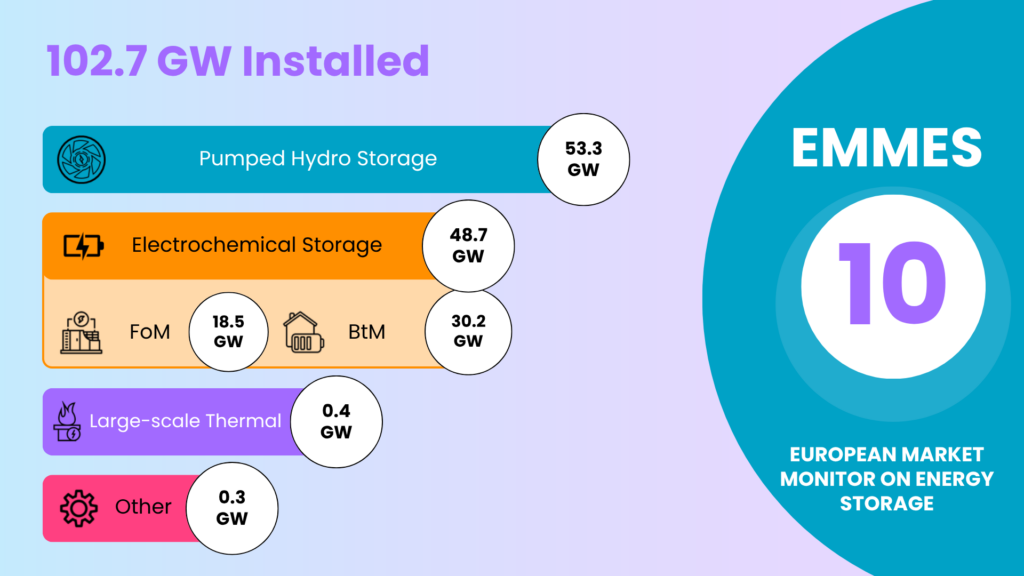
In 2025, Europe surpassed 100 GW of installed storage capacity for the first time, and by Q2 2026 storage overtook nuclear as a source of installed power capacity. With electrochemical storage forecast to grow by a further 153 GW by 2030, energy storage is becoming a core pillar of Europe's future electricity system.
In 2025, Europe surpassed 100 GW of installed storage capacity for the first time, and by Q2 2026 storage overtook nuclear as a source of installed power capacity. With electrochemical storage forecast to grow by a further 153 GW by 2030, energy storage is becoming a core pillar of Europe's future electricity system.
Thermal Energy Storage can help European industry decarbonise, reduce costs, and access new revenue streams. Yet significant regulatory, economic, and financial barriers continue to limit its deployment.
Energy Storage Europe welcomes the proposal for an Industrial Accelerator Act (IAA) and supports its overall objective of strengthening industrial capacity, accelerating decarbonisation, and creating stronger lead markets for strategic clean technologies in the European Union.