This position paper, prepared by the Energy Storage Europe Association, assesses the system value of long-duration energy storage, identifies barriers to deployment, and proposes recommendations to better align European energy, industrial, and financing frameworks with the long-term flexibility needs of a fully decarbonised power system.
February 2026 / Policy Papers
Ensuring System Stability in Europe: The Role of Energy Storage in Providing Inertia
Energy Storage Europe's position paper, "Ensuring System Stability in Europe: The Role of Energy Storage in Providing Inertia", focuses on how the EU can implement a cost-effective and technologically neutral approach to procuring inertia. It also outlines how such an approach should be firmly embedded within a harmonised European methodology for assessing and monitoring inertia needs within the same synchronous areas.
The European power system is becoming increasingly vulnerable to system stability challenges. As traditional synchronous machines are progressively being accompanied by inverter-based renewable energy sources (IBRs), such as PV and wind turbines, the overall system inertia is declining significantly. This reduction limits the system’s ability to withstand sudden frequency deviations and voltage disturbances, increasing the risk of instability. Despite these needs, the European Union still lacks a harmonised framework for assessing inertia needs and, consequently, procuring inertia.
The paper calls for EU-wide non-binding procurement guidelines that would support NRAs and TSOs in delivering inertia as a market-based service, procured via technology-neutral tenders with pre-defined product characteristics, delivery obligations and penalties for non-compliance. European Union and national policymakers should adopt a harmonised framework for the assessment of inertia needs, aiming to quantify local needs based on a common methodology.
Energy Storage Europe calls on the European Commission to accelerate the adoption of the amended NC RfG 2.0, so that all relevant synchronous and inverter-based assets can contribute to system stability on a level playing field.
In particular, Energy Storage Europe identifies the following measures as needed to ensure non-discriminatory market-based mechanisms for inertia procurement.
This position paper, prepared by the Energy Storage Europe Association, assesses the system value of long-duration energy storage, identifies barriers to deployment, and proposes recommendations to better align European energy, industrial, and financing frameworks with the long-term flexibility needs of a fully decarbonised power system.
Not a member yet ?
Explore the benefits of joining Energy Storage Europe
Energy Storage Europe welcomes the European Commission's growing focus on cybersecurity in the energy sector and supports the direction of travel across the Cyber Resilience Act (CRA), the Network Code on Cybersecurity, and the proposed Cybersecurity Act (CSA) 2.0. Yet raises concerns that require targeted corrections to ensure these frameworks deliver on their security objectives without inadvertently slowing battery storage deployment.
Energy Storage Europe replies to the European Commission’s public consultation on the Methodology for the Calculation of the recycled content of industrial and EV batteries. Under the Batteries Regulation, several categories of batteries, including industrial batteries, will have to contain a certain percentage of recycled metals to be allowed to be placed on the EU market.
Energy Storage Europe welcomes the proposed revision of the Network Code for generators and the explicit integration of storage, including grid-forming capabilities. Further clarity is needed on requirements for bidirectional storage and the treatment of existing projects.
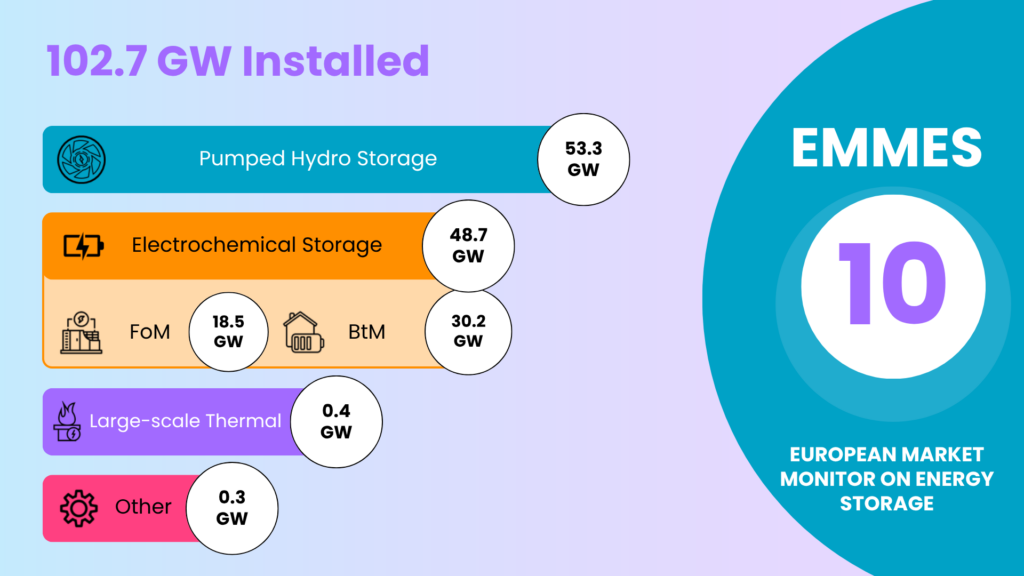
In 2025, Europe surpassed 100 GW of installed storage capacity for the first time, and by Q2 2026 storage overtook nuclear as a source of installed power capacity. With electrochemical storage forecast to grow by a further 153 GW by 2030, energy storage is becoming a core pillar of Europe's future electricity system.