Let’s start with the bad news: the transport sector is the only European sector in which greenhouse gas emissions have risen since 1990. Now, the good news: it is possible to reduce these emissions.
03.06.2020 / News
Storage Stories: EASE First External Newsletter is Now Online
We are proud to announce that the first EASE external newsletter was just sent to over 3.000 contacts.
"Storage Stories" is an overview of selected energy storage hot topics, sent directly to your mailbox three times per year.
Clean energy technologies are developing at an incredible pace, and energy storage is no exception. Staying up to date with the latest policy and technical developments can be challenging. This is why we decided to create this external newsletter.
Let’s start with the bad news: the transport sector is the only European sector in which greenhouse gas emissions have risen since 1990. Now, the good news: it is possible to reduce these emissions.
Energy Storage Europe welcomes the European Commission's growing focus on cybersecurity in the energy sector and supports the direction of travel across the Cyber Resilience Act (CRA), the Network Code on Cybersecurity, and the proposed Cybersecurity Act (CSA) 2.0. Yet raises concerns that require targeted corrections to ensure these frameworks deliver on their security objectives without inadvertently slowing battery storage deployment.
Energy Storage Europe replies to the European Commission’s public consultation on the Methodology for the Calculation of the recycled content of industrial and EV batteries. Under the Batteries Regulation, several categories of batteries, including industrial batteries, will have to contain a certain percentage of recycled metals to be allowed to be placed on the EU market.
Energy Storage Europe welcomes the proposed revision of the Network Code for generators and the explicit integration of storage, including grid-forming capabilities. Further clarity is needed on requirements for bidirectional storage and the treatment of existing projects.
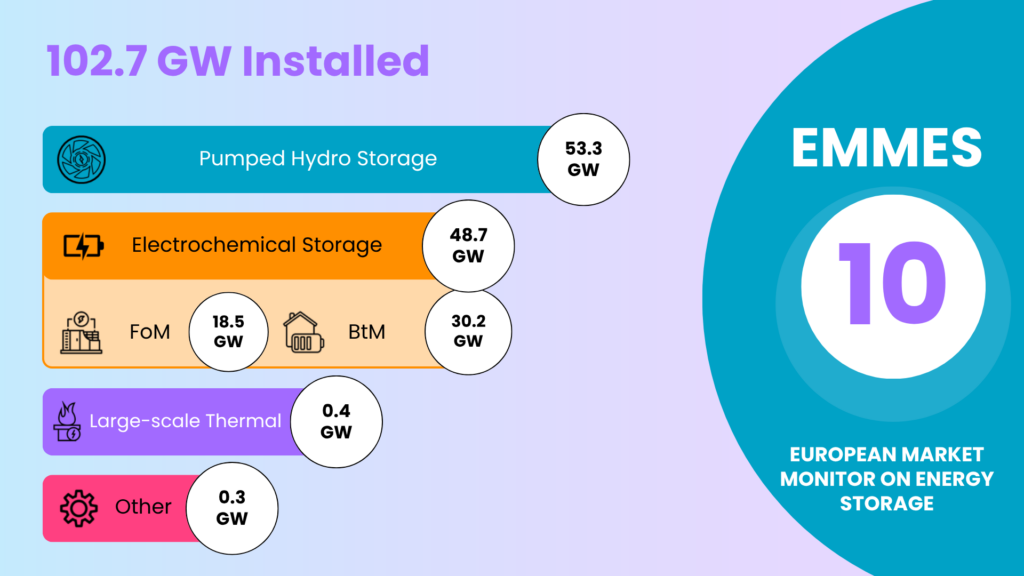
In 2025, Europe surpassed 100 GW of installed storage capacity for the first time, and by Q2 2026 storage overtook nuclear as a source of installed power capacity. With electrochemical storage forecast to grow by a further 153 GW by 2030, energy storage is becoming a core pillar of Europe's future electricity system.