Energy Storage Europe Association responds to the European Commission’s Public Consultations on the Electrification Action Plan and the Heating and Cooling Strategy, highlighting the need for stronger recognition of storage as a central enabler of electrification and heating decarbonisation. This requires clearer policies to integrate storage into planning and investment pathways, along with measures to remove persistent barriers such as high upfront costs, slow permitting, unfavourable taxation, and weak market signals. Storage should be treated as a default element of a cost-effective, system-friendly transition and reflected accordingly in planning frameworks, financing tools, and flexibility market design.
December 2025 / Policy Papers
Position Paper on Improving Permitting Procedures
The European Union faces growing permitting bottlenecks that threaten its ability to deploy the energy storage capacity needed for a secure, flexible, and decarbonised electricity system. Across Member States, storage projects continue to encounter complex, fragmented, and slow permitting procedures—often lasting several years—despite their critical role in integrating renewable energy and reducing congestion. These delays risk undermining Europe’s 2030 climate targets and slowing industrial decarbonisation.
In response, the Energy Storage Europe Association has published its Position Paper on Improving Permitting Procedures, highlighting the urgent need to streamline, harmonise, and modernise permitting frameworks for energy storage across the EU.
The paper calls for a permitting system that is transparent, technology-neutral, and capacity-enabling, including:
Binding time limits for permitting
Introducing clear, maximum deadlines—12 months in acceleration areas and 24 months elsewhere—to provide certainty for investors and accelerate deployment.
Equal treatment of all storage technologies
Ensuring that long-duration, thermal, and other storage solutions are not disadvantaged compared to batteries, unless justified by proportionate environmental or safety criteria.
Stronger institutional capacity
Equipping national, regional, and local authorities with the technical expertise needed to assess storage projects efficiently, including fire safety, land-use considerations, and technology-specific risks.
Clarifying that full Environmental Impact Assessments should apply only when significant environmental risks exist, avoiding unnecessary delays and excessive burdens for low-impact storage installations.
Digitalisation and transparency
Developing an EU-wide permitting platform, improving data sharing, introducing monitoring of permitting durations, and enabling more consistent cross-border coordination.
Europe needs a fast, fair, and future-proof permitting framework to unlock the estimated 200 GW of energy storage required by 2030. Streamlined permitting is essential not only for renewable integration, but also for energy security, grid resilience, and the competitiveness of European industry.
Energy Storage Europe Association responds to the European Commission’s Public Consultations on the Electrification Action Plan and the Heating and Cooling Strategy, highlighting the need for stronger recognition of storage as a central enabler of electrification and heating decarbonisation. This requires clearer policies to integrate storage into planning and investment pathways, along with measures to remove persistent barriers such as high upfront costs, slow permitting, unfavourable taxation, and weak market signals. Storage should be treated as a default element of a cost-effective, system-friendly transition and reflected accordingly in planning frameworks, financing tools, and flexibility market design.
Not a member yet ?
Explore the benefits of joining Energy Storage Europe
Energy Storage Europe welcomes the European Commission's growing focus on cybersecurity in the energy sector and supports the direction of travel across the Cyber Resilience Act (CRA), the Network Code on Cybersecurity, and the proposed Cybersecurity Act (CSA) 2.0. Yet raises concerns that require targeted corrections to ensure these frameworks deliver on their security objectives without inadvertently slowing battery storage deployment.
Energy Storage Europe replies to the European Commission’s public consultation on the Methodology for the Calculation of the recycled content of industrial and EV batteries. Under the Batteries Regulation, several categories of batteries, including industrial batteries, will have to contain a certain percentage of recycled metals to be allowed to be placed on the EU market.
Energy Storage Europe welcomes the proposed revision of the Network Code for generators and the explicit integration of storage, including grid-forming capabilities. Further clarity is needed on requirements for bidirectional storage and the treatment of existing projects.
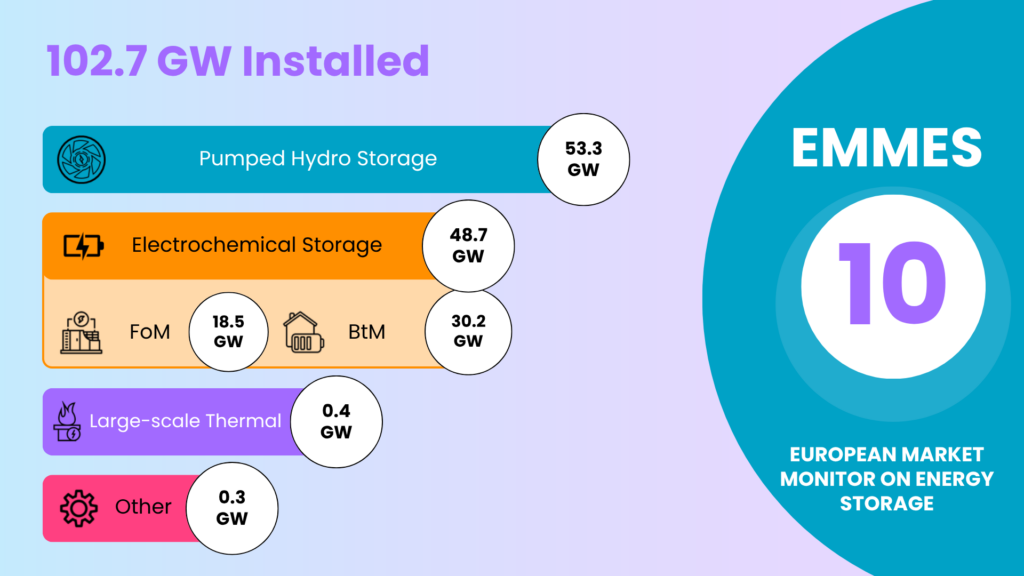
In 2025, Europe surpassed 100 GW of installed storage capacity for the first time, and by Q2 2026 storage overtook nuclear as a source of installed power capacity. With electrochemical storage forecast to grow by a further 153 GW by 2030, energy storage is becoming a core pillar of Europe's future electricity system.