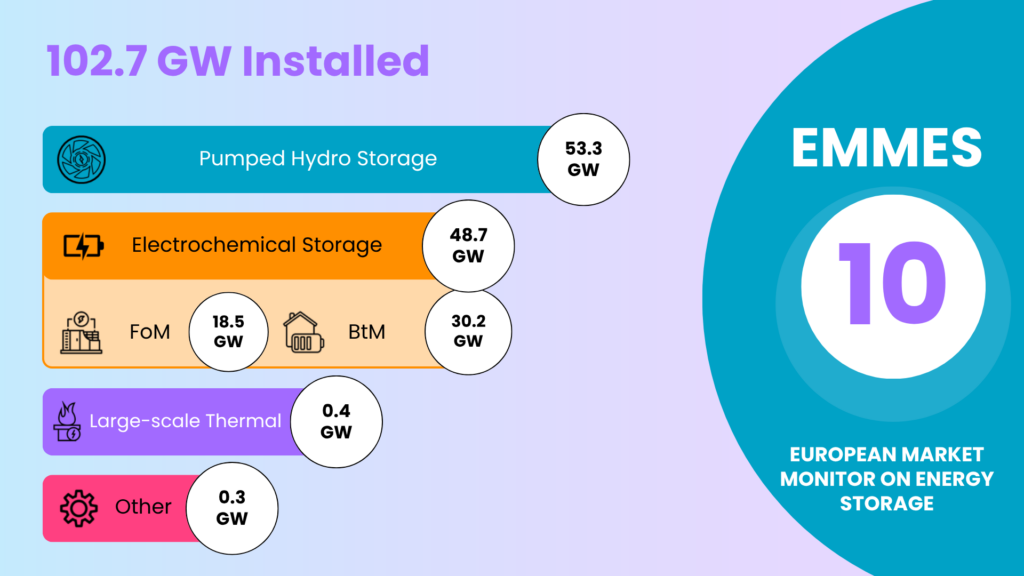
The 9.5 edition of the European Market Monitor on Energy Storage (EMMES) by the Energy Storage Europe Association and LCP Delta, is now available. The EU, UK, Norway, and Switzerland together are expected to reach 100 GW of installed energy storage in November 2025. This milestone represents enough capacity to meet the peak electricity demand of Germany and the Netherlands. With storage capacity forecast to grow by a further 115% by 2030, this will play a crucial role in Europe’s energy transition, creating more space for renewables on the grid.
December 2025 / Consultations & Advocacy
Electrification Action Plan and the Heating and Cooling Strategy
Energy Storage Europe Association replies to the European Commission’s Public Consultations on the Electrification Action Plan and the Heating and Cooling Strategy, and their objective to support both the electrification of transport, industry, and buildings and the definition of a common European strategy for heating and cooling systems.
By identifying key barriers and priority policy actions, the Electrification Action Plan and the Heating and Cooling Strategy aim to accelerate cost-effective and system-friendly electrification and decarbonisation of heating network systems across the EU, both supported by continuous investments in clean energy and flexibility. As Europe transitions toward an increasingly electrified and decarbonised energy system, the role of energy storage solutions must be central in system planning.
High upfront investment costs, unfavourable electricity taxation compared to fossil fuels, lengthy permitting and grid connection procedures, and limited access to grid capacity continue to hinder the deployment of storage solutions both for the electrification of EU industry and the decarbonisation of heating systems. Double taxation, insufficient remuneration for flexibility services, and tariff structures that do not reward system-supportive behaviour further weaken the business cases for the deployment of storage solutions. These shortcomings pose challenges not only for power system flexibility but also for the electrification of buildings and industry networks, where storage — including thermal energy storage — can provide cost-effective, reliable heat.
Energy Storage Systems (ESS) are versatile assets capable of delivering a wide range of services essential for an electrified energy system. Beyond demand shifting and renewable integration, ESS technologies can deliver short-, medium-, and long-duration energy, alleviate grid congestion, and support system adequacy. Despite these capabilities, storage solutions remain undervalued in current planning processes, market frameworks, and infrastructure investment strategies.
To close these gaps, Energy Storage Europe Association calls for clearer policy guidance and stronger implementation of existing regulatory provisions supporting electrification and flexibility, by removing the above-mentioned barriers. Moreover, public financing tools should support private investment, while ensuring a fair remuneration for flexibility services and arbitrage will be critical to unlock value stacking for storage assets and to ensure that storage is considered as a de-fault resource for the electrification of EU industry and the decarbonisation of heating and cooling systems.
The 9.5 edition of the European Market Monitor on Energy Storage (EMMES) by the Energy Storage Europe Association and LCP Delta, is now available. The EU, UK, Norway, and Switzerland together are expected to reach 100 GW of installed energy storage in November 2025. This milestone represents enough capacity to meet the peak electricity demand of Germany and the Netherlands. With storage capacity forecast to grow by a further 115% by 2030, this will play a crucial role in Europe’s energy transition, creating more space for renewables on the grid.
Not a member yet ?
Explore the benefits of joining Energy Storage Europe
Energy Storage Europe replies to the European Commission’s public consultation on the Methodology for the Calculation of the recycled content of industrial and EV batteries. Under the Batteries Regulation, several categories of batteries, including industrial batteries, will have to contain a certain percentage of recycled metals to be allowed to be placed on the EU market.
Energy Storage Europe welcomes the proposed revision of the Network Code for generators and the explicit integration of storage, including grid-forming capabilities. Further clarity is needed on requirements for bidirectional storage and the treatment of existing projects.
In 2025, Europe surpassed 100 GW of installed storage capacity for the first time, and by Q2 2026 storage overtook nuclear as a source of installed power capacity. With electrochemical storage forecast to grow by a further 153 GW by 2030, energy storage is becoming a core pillar of Europe's future electricity system.
In 2025, Europe surpassed 100 GW of installed storage capacity for the first time, and by Q2 2026 storage overtook nuclear as a source of installed power capacity. With electrochemical storage forecast to grow by a further 153 GW by 2030, energy storage is becoming a core pillar of Europe's future electricity system.