EASE is launching its members-only webinar series to help you navigate the complex world of EU funding!
Over the course of five webinars, the EASE Secretariat, in collaboration with CLERENS, will present the different EU funding programmes with a focus on opportunities for the energy storage sector.
10.05.2021 / News
Increase System Efficiency Through Demand-Side Flexibility of End-Users
EASE, together with 16 European business organisations supporting the cost-effective decarbonisation of Europe’s energy system, have come together to encourage the European Commission to put forward an ambitious ‘Fit for 55’ Package that fosters system efficiency through the empowerment and active participation of all European energy end-users, to unleash their demand-side flexibility from demand response, distributed energy storage, renewable and efficient generation.
Demand-side flexibility is the bridging solution supporting greater electrification and smart sector integration, it helps stabilise an increasingly variable power system and contributes to reaching climate neutrality cost-effectively.
Demand-side flexibility from all end-use sectors is a reliable, accessible and competitive resource to meet the new requirements of the decarbonisation challenge. Making these benefits a reality requires the activation of all end-use sectors through the development of an economically attractive business model.
The 16 European business organisations ask the Commission to:
Give the deserved political relevance and visibility to demand-side flexibility, both at European and national level, notably by setting clear milestones for its activation to reduce peak demand.
Ensure that a comprehensive assessment of the demand-side flexibility potential of all end-use sectors – buildings, industries and transport – is carried out at Member State level and national plans are developed to activate it in order to ensure system adequacy and support a cost-effective decarbonisation. Such assessment should be reported in future updates of the National Energy and Climate Plans.
Evolve from a static to a dynamic approach to energy efficiency to help the cost-effective uptake of variable renewable energy. A modern understanding of energy efficiency should incorporate flexible, time-dependent, dynamic and data-driven consumption and self-generation patterns. This does imply that savings obtained during peak-demand and savings from avoided CO2 emissions would be valorised, recognising their contribution to system efficiency.
Ensure all end-use sectors have the right to interact with the power system, including through local peer-to-peer trading, and are fairly rewarded to contribute to increase system efficiency by flexibly adapting their energy consumption, storage operation as well as on-site renewable and efficient generation. In this light, smart charging for electric vehicles and building renovations aiming to activate and smarten buildings should be promoted in the forthcoming revisions of the Alternative Fuels Infrastructure and Energy Performance of Buildings Directives.
Guide Member States and regulated entities to valorise demand-side flexibility and prioritise non-wires alternatives in their electricity networks development plans, when more cost-effective. This would require developing smart grids, and the establishment of harmonised “smart grids indicators” by National Regulatory Agencies would be beneficial.
EASE is launching its members-only webinar series to help you navigate the complex world of EU funding!
Over the course of five webinars, the EASE Secretariat, in collaboration with CLERENS, will present the different EU funding programmes with a focus on opportunities for the energy storage sector.
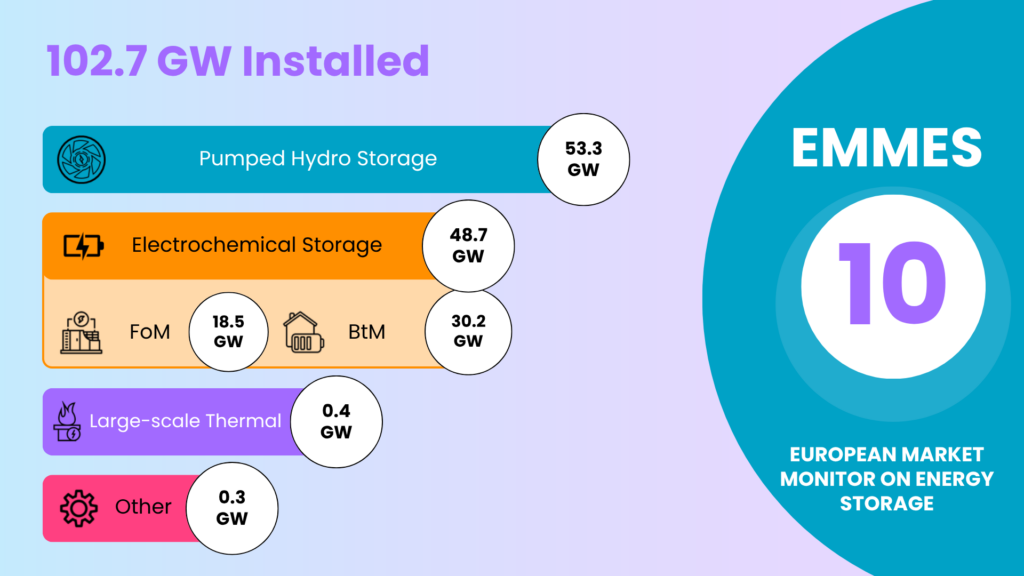
In 2025, Europe surpassed 100 GW of installed storage capacity for the first time, and by Q2 2026 storage overtook nuclear as a source of installed power capacity. With electrochemical storage forecast to grow by a further 153 GW by 2030, energy storage is becoming a core pillar of Europe's future electricity system.
In 2025, Europe surpassed 100 GW of installed storage capacity for the first time, and by Q2 2026 storage overtook nuclear as a source of installed power capacity. With electrochemical storage forecast to grow by a further 153 GW by 2030, energy storage is becoming a core pillar of Europe's future electricity system.
Thermal Energy Storage can help European industry decarbonise, reduce costs, and access new revenue streams. Yet significant regulatory, economic, and financial barriers continue to limit its deployment.
Energy Storage Europe welcomes the proposal for an Industrial Accelerator Act (IAA) and supports its overall objective of strengthening industrial capacity, accelerating decarbonisation, and creating stronger lead markets for strategic clean technologies in the European Union.