EASE has prepared a short summary on one of the following energy storage application groups - Services to Support Distribution Infrastructure.
November 2021 / Reports and Studies
Services to Support Transmission Infrastructure
The Task Force on Segmentation of Applications has developed the Services to Support Transmission Infrastructure Report, among other application descriptions. This work builds on the Summary of Energy Storage Applications published in June 2020.
This overview provides a summary of different energy storage applications, focused mainly on the electricity system. Transmission infrastructure services could be provided by energy storage could as an alternative or complement to traditional transmission infrastructure assets.
Services to Support Transmission Infrastructure are composed of three key systems:
Transmission Investment Deferral: deferring transmission infrastructure upgrades and solving transmission congestion issues by installing energy storage systems instead of new lines.
Angular stability: use of energy storage to charge and discharge high levels of energy in short periods when an accident occurs, overall improving angular stability of the system.
Transmission Support: use of energy storage to improve the performance of the transmission system by compensating for electrical anomalies and disturbances such as voltage sag, unstable voltage, and subsynchronous resonance.
Energy Storage Europe replies to the European Commission’s public consultation on the Methodology for the Calculation of the recycled content of industrial and EV batteries. Under the Batteries Regulation, several categories of batteries, including industrial batteries, will have to contain a certain percentage of recycled metals to be allowed to be placed on the EU market.
Energy Storage Europe welcomes the proposed revision of the Network Code for generators and the explicit integration of storage, including grid-forming capabilities. Further clarity is needed on requirements for bidirectional storage and the treatment of existing projects.
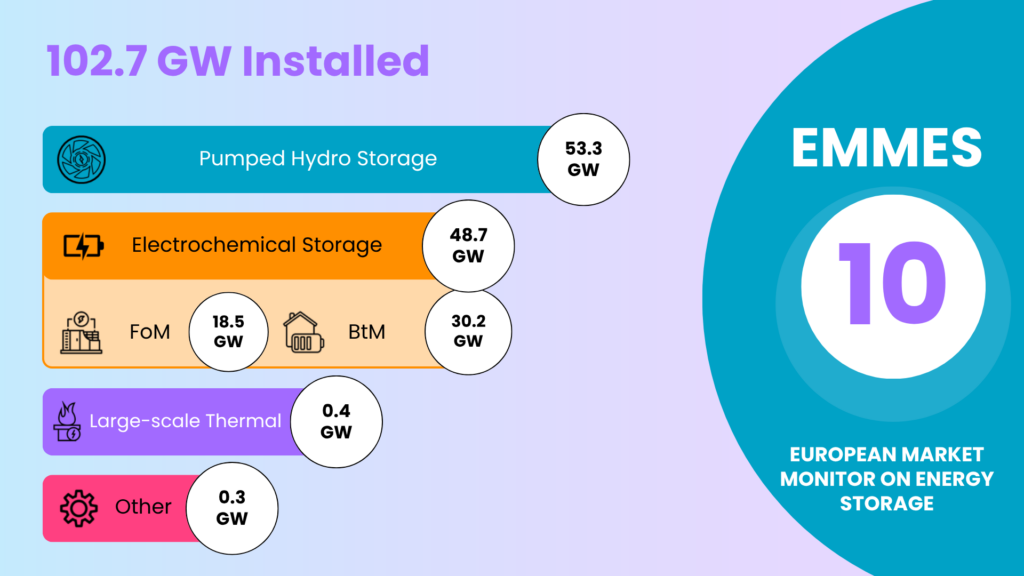
In 2025, Europe surpassed 100 GW of installed storage capacity for the first time, and by Q2 2026 storage overtook nuclear as a source of installed power capacity. With electrochemical storage forecast to grow by a further 153 GW by 2030, energy storage is becoming a core pillar of Europe's future electricity system.
In 2025, Europe surpassed 100 GW of installed storage capacity for the first time, and by Q2 2026 storage overtook nuclear as a source of installed power capacity. With electrochemical storage forecast to grow by a further 153 GW by 2030, energy storage is becoming a core pillar of Europe's future electricity system.