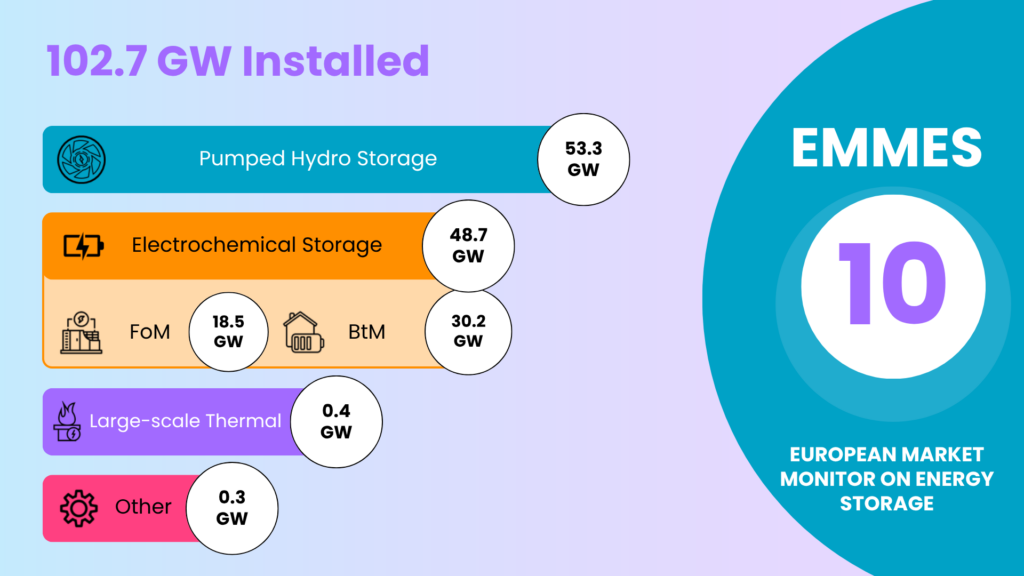
EASE and LCP-Delta are pleased to announce the publication of the seventh edition of the European Market Monitor on Energy Storage (EMMES). The Market Monitor is based on the most extensive database of European energy storage projects. The database of over 2,600 projects includes detailed data on current installations by customer segment (residential, C&I and front-of-meter) across 24 European countries, future projects and forecasts to 2030.
May 2023 / Policy Papers
The Electricity Market Design Revision Proposal
The Russian invasion of Ukraine has emphasised that relying on fossil fuels imports for the European Union’s energy system can have dramatic consequences on energy security and the economy at large. More than ever, energy independence, security of supply, sector integration, and decarbonisation are guiding policymakers’ actions.
Although decarbonising the energy sector is crucial, most system flexibility is currently provided by fossil gas: this has led to an insecure energy system and forced the European Union to depend on energy imports. The resulting price spikes and gas shortages have prompted quick action by European Union policymakers.
On March 14, 2023, the European Commission released a proposed reform of the Electricity Market Design, which, while somewhat limited in scope, has the potential to significantly impact the energy storage sector. The Energy Storage Europe Association (previously EASE) strongly supports this proposed revision, as it strikes a good balance between public involvement and market-based mechanisms and aims to maintain the current framework focused on day-ahead and intraday markets while introducing some changes. However, policymakers require guidance to make the most of this opportunity to change the electricity market framework.
To achieve the 2030 and 2050 climate and energy targets, the regulatory environment must be adjusted to ensure long-term investment signals and adequate deployment of flexibility and energy shifting capacity.
The Energy Storage Europe Association outlines below its key position on how to enhance the proposal and make non-fossil flexibility a central component of the new decarbonised energy system.
EASE and LCP-Delta are pleased to announce the publication of the seventh edition of the European Market Monitor on Energy Storage (EMMES). The Market Monitor is based on the most extensive database of European energy storage projects. The database of over 2,600 projects includes detailed data on current installations by customer segment (residential, C&I and front-of-meter) across 24 European countries, future projects and forecasts to 2030.
Not a member yet ?
Explore the benefits of joining Energy Storage Europe
Energy Storage Europe welcomes the European Commission's growing focus on cybersecurity in the energy sector and supports the direction of travel across the Cyber Resilience Act (CRA), the Network Code on Cybersecurity, and the proposed Cybersecurity Act (CSA) 2.0. Yet raises concerns that require targeted corrections to ensure these frameworks deliver on their security objectives without inadvertently slowing battery storage deployment.
Energy Storage Europe replies to the European Commission’s public consultation on the Methodology for the Calculation of the recycled content of industrial and EV batteries. Under the Batteries Regulation, several categories of batteries, including industrial batteries, will have to contain a certain percentage of recycled metals to be allowed to be placed on the EU market.
Energy Storage Europe welcomes the proposed revision of the Network Code for generators and the explicit integration of storage, including grid-forming capabilities. Further clarity is needed on requirements for bidirectional storage and the treatment of existing projects.
In 2025, Europe surpassed 100 GW of installed storage capacity for the first time, and by Q2 2026 storage overtook nuclear as a source of installed power capacity. With electrochemical storage forecast to grow by a further 153 GW by 2030, energy storage is becoming a core pillar of Europe's future electricity system.