Through StoRIES Transnational Access (TNA) calls, researchers can have free access to 64 world-class Research Infrastructures, addressing all five technology areas from electrochemical energy storage over to chemical, thermal, mechanical up to superconducting magnetic energy storage. The second call for accessing the research infrastructures is now open.
20.01.2023 / News
InterSTORE Project is Officially Launched
The EU-funded project InterSTORE officially started on 1 January 2023. InterSTORE stands for Interoperable open-source tools to enable hybridisation, utilisation, and monetisation of storage flexibility. This is a HORIZON Innovation Action, funded by the European Union with the total grant amount of nearly 3.5 mil €.
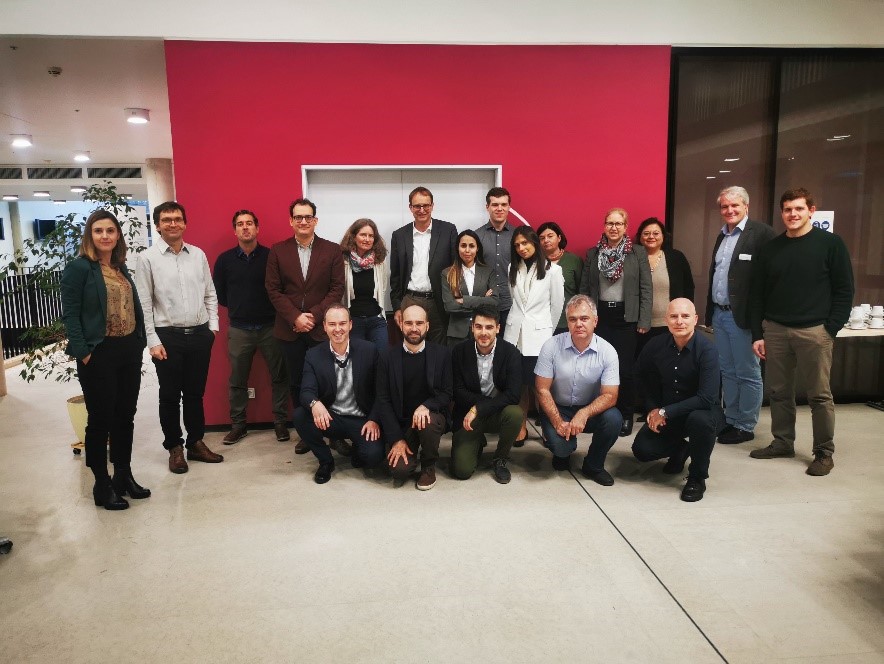
Project consortium gathered in Aachen, Germany, for a kick-off meeting that was followed by the visit to the Julich Energy Campus Living Lab. The meeting announced the beginning of a productive cooperation that is about to deliver innovative solutions in energy storage within the 3-year long project. The consortium has 12 diverse partners, coming from Belgium, Germany, Austria, Italy, Slovenia, Spain, and Portugal.
Today, storage is one of the most critical assets for modern energy systems. At the same time storage is a very diverse universe of solutions and technologies with very different characteristics. InterSTORE plans to address this complexity by developing an innovative middleware that, while virtualizing the storage technology, will simplify its use from the point of view of integration platform thanks to a technology agnostic approach.
The middleware solution will be integrated both in open source and commercial platforms that will be incorporated in 4 large real-life demos to enhance the successfully flexibility platforms and check the user acceptance and economic value of the new solution.
InterSTORE has also a strong focus towards impact. First of all, the solution will become part of already running commercial platforms making sure that a real adoption will be deployed beyond project end. The consortium will make sure the software maintenance will continue after the end of the project with the support of Linux Foundation Energy and that the work done will be considered by on-going standardization activities.
Through StoRIES Transnational Access (TNA) calls, researchers can have free access to 64 world-class Research Infrastructures, addressing all five technology areas from electrochemical energy storage over to chemical, thermal, mechanical up to superconducting magnetic energy storage. The second call for accessing the research infrastructures is now open.
Energy Storage Europe's position paper, "Ensuring System Stability in Europe: The Role of Energy Storage in Providing Inertia", focuses on how the EU can implement a cost-effective and technologically neutral approach to procuring inertia. It also outlines how such an approach can be firmly embedded within a harmonised European methodology for assessing and monitoring inertia needs across synchronous areas.
This position paper, prepared by the Energy Storage Europe Association, assesses the system value of long-duration energy storage, identifies barriers to deployment, and proposes recommendations to better align European energy, industrial, and financing frameworks with the long-term flexibility needs of a fully decarbonised power system.
In this position paper, the Energy Storage Europe Association calls for a shift from today’s “first-come, first-served” queue system to a more efficient, strategic, and transparent framework that recognises the unique value of energy storage for reducing congestion, enhancing flexibility, and making better use of existing grid infrastructure.
Energy Storage Europe Association has published its Position Paper on Improving Permitting Procedures, highlighting the urgent need to streamline, harmonise, and modernise permitting frameworks for energy storage across the EU. Europe needs a fast, fair, and future-proof permitting framework to unlock the estimated 200 GW of energy storage required by 2030.