EASE has prepared an overview of the upcoming and existing key policy and actions of Spain, the Netherlands and Germany to support the uptake of hydrogen and Power-to-Gas solutions.
March 2021 / Market Analyses
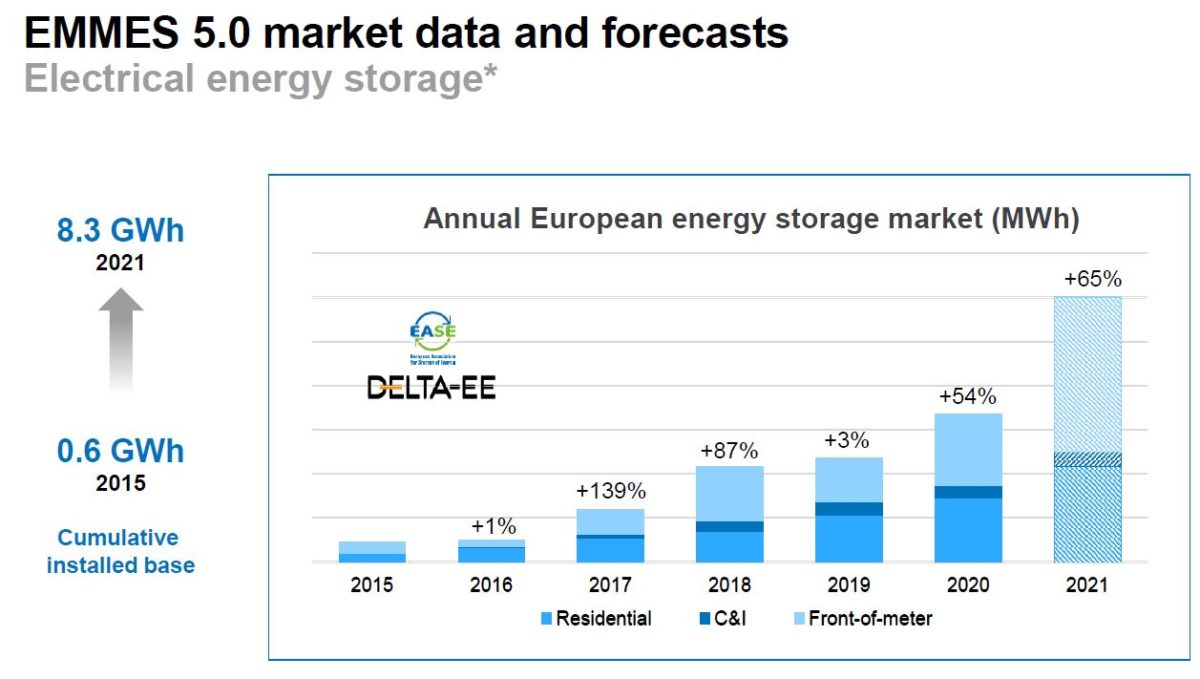
EMMES 5.0 - March 2021
EASE and Delta-ee are pleased to announce the publication of the fifth edition of the European Market Monitor on Energy Storage (EMMES).
The report reveals the effects of the pandemic on the energy storage market, with lockdown affecting commercial and industrial, and behind-the-meter segments, while front-of-meter projects proved more resilient. Looking ahead, 2021 looks particularly strong for the sector with new ancillary services opening across Europe and national targets further supporting regional projects.
EMMES 5.0 shows that:
The European annual energy storage market grew to 1.7 GWh in 2020, with a cumulative installed base of 5.4 GWh across all segments.
The total annual energy storage market in Europe is expected to reach 3,000 MWh in 2021, almost double the annual storage deployments seen in 2020.
EASE has prepared an overview of the upcoming and existing key policy and actions of Spain, the Netherlands and Germany to support the uptake of hydrogen and Power-to-Gas solutions.
Energy Storage Europe replies to the European Commission’s public consultation on the Battery Booster Facility. On 16 December 2025, the European Commission announced a Battery Booster Strategy, within the Automotive Action Plan. The Strategy includes a Facility of EUR 1.5 billion in the form of loans for projects in the production of battery cells in Europe.
Energy Storage Europe's position paper, "Ensuring System Stability in Europe: The Role of Energy Storage in Providing Inertia", focuses on how the EU can implement a cost-effective and technologically neutral approach to procuring inertia. It also outlines how such an approach can be firmly embedded within a harmonised European methodology for assessing and monitoring inertia needs across synchronous areas.
This position paper, prepared by the Energy Storage Europe Association, assesses the system value of long-duration energy storage, identifies barriers to deployment, and proposes recommendations to better align European energy, industrial, and financing frameworks with the long-term flexibility needs of a fully decarbonised power system.
In this position paper, the Energy Storage Europe Association calls for a shift from today’s “first-come, first-served” queue system to a more efficient, strategic, and transparent framework that recognises the unique value of energy storage for reducing congestion, enhancing flexibility, and making better use of existing grid infrastructure.