On May 2015, the TVAC Working Group 1 prepared a document on Storage Efficiency Calculation Methods.
March 2016 / Campaigns
EASE Annual Student Award
EASE launched in 2016 the EASE Annual Student Award, a competition aimed at recognising outstanding graduate student research in the field of energy storage.
EASE is dedicated to promoting young talents in the field and support students who are keen to contribute to the development and research of energy storage.
The competition is open to all students currently enrolled or that have completed an MSc or PhD programme at an accredited EU university. The thesis which is the basis for the application must focus on an energy storage-related topic.
The selection of the winning student will be performed by the EASE Secretariat and a selected committee of EASE members. The selection procedure is based on the abstracts provided by students in the application form. Students will be judged on the quality of the responses, the research design, and on the relevance of the research topic to the energy storage industry.
The winning student is invited to participate and presents their research during the annual Energy Storage Global Conference organised by EASE. This is a valuable opportunity to network with industry leaders in the energy storage sector and to learn more about energy storage technologies, business cases, and policy developments.
Energy Storage Europe welcomes the European Commission's growing focus on cybersecurity in the energy sector and supports the direction of travel across the Cyber Resilience Act (CRA), the Network Code on Cybersecurity, and the proposed Cybersecurity Act (CSA) 2.0. Yet raises concerns that require targeted corrections to ensure these frameworks deliver on their security objectives without inadvertently slowing battery storage deployment.
Energy Storage Europe replies to the European Commission’s public consultation on the Methodology for the Calculation of the recycled content of industrial and EV batteries. Under the Batteries Regulation, several categories of batteries, including industrial batteries, will have to contain a certain percentage of recycled metals to be allowed to be placed on the EU market.
Energy Storage Europe welcomes the proposed revision of the Network Code for generators and the explicit integration of storage, including grid-forming capabilities. Further clarity is needed on requirements for bidirectional storage and the treatment of existing projects.
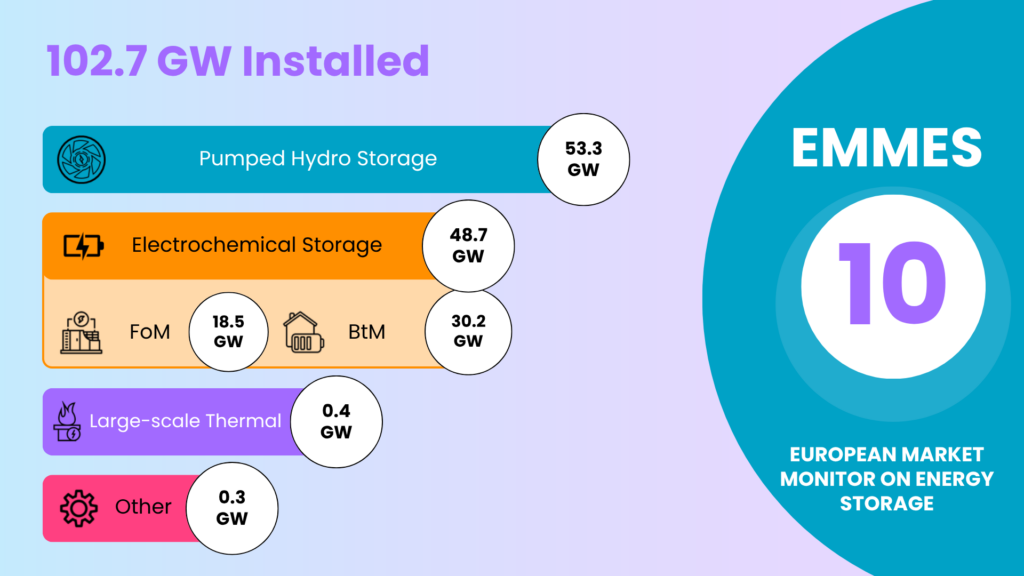
In 2025, Europe surpassed 100 GW of installed storage capacity for the first time, and by Q2 2026 storage overtook nuclear as a source of installed power capacity. With electrochemical storage forecast to grow by a further 153 GW by 2030, energy storage is becoming a core pillar of Europe's future electricity system.