Energy Storage Europe welcomes the European Commission's growing focus on cybersecurity in the energy sector and supports the direction of travel across the Cyber Resilience Act (CRA), the Network Code on Cybersecurity, and the proposed Cybersecurity Act (CSA) 2.0. Yet raises concerns that require targeted corrections to ensure these frameworks deliver on their security objectives without inadvertently slowing battery storage deployment.
Battery Energy Storage Systems (BESS) actively regulate the grid in real time. They are not inherently more vulnerable than other grid-connected technologies; but their combination of deep cyber-physical coupling, multi-vendor architectures, and third-party control dependencies creates a governance challenge where control-layer failures can escalate rapidly to grid-stability events. With BESS hitting 50 GW installed with 200 GW projected by 2030, cybersecurity risks are no longer isolated asset-level concerns.
The current EU framework does not yet provide a coherent approach to BESS cybersecurity risks. Important accountability gaps remain, particularly for legacy assets, outsourced operations, special purpose vehicle structures, and manufacturers without an EU legal entity. Divergent implementation of NIS2 and inconsistent connectivity requirements across Member States increase compliance costs, create unnecessary complexity, and slow project deployment. This is particularly burdensome for battery storage; a technology manufactured at scale through highly standardised global supply chains. As the supply chain framework under the Cybersecurity Act 2.0 continues to develop, the Industry calls for a clear, risk-based, and component-level approach to cybersecurity requirements, with proportionate obligations and realistic implementation timelines that support both resilience and investment.
Energy Storage Europe welcomes the European Commission's growing focus on cybersecurity in the energy sector and supports the direction of travel across the Cyber Resilience Act (CRA), the Network Code on Cybersecurity, and the proposed Cybersecurity Act (CSA) 2.0. Yet raises concerns that require targeted corrections to ensure these frameworks deliver on their security objectives without inadvertently slowing battery storage deployment.
Energy Storage Europe replies to the European Commission’s public consultation on the Methodology for the Calculation of the recycled content of industrial and EV batteries. Under the Batteries Regulation, several categories of batteries, including industrial batteries, will have to contain a certain percentage of recycled metals to be allowed to be placed on the EU market.
Energy Storage Europe welcomes the proposed revision of the Network Code for generators and the explicit integration of storage, including grid-forming capabilities. Further clarity is needed on requirements for bidirectional storage and the treatment of existing projects.
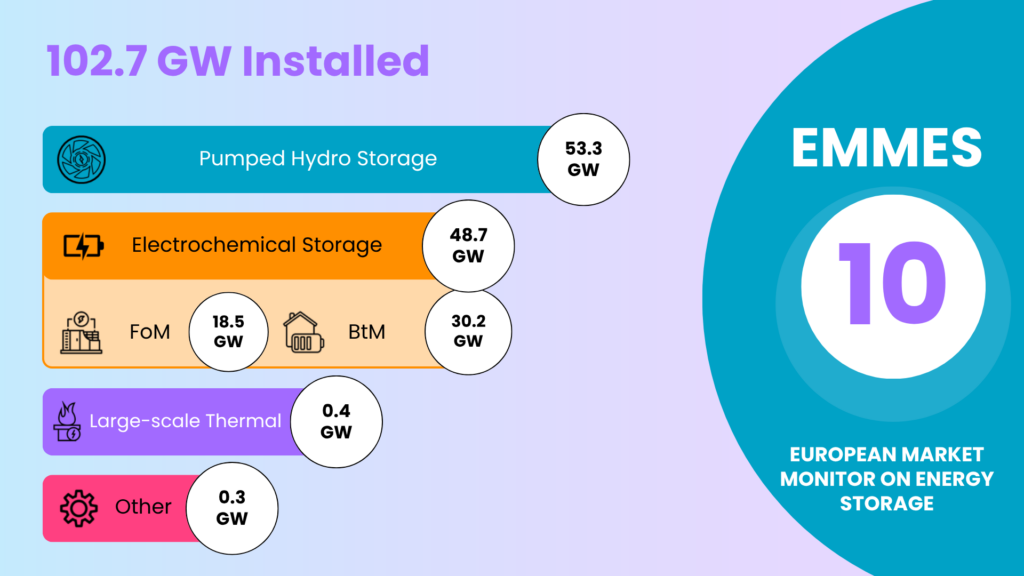
In 2025, Europe surpassed 100 GW of installed storage capacity for the first time, and by Q2 2026 storage overtook nuclear as a source of installed power capacity. With electrochemical storage forecast to grow by a further 153 GW by 2030, energy storage is becoming a core pillar of Europe's future electricity system.