EASE has organised the "Financing Clean Energy in the Context of EU Recovery" for the SMARTSPEND project on 30 September 2020.
22.10.2020 / News
A Mentorship Programme to Empower Women in the Energy Storage Sector
The European energy sector is innovative, forward-thinking, and committed to advancing the transition to a net-zero emissions energy system by mid-century. The industry is rightly recognised by EU policymakers as a priority for the “Next Generation EU” Recovery Plan given the potential for job growth and the vital importance of ensuring a green economic recovery.
But the energy sector, like other STEM fields (science, technology, engineering, and mathematics), is dogged by a persistent problem: it employs too few women, especially in leadership positions. Only 22% of the EU energy sector workforce is composed of women, according to a 2017 study by the European Institute for Gender Equality. The renewable energy sector performs slightly better: According to an IRENA survey carried out in 2018, the share of women in the global renewable energy workforce is 32%.
Although data are not available for the energy storage sector, anecdotal evidence confirms the gender inequality issues seen across the broader energy industry. This is a shame, because ensuring women’s participation in the workforce has many benefits. Not only does it expand the talent pool for companies, but increasing gender diversity in teams has been found to improve collaboration, bringing fresh perspectives and approaches. Also, higher shares of female leadership have been linked to better performance for organisations.
The 12-month programme is led by the Secretariat of the Energy Storage Partnership, hosted by ESMAP, and the Global Women’s Network for the Energy Transition (GWNET). It involves 25 women from 17 developing countries and centres on comprehensive knowledge-transfer through webinars, virtual networking, and peer-to-peer exchange. Each of the 25 mentees (selected from over 240 applicants) is paired with a mentor to share ideas, experiences, and advice to boost women’s chances of success in the storage sector.
EASE Policy Manager Brittney Elzarei was delighted to be chosen as a mentor for the programme. Having witnessed first-hand the lack of female participation in the EU energy sector, she was eager to get involved in a programme that seeks to encourage more women to become active in the energy storage industry.
Clearly, much more must be done to support women’s participation in the energy storage sector. But a dedicated mentorship programme, bringing together women from around the world, is a very good place for the energy storage sector to start.
EASE is committed to promoting diversity, gender equality, and inclusivity in energy storage. We are striving to involve and recognise more women in all of our association’s activities, to serve as speakers and moderators at EASE events, fill leadership roles within the association, and participate in Committees, Working Groups, and Task Forces.
Follow the activities of the Women in Energy Storage Mentoring Programme and consider applying as a mentor (or mentee) next year. Alternatively, seek out a mentee or mentor on your own.
If you are a female expert in energy storage or would like to recommend an expert for EASE to consider featuring in our events and activities, get in touch!
If you are an EASE member, consider how you can involve more women from your organisation in EASE activities, particularly in leadership roles (Presidency team, Executive Board, or leading a Working Group or Task Force).
Energy Storage Europe welcomes the European Commission's growing focus on cybersecurity in the energy sector and supports the direction of travel across the Cyber Resilience Act (CRA), the Network Code on Cybersecurity, and the proposed Cybersecurity Act (CSA) 2.0. Yet raises concerns that require targeted corrections to ensure these frameworks deliver on their security objectives without inadvertently slowing battery storage deployment.
Energy Storage Europe replies to the European Commission’s public consultation on the Methodology for the Calculation of the recycled content of industrial and EV batteries. Under the Batteries Regulation, several categories of batteries, including industrial batteries, will have to contain a certain percentage of recycled metals to be allowed to be placed on the EU market.
Energy Storage Europe welcomes the proposed revision of the Network Code for generators and the explicit integration of storage, including grid-forming capabilities. Further clarity is needed on requirements for bidirectional storage and the treatment of existing projects.
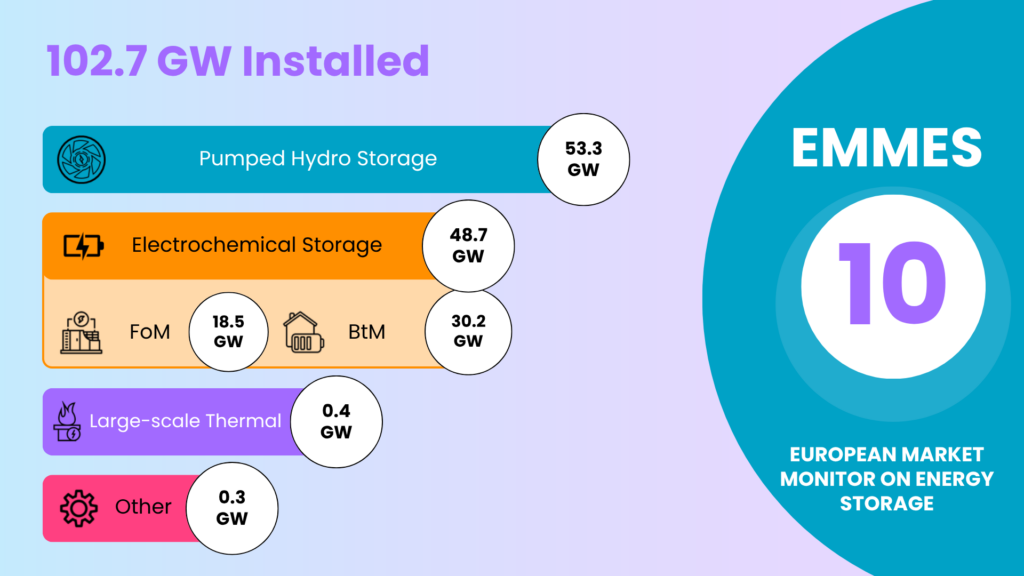
In 2025, Europe surpassed 100 GW of installed storage capacity for the first time, and by Q2 2026 storage overtook nuclear as a source of installed power capacity. With electrochemical storage forecast to grow by a further 153 GW by 2030, energy storage is becoming a core pillar of Europe's future electricity system.