EASE welcomes EU policymakers’ efforts to revise the Renewable Energy Directive II (RED II) as part of the ‘Fit for 55’ package, expected July 2021. Accelerating the deployment of renewable energy sources (RES) is essential to achieve the EU’s ambitious goals of a 55% GHG emissions reduction by 2030 and carbon neutrality by 2050.
August 2021 / Policy Papers - Responses to Public Consultations
Energy Storage Technologies are Essential to Decarbonisation: Revision of the Climate, Energy and Environmental Aid Guidelines
EASE welcomes the revision of the Climate, Energy and Environmental Aid Guidelines (CEEAG) to align the State aid framework with the EU’s ambitious decarbonisation targets and the European Green Deal. With the revision of the EEAG, the EU seeks to address the challenge of ensuring a clear framework that supports decarbonisation in a cost-effective manner while maintaining competition and fair trade.
Overall, EASE supports the proposed enlargement of the scope of the guidelines to new areas (e.g. clean mobility, more forms of energy storage) and all technologies that can deliver the Green Deal, allowing higher aid amounts (up to 100% of the funding gap) as well as new aid instruments (e.g. Carbon Contracts for Difference).
EASE believes that appropriate levels of support through State aid should be allowed for energy storage technologies since their contribution to decarbonisation is already essential and will only become more so in the coming years. Providing valuable flexibility services at different grid locations and timescales, energy storage is essential to enabling the widespread deployment of renewable energy sources. Moreover, energy storage can play a vital role in supporting the transition of sectors that are particularly fossil fuels dependent or are hard to decarbonise. Grids are using more renewable energy to decarbonise and the effects of adding more intermittent renewable energy sources to those grids are creating characteristics which will require significant redress to stabilise and encourage further renewable energy penetration. These elements can be addressed by the introduction of energy storage technologies, and as a result energy storage support through State aid should have adequate safeguards against market distortions.
The importance of energy storage for the energy transition should be clearly reflected in the CEEAG. To see all EASE proposals for the revision, please look at the file below.
EASE welcomes EU policymakers’ efforts to revise the Renewable Energy Directive II (RED II) as part of the ‘Fit for 55’ package, expected July 2021. Accelerating the deployment of renewable energy sources (RES) is essential to achieve the EU’s ambitious goals of a 55% GHG emissions reduction by 2030 and carbon neutrality by 2050.
Not a member yet ?
Explore the benefits of joining Energy Storage Europe
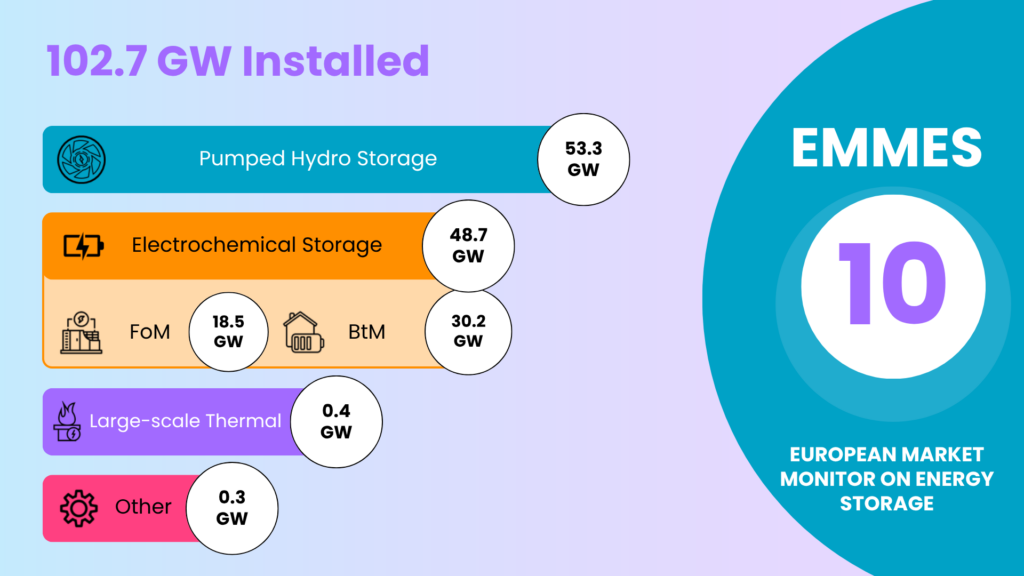
In 2025, Europe surpassed 100 GW of installed storage capacity for the first time, and by Q2 2026 storage overtook nuclear as a source of installed power capacity. With electrochemical storage forecast to grow by a further 153 GW by 2030, energy storage is becoming a core pillar of Europe's future electricity system.
In 2025, Europe surpassed 100 GW of installed storage capacity for the first time, and by Q2 2026 storage overtook nuclear as a source of installed power capacity. With electrochemical storage forecast to grow by a further 153 GW by 2030, energy storage is becoming a core pillar of Europe's future electricity system.
Thermal Energy Storage can help European industry decarbonise, reduce costs, and access new revenue streams. Yet significant regulatory, economic, and financial barriers continue to limit its deployment.
Energy Storage Europe welcomes the proposal for an Industrial Accelerator Act (IAA) and supports its overall objective of strengthening industrial capacity, accelerating decarbonisation, and creating stronger lead markets for strategic clean technologies in the European Union.