EASE has provided a response to ENTSO-E Public Consultation on the All Continental Europe TSO’s proposal to determine a minimum activation time period required for limited energy reservoirs to remain available during alert state in accordance with Article 156(11) of the SO GL. Although several flaws in the methodology have been detected, EASE has suggested reasessment of the methodology to enhance the proposal.
September 2021 / Policy Papers
Third Gas Package Revision: EASE Proposals for a Decarbonised Gas Market
The European Commission announced in its 2021 Working Programme that the Third Gas Package will be revised to regulate competitive decarbonised gas markets: EASE believes that energy storage solutions such as Hydrogen and Power-to-Gas will play a key role in the transition of the gas system, and sees the proposed revision as a great opportunity to enhance sector integration as well as the deployment of renewable carbon gases, as already stated in the Reply to the Public Consultation on the Hydrogen and Decarbonised Gas Market Package.
This document presents revision of the Third Gas Package in two sections. To read about the high level policy decisions needed to reshape the energy system, taking into account Power-to-Gas role, head to Chapter 1. To discover the specific regulatory changes necessary to improve the Power-to-Gas legislation at the EU level, head to Chapter 2.
The first part of the paper focuses on a few, key high-level messages that can help decision-makers design a new gas market that is inclusive of Hydrogen and Power-to-Gas storage solutions:
Develop an energy storage definition for the gas sector;
Develop technology neutral definitions for renewable and low-carbon gases;
Rely on a market-based approach for PtG;
Ensure that the new Package is in line with the EU Strategy on Energy System Integration;
Strengthen European R&D&I.
The second part of the paper collects specific suggestions which tackle different challenges for the Hydrogen and Decarbonised Gas Market Package:
Infrastructure planning;
Market regulation;
Guarantees of origin;
Consumers and communities;
Gas quality and blending;
Hydrogen trade and imports;
Security of supply.
The document is thoroughly analysed and the different proposals aim at supporting policymakers taking into account the storage industry’s take on the upcoming revision, making sure to untap the potential of energy storage technologies, especially Power-to-Gas, in decarbonising the gas sector.
EASE has provided a response to ENTSO-E Public Consultation on the All Continental Europe TSO’s proposal to determine a minimum activation time period required for limited energy reservoirs to remain available during alert state in accordance with Article 156(11) of the SO GL. Although several flaws in the methodology have been detected, EASE has suggested reasessment of the methodology to enhance the proposal.
Not a member yet ?
Explore the benefits of joining Energy Storage Europe
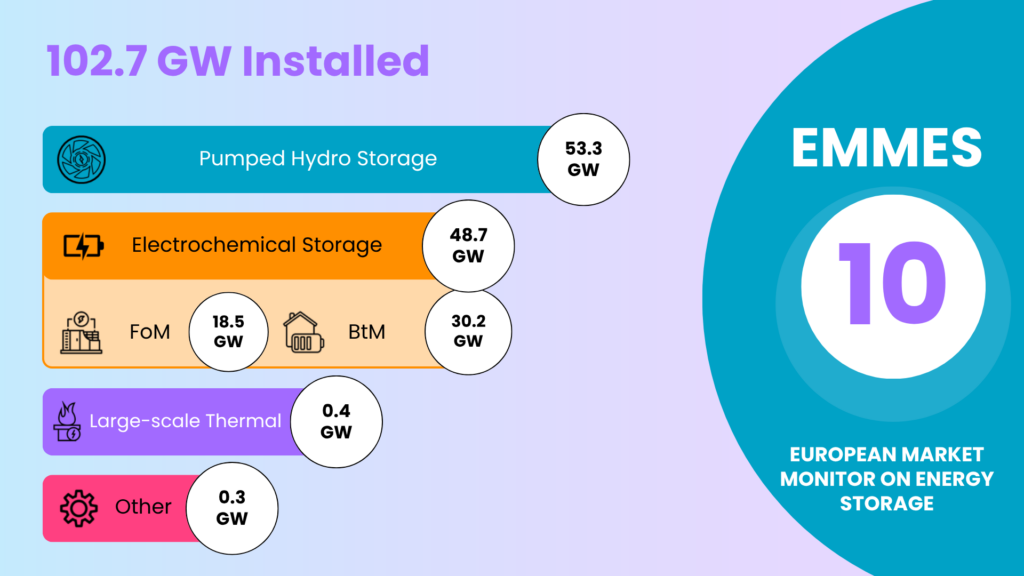
In 2025, Europe surpassed 100 GW of installed storage capacity for the first time, and by Q2 2026 storage overtook nuclear as a source of installed power capacity. With electrochemical storage forecast to grow by a further 153 GW by 2030, energy storage is becoming a core pillar of Europe's future electricity system.
In 2025, Europe surpassed 100 GW of installed storage capacity for the first time, and by Q2 2026 storage overtook nuclear as a source of installed power capacity. With electrochemical storage forecast to grow by a further 153 GW by 2030, energy storage is becoming a core pillar of Europe's future electricity system.
Thermal Energy Storage can help European industry decarbonise, reduce costs, and access new revenue streams. Yet significant regulatory, economic, and financial barriers continue to limit its deployment.
Energy Storage Europe welcomes the proposal for an Industrial Accelerator Act (IAA) and supports its overall objective of strengthening industrial capacity, accelerating decarbonisation, and creating stronger lead markets for strategic clean technologies in the European Union.