EASE welcomes the revision of the Climate, Energy and Environmental Aid Guidelines to align the State aid framework with the EU’s ambitious decarbonisation targets and the European Green Deal. With the revision of the EEAG, the EU seeks to address challenge of ensuring a clear framework that supports decarbonisation in a cost-effective manner while maintaining competition and fair trade.
September 2021 / Policy Papers
Reply to the Public Consultation on All Continental Europe TSOs Proposal
The European Union as a whole has agreed on ambitious goals to increase renewable energy in the energy system and become carbon neutral by 2050. Energy storage technologies can provide an important contribution to system security while enabling the transition to a decarbonised energy system. The fast-dynamic response of energy storage devices is expected to help cope with the system inertia decrease and the RES variability, thereby contributing to grid stability. However, energy storage can only provide such services if there are no undue barriers in the network code provisions and market entry and development is attractive for LER.
EASE supports setting Tmin for FCR providers with LER to 15 minutes, however, EASE notes that the methodology itself should be re-assessed before it is possible to carry out the CBA and based on that, to discuss the results.
To see EASE’s reply to the ENTSO-E stakeholder consultation, please look at the file below.
EASE welcomes the revision of the Climate, Energy and Environmental Aid Guidelines to align the State aid framework with the EU’s ambitious decarbonisation targets and the European Green Deal. With the revision of the EEAG, the EU seeks to address challenge of ensuring a clear framework that supports decarbonisation in a cost-effective manner while maintaining competition and fair trade.
Not a member yet ?
Explore the benefits of joining Energy Storage Europe
Energy Storage Europe welcomes the European Commission's growing focus on cybersecurity in the energy sector and supports the direction of travel across the Cyber Resilience Act (CRA), the Network Code on Cybersecurity, and the proposed Cybersecurity Act (CSA) 2.0. Yet raises concerns that require targeted corrections to ensure these frameworks deliver on their security objectives without inadvertently slowing battery storage deployment.
Energy Storage Europe replies to the European Commission’s public consultation on the Methodology for the Calculation of the recycled content of industrial and EV batteries. Under the Batteries Regulation, several categories of batteries, including industrial batteries, will have to contain a certain percentage of recycled metals to be allowed to be placed on the EU market.
Energy Storage Europe welcomes the proposed revision of the Network Code for generators and the explicit integration of storage, including grid-forming capabilities. Further clarity is needed on requirements for bidirectional storage and the treatment of existing projects.
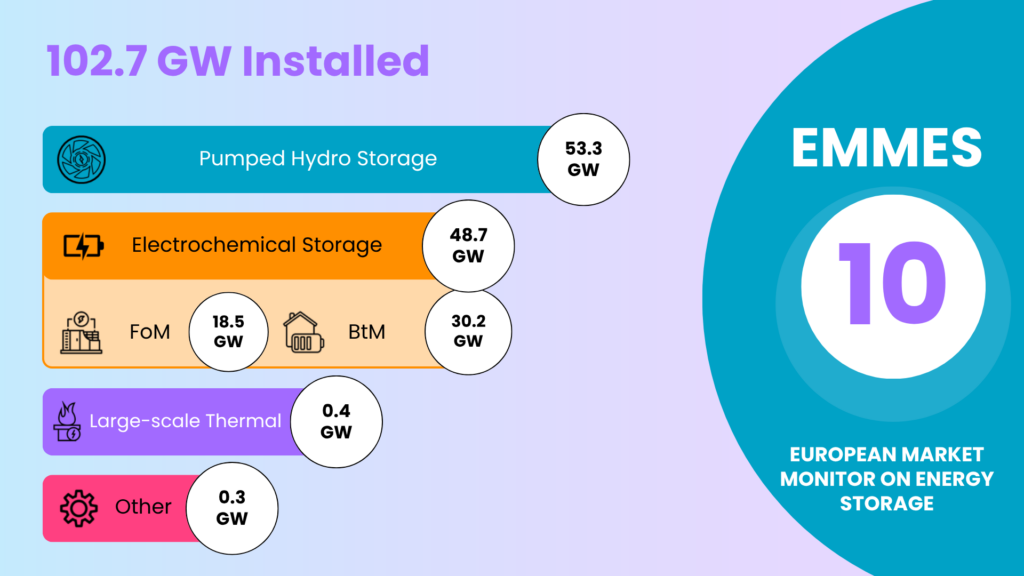
In 2025, Europe surpassed 100 GW of installed storage capacity for the first time, and by Q2 2026 storage overtook nuclear as a source of installed power capacity. With electrochemical storage forecast to grow by a further 153 GW by 2030, energy storage is becoming a core pillar of Europe's future electricity system.