Unleashing Flexibility Needs: How Energy Storage Can Make or Break the Case for Renewables
EASE has prepared a position paper on the Renewable Energy Directive Revision (REDIII) highlighting the great opportunity this review offers in terms of speeding up decarbonisation efforts in the energy system: EASE welcomes the 40% renewable energy targets for 2030, but calls for clearer support for energy storage to step up renewables deployment and ensure security of supply.
EASE believes energy storage can be fostered through RED III in multiple ways. Our key points:
Development of a strategy for energy storage, through a sound methodology assessing flexibility and energy shifting needs;
Definition of co-located storage facility and non-discriminatory treatment in tenders for RES plants;
Support the uptake of RES + storage PPAs and ensure non-discriminatory treatment for the issuing of Guarantees of Origin and green certificates;
Ensure full system integration through the proposed art. 20a;
Include energy storage technologies in the efforts to decarbonise the buildings and transport sectors.
Policymakers need to act quickly in view of the urgent need to decarbonise the European energy system: renewables need to be supported by flexibility technologies and through energy shifting, which only energy storage can provide.
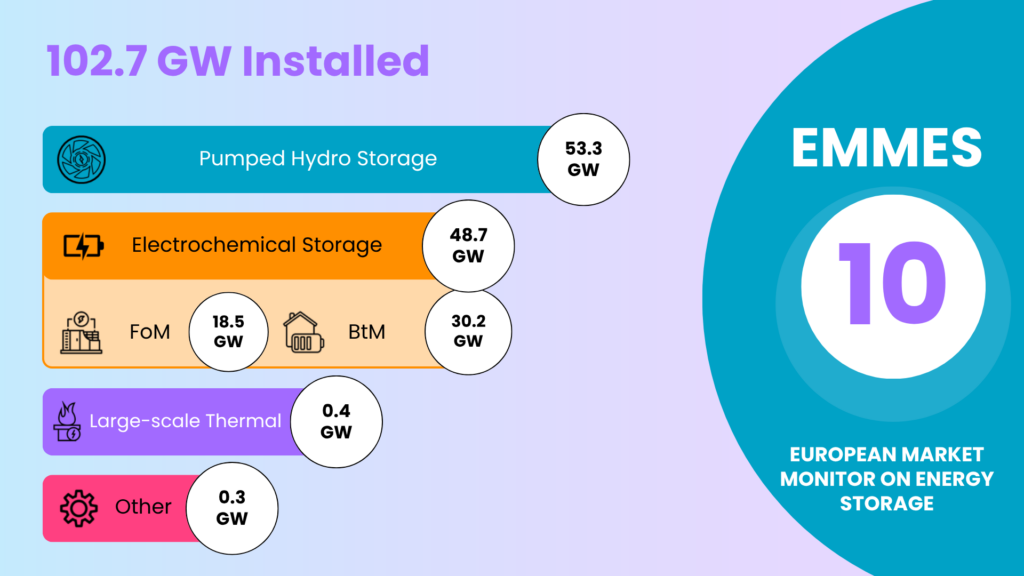
In 2025, Europe surpassed 100 GW of installed storage capacity for the first time, and by Q2 2026 storage overtook nuclear as a source of installed power capacity. With electrochemical storage forecast to grow by a further 153 GW by 2030, energy storage is becoming a core pillar of Europe's future electricity system.
In 2025, Europe surpassed 100 GW of installed storage capacity for the first time, and by Q2 2026 storage overtook nuclear as a source of installed power capacity. With electrochemical storage forecast to grow by a further 153 GW by 2030, energy storage is becoming a core pillar of Europe's future electricity system.
Thermal Energy Storage can help European industry decarbonise, reduce costs, and access new revenue streams. Yet significant regulatory, economic, and financial barriers continue to limit its deployment.
Energy Storage Europe welcomes the proposal for an Industrial Accelerator Act (IAA) and supports its overall objective of strengthening industrial capacity, accelerating decarbonisation, and creating stronger lead markets for strategic clean technologies in the European Union.