EASE has responded to the European Commission's Public Consultation on the proposal for ‘Hydrogen and Decarbonised Gas markets’ Package. This Package, consisting of a review of the Gas Regulation and of the Gas Directive, aims to decarbonise gas consumption, and puts forward policy measures required for supporting the creation of optimum and dedicated infrastructure, as well as efficient markets.
April 2022 / Policy Papers - Responses to Public Consultations
Renewable Energy Projects: Permit-Granting Processes & Power Purchase Agreements
EASE has responded to the European Commission's Public Consultation on 'Renewable Energy Projects - Permit-Granting Processes & Power Purchase Agreements'. This initiative aims to facilitate renewable energy production projects. It will focuses on the key barriers for implementation of renewable energy projects and outline good practices addressing the identified barriers and ways to facilitate power purchase agreements across borders.
EASE prepared a reply to this consultation to contribute to the efficient development and deployment of renewable energy projects in the EU Member States in a favourable way to the energy storage sector. EASE welcomes the initiative as removing barriers to the permit-granting processes and power purchase agreements (PPAs) issues is essential for decarbonisation, clean energy transition, and energy security.
Regarding permitting procedures, EASE recognises the need for facility providing flexibility in the energy supply chain and options for flexible connection agreements for energy storage. In terms of its legislation, sharing the harmonised categorisation for energy storage among Member States is essential. Moreover, an accurate and accessible guideline for permitting is necessary as well as better training for government staff. EASE believes that procedures should be shortened and digitalised as well as that permitting should not be blocked while new legislation is elaborated. Concerning the PPAs, EASE supports the recognition of hybrid (RES + storage) PPAs in the EU legislation to enable that Member States set up frameworks. Lastly, EASE believes that all the changes should be based on political willingness for active renewable deployment, especially on energy storage, at both European and national levels.
EASE has responded to the European Commission's Public Consultation on the proposal for ‘Hydrogen and Decarbonised Gas markets’ Package. This Package, consisting of a review of the Gas Regulation and of the Gas Directive, aims to decarbonise gas consumption, and puts forward policy measures required for supporting the creation of optimum and dedicated infrastructure, as well as efficient markets.
Not a member yet ?
Explore the benefits of joining Energy Storage Europe
Energy Storage Europe replies to the European Commission’s public consultation on the Methodology for the Calculation of the recycled content of industrial and EV batteries. Under the Batteries Regulation, several categories of batteries, including industrial batteries, will have to contain a certain percentage of recycled metals to be allowed to be placed on the EU market.
Energy Storage Europe welcomes the proposed revision of the Network Code for generators and the explicit integration of storage, including grid-forming capabilities. Further clarity is needed on requirements for bidirectional storage and the treatment of existing projects.
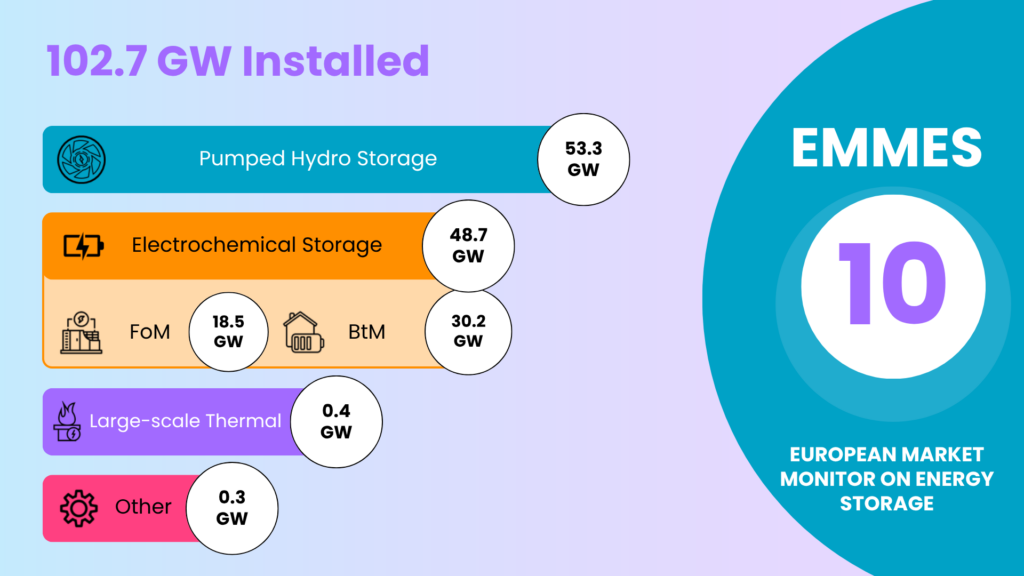
In 2025, Europe surpassed 100 GW of installed storage capacity for the first time, and by Q2 2026 storage overtook nuclear as a source of installed power capacity. With electrochemical storage forecast to grow by a further 153 GW by 2030, energy storage is becoming a core pillar of Europe's future electricity system.
In 2025, Europe surpassed 100 GW of installed storage capacity for the first time, and by Q2 2026 storage overtook nuclear as a source of installed power capacity. With electrochemical storage forecast to grow by a further 153 GW by 2030, energy storage is becoming a core pillar of Europe's future electricity system.