The revisions of the Energy Performance and Buildings Directive and the Energy Efficiency Directive are vital to achieving a zero-emission and fully decarbonised building stock and a carbon-neutral energy system by 2050. EASE welcomes these revisions as an opportunity to speed up decarbonisation efforts through the efficient and optimised use of energy. However, stronger integration of energy storage solutions is required.
April 2022 / Policy Papers - Responses to Public Consultations
Hydrogen and Decarbonised Gas markets Package
EASE has responded to the European Commission's Public Consultation on the proposal for ‘Hydrogen and Decarbonised Gas markets’ Package. This Package, consisting of a review of the Gas Regulation and of the Gas Directive, aims to decarbonise gas consumption, and puts forward policy measures required for supporting the creation of optimum and dedicated infrastructure, as well as efficient markets. It will remove barriers to decarbonisation and create the conditions for a more cost-effective transition. The objective of the revision proposal of the Package is to revise EU gas rules to facilitate the market entry of renewable and low-carbon gases and remove any undue regulatory barriers.
EASE has prepared two replies to this consultation, for the Gas Regulation and the Gas Directive separately, wishing to contribute to the change in the European gas market in favour of the energy storage sector. EASE welcomes the proposal for the Hydrogen and Decarbonised Gas package and it is fundamental for the clean energy transition. Yet, renewable and low-carbon gases' role in energy storage solutions and technologies is not sufficiently acknowledged, such as in the definition and security of supply. In replies to the Regulation and the Directive of the Gas Package revision, EASE focuses on several significant points, including definitions, security of supply, tariff reduction, and blending of hydrogen. EASE believes that ensuring flexibility in the energy market by transparently and efficiently introducing renewable and low-carbon gases is the key to the energy transition.
The revisions of the Energy Performance and Buildings Directive and the Energy Efficiency Directive are vital to achieving a zero-emission and fully decarbonised building stock and a carbon-neutral energy system by 2050. EASE welcomes these revisions as an opportunity to speed up decarbonisation efforts through the efficient and optimised use of energy. However, stronger integration of energy storage solutions is required.
Not a member yet ?
Explore the benefits of joining Energy Storage Europe
Energy Storage Europe replies to the European Commission’s public consultation on the Methodology for the Calculation of the recycled content of industrial and EV batteries. Under the Batteries Regulation, several categories of batteries, including industrial batteries, will have to contain a certain percentage of recycled metals to be allowed to be placed on the EU market.
Energy Storage Europe welcomes the proposed revision of the Network Code for generators and the explicit integration of storage, including grid-forming capabilities. Further clarity is needed on requirements for bidirectional storage and the treatment of existing projects.
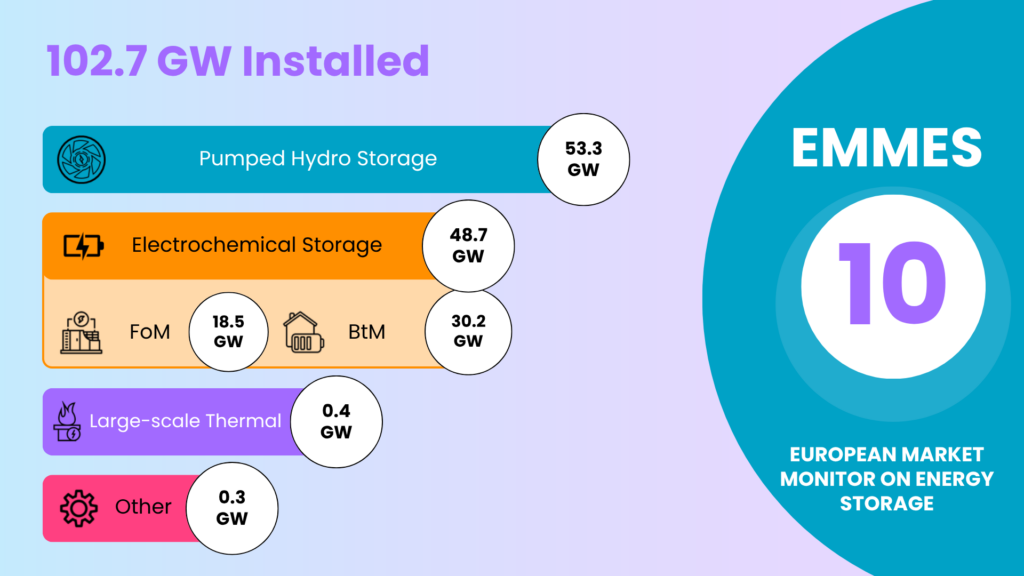
In 2025, Europe surpassed 100 GW of installed storage capacity for the first time, and by Q2 2026 storage overtook nuclear as a source of installed power capacity. With electrochemical storage forecast to grow by a further 153 GW by 2030, energy storage is becoming a core pillar of Europe's future electricity system.
In 2025, Europe surpassed 100 GW of installed storage capacity for the first time, and by Q2 2026 storage overtook nuclear as a source of installed power capacity. With electrochemical storage forecast to grow by a further 153 GW by 2030, energy storage is becoming a core pillar of Europe's future electricity system.