The EASE Task Force on Multi-Services Business Cases for Energy Storage has prepared a report looking at the key role of energy storage as a Local Flexibility provider. This paper gives an overview of existing short-term local flexibility schemes in Europe today including Active-network management (ANM) and other flexibility services and their implications on the business case for energy storage.
July 2022 / Policy Papers
The Way Forward for Energy Storage Grid Fees
EASE has prepared a general overview and the best practices across member states, when looking at the way forward for energy storage grid fees. Energy storage doesn’t receive the same treatment across the European Union as far as grid fees go: different technologies, different location (behind-the-meter vs front of the meter), have to face a variety of tariff structures, often not consistent with the EU-level rules as set by the Electricity Market Regulation.
To make sure grid fees don’t hinder energy storage development, EASE recommends:
Full implementation of the Clean Energy Package market design;
An analysis of network investments and the procurement of flexibility by system operators;
Grid tariff design should follow the main principle of cost-reflectiveness;
Behind-the-Meter energy storage systems should receive the same treatment as self-consumed energy which remains within the prosumer’s premises;
Tariff methodologies and procurement of flexibility should contribute to the deployment of energy storage.
In the Annex to this paper, a detailed description of the best practices carried out in Ireland (temporary abolition of generation related charges for commercial energy storage providers) and Portugal (for collective self-consumers and renewable energy communities, the use of the internal grid between a self-consumption unit and the consumption unit is exempted from grid fee payment) can be found.
The EASE Task Force on Multi-Services Business Cases for Energy Storage has prepared a report looking at the key role of energy storage as a Local Flexibility provider. This paper gives an overview of existing short-term local flexibility schemes in Europe today including Active-network management (ANM) and other flexibility services and their implications on the business case for energy storage.
Not a member yet ?
Explore the benefits of joining Energy Storage Europe
Energy Storage Europe welcomes the European Commission's growing focus on cybersecurity in the energy sector and supports the direction of travel across the Cyber Resilience Act (CRA), the Network Code on Cybersecurity, and the proposed Cybersecurity Act (CSA) 2.0. Yet raises concerns that require targeted corrections to ensure these frameworks deliver on their security objectives without inadvertently slowing battery storage deployment.
Energy Storage Europe replies to the European Commission’s public consultation on the Methodology for the Calculation of the recycled content of industrial and EV batteries. Under the Batteries Regulation, several categories of batteries, including industrial batteries, will have to contain a certain percentage of recycled metals to be allowed to be placed on the EU market.
Energy Storage Europe welcomes the proposed revision of the Network Code for generators and the explicit integration of storage, including grid-forming capabilities. Further clarity is needed on requirements for bidirectional storage and the treatment of existing projects.
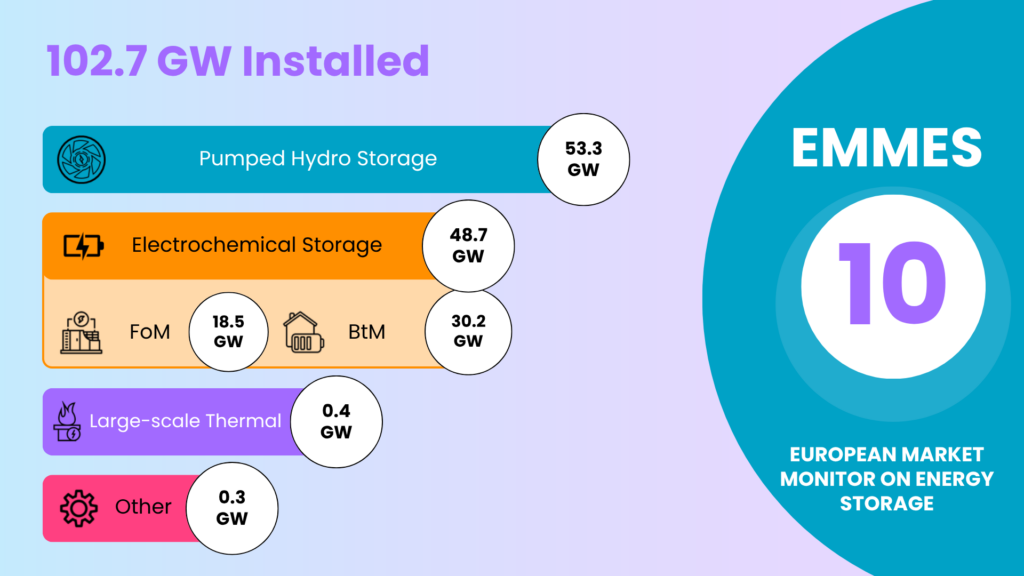
In 2025, Europe surpassed 100 GW of installed storage capacity for the first time, and by Q2 2026 storage overtook nuclear as a source of installed power capacity. With electrochemical storage forecast to grow by a further 153 GW by 2030, energy storage is becoming a core pillar of Europe's future electricity system.