EASE position paper on guiding principles to develop an AFN methodology which aims to ensure that energy storage technologies are properly taken into account in the methodology.
July 2024 / Consultations & Advocacy
Introduction of Voluntary Templates for Power Purchase Agreement Contracts in the EU Energy Market
Energy Storage Europe Association (previously EASE) has prepared a response to ACER's public consultation on templates for voluntary Power Purchase Agreements (PPAs) in the EU energy market. The response highlights that while current voluntary PPA templates serve as a solid foundation for negotiations, they often require modifications. This is due to the need to accommodate specific product conditions, varying national jurisdictions across Europe, and market-specific responsibilities such as grid connection delays, force majeure events, and fluctuating prices.
The response underlines that power generation assets, prospective storage solutions, and constraints imposed by public bodies or multi-buyer contracts can lead to delays and increase costs. To address these challenges, private initiatives must reflect industry demands and be adaptable over time.
EASE advocates for a flexible voluntary template that offers various options to adapt to specific clauses and leverages Electricity Market Design provisions. Such a template would lower entry barriers, streamline processes, and ensure standardised procedures, ultimately facilitating a more efficient and adaptable PPA market.
EASE position paper on guiding principles to develop an AFN methodology which aims to ensure that energy storage technologies are properly taken into account in the methodology.
Not a member yet ?
Explore the benefits of joining Energy Storage Europe
Energy Storage Europe welcomes the European Commission's growing focus on cybersecurity in the energy sector and supports the direction of travel across the Cyber Resilience Act (CRA), the Network Code on Cybersecurity, and the proposed Cybersecurity Act (CSA) 2.0. Yet raises concerns that require targeted corrections to ensure these frameworks deliver on their security objectives without inadvertently slowing battery storage deployment.
Energy Storage Europe replies to the European Commission’s public consultation on the Methodology for the Calculation of the recycled content of industrial and EV batteries. Under the Batteries Regulation, several categories of batteries, including industrial batteries, will have to contain a certain percentage of recycled metals to be allowed to be placed on the EU market.
Energy Storage Europe welcomes the proposed revision of the Network Code for generators and the explicit integration of storage, including grid-forming capabilities. Further clarity is needed on requirements for bidirectional storage and the treatment of existing projects.
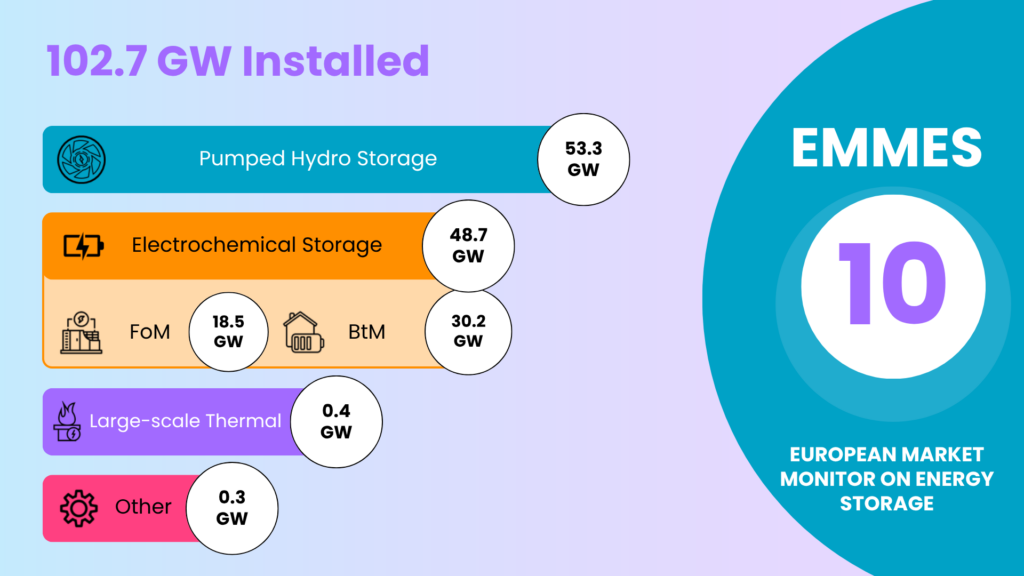
In 2025, Europe surpassed 100 GW of installed storage capacity for the first time, and by Q2 2026 storage overtook nuclear as a source of installed power capacity. With electrochemical storage forecast to grow by a further 153 GW by 2030, energy storage is becoming a core pillar of Europe's future electricity system.