EASE reply to Public Consultation to ACER on the introduction of voluntary templates for power purchase agreement contracts in the EU energy market.
December 2024 / Consultations & Advocacy
The European Union's Flexibility Needs Assessment Methodology
Significant challenges lie ahead to make the electricity system more flexible to integrate variable renewables and achieve a cost-efficient path to meet the European Union’s decarbonisation objectives. The deployment of energy storage technologies will grow significantly and play an indispensable role in this transformation. A deeper understanding of evolving flexibility needs and the role of storage in addressing them is essential.
The Electricity Market Design Reform (EMDR) tasked the DSO Entity and ENTSO-E with developing a methodology to analyse flexibility needs. A draft proposal of this methodology is currently under consultation before its submission to ACER for possible amendments and approval. Once finalised, TSOs and DSOs will apply the methodology to analyse flexibility needs, producing results that will inform national reports prepared by National Regulatory Authorities or other designated entities. Based on these reports, Member States will set indicative targets for non-fossil flexibility, including specific sub-targets for energy storage. Developing a robust methodology is crucial to ensure policymakers receive accurate and actionable insights.
EASE’s response provides detailed comments on specific Articles of the draft methodology, while broader remarks are addressed in the last question addressing general feedback.
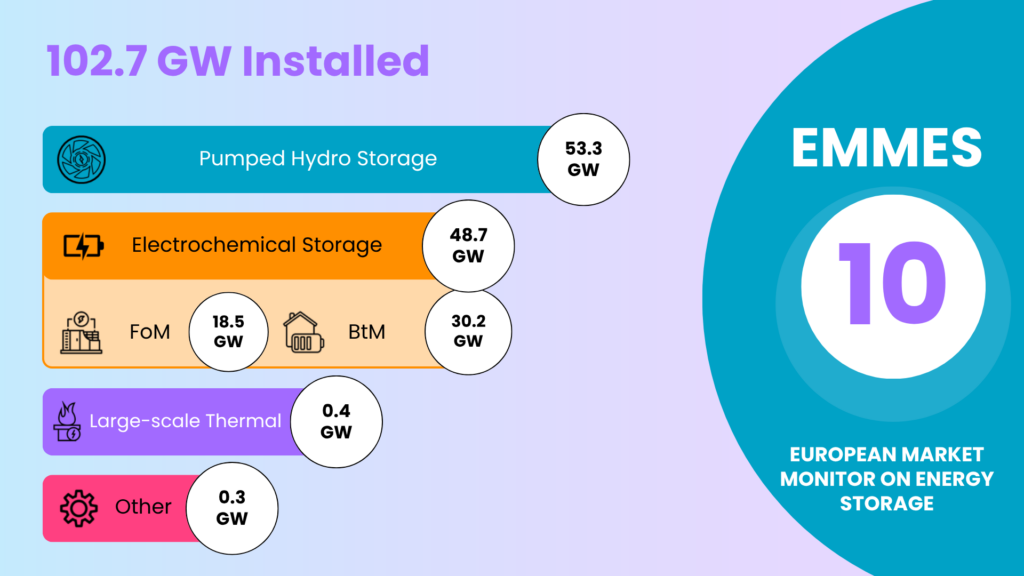
In 2025, Europe surpassed 100 GW of installed storage capacity for the first time, and by Q2 2026 storage overtook nuclear as a source of installed power capacity. With electrochemical storage forecast to grow by a further 153 GW by 2030, energy storage is becoming a core pillar of Europe's future electricity system.
In 2025, Europe surpassed 100 GW of installed storage capacity for the first time, and by Q2 2026 storage overtook nuclear as a source of installed power capacity. With electrochemical storage forecast to grow by a further 153 GW by 2030, energy storage is becoming a core pillar of Europe's future electricity system.
Thermal Energy Storage can help European industry decarbonise, reduce costs, and access new revenue streams. Yet significant regulatory, economic, and financial barriers continue to limit its deployment.
Energy Storage Europe welcomes the proposal for an Industrial Accelerator Act (IAA) and supports its overall objective of strengthening industrial capacity, accelerating decarbonisation, and creating stronger lead markets for strategic clean technologies in the European Union.