On 4 March 2026 the European Commission published the Industrial Accelerator Act. The Act introduces Made in Europe requirements for the procurement and auction of numerous industrial products, including energy storage technologies.
22.04.2026 / Press Releases
AccelerateEU Sends a Clear Signal — Europe’s Future Competitiveness Depends on Energy Storage
22 April 2026: Over €24 billion bill on fossil fuel imports already. Around €500 million every single day! That is the cost Europe has paid in only a few weeks due to continued dependence on imported fossil fuels, as it was highlighted by EU Commissioner for energy Dan Jørgensen today, while presenting the European Commission’s new Communication AccelerateEU – Affordable and Secure Energy through Accelerated Action.
This is why the European Commission’s Communication AccelerateEU matters – it sends a strong system-wide policy signal: the EU increasingly recognises that affordability, security, competitiveness and decarbonisation are impossible without flexibility. And flexibility depends on storage.
For the storage sector, this is key: energy storage is being recognised not only as a decarbonisation enabler but a strategic competitiveness asset in the EU policy framework.
The recognition that energy storage is no longer a side topic to renewables but a strategic infrastructure is a far more powerful investment signal than a narrow renewables policy.
As Commissioner Dan Jørgensen stressed, Europe now needs stronger investment into high-impact energy projects. Storage should be firmly among them.
Why? Because storage can:
lower peak electricity prices
integrate more solar and wind
strengthen resilience during crises
reduce congestion and curtailment
support industrial competitiveness
cut fossil fuel imports faster.
In short: no affordable, resilient energy system without storage.
Now the EU should move next on:
Introducing faster permitting for storage projects for more rapid deployment;
Guiding member states to adopt grid connection procedures which prioritise assets that alleviate congestion;
Ensuring fair implementation of Electricity Market Design rules that reward flexibility and stacked revenues, allowing participation in frequency and non-frequency markets;
Ensuring clear recognition in Electricity Market Design of storage as a standalone asset class;
Target EU and national investment frameworks to support high-CAPEX storage projects;
Measures to strengthen EU manufacturing and supply chains for batteries for stationary storage and long-duration energy storage technologies;
Adopt a legal proposal on network tariffs and taxation which reflects storage's cost- and benefit to the electricity grid.
Define sub-targets for multi-day and seasonal storage within the 200 GW 2030 goal to ensure a diverse flexibility mix.
Mandate long-term flexibility assessments in National Energy and Climate Plans (NECPs) to identify gaps in multi-day energy resilience.
AccelerateEU’s signal is loud and clear. Now is the moment to accelerate deployment at scale by investing massively in solutions that can be built and deployed in Europe. The storage industry is ready to deliver. However, EU policymaking must follow with equal ambition through existing and forthcoming legislative processes, as well as targeted new EU financial instruments. Implementation must also become faster and more coherent across Europe in order to truly accelerate the transition.
On 4 March 2026 the European Commission published the Industrial Accelerator Act. The Act introduces Made in Europe requirements for the procurement and auction of numerous industrial products, including energy storage technologies.
Energy Storage Europe replies to the European Commission’s public consultation on the Methodology for the Calculation of the recycled content of industrial and EV batteries. Under the Batteries Regulation, several categories of batteries, including industrial batteries, will have to contain a certain percentage of recycled metals to be allowed to be placed on the EU market.
Energy Storage Europe welcomes the proposed revision of the Network Code for generators and the explicit integration of storage, including grid-forming capabilities. Further clarity is needed on requirements for bidirectional storage and the treatment of existing projects.
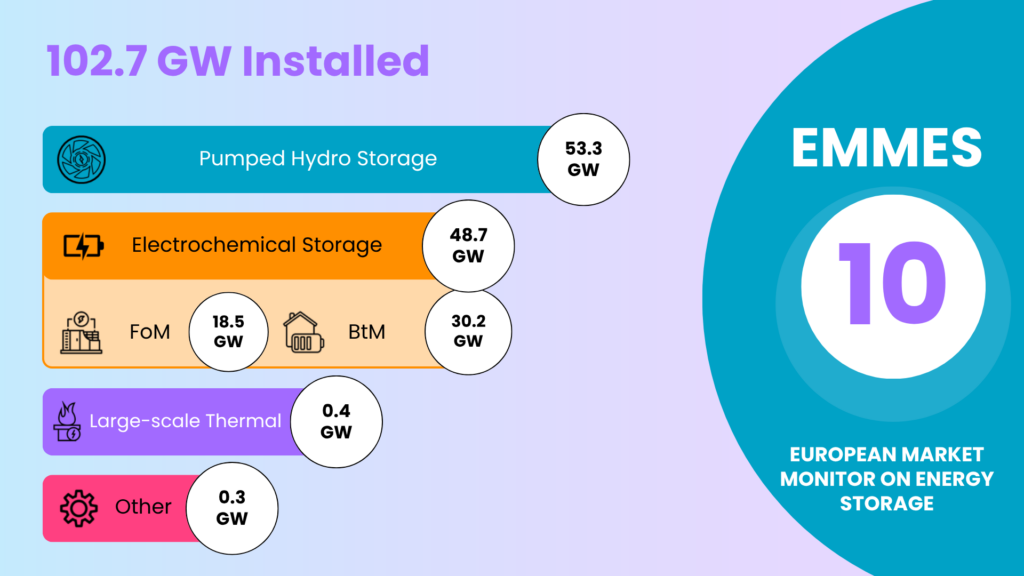
In 2025, Europe surpassed 100 GW of installed storage capacity for the first time, and by Q2 2026 storage overtook nuclear as a source of installed power capacity. With electrochemical storage forecast to grow by a further 153 GW by 2030, energy storage is becoming a core pillar of Europe's future electricity system.
In 2025, Europe surpassed 100 GW of installed storage capacity for the first time, and by Q2 2026 storage overtook nuclear as a source of installed power capacity. With electrochemical storage forecast to grow by a further 153 GW by 2030, energy storage is becoming a core pillar of Europe's future electricity system.