We are pleased to announce that a new member has joined EASE: Aarhus University. Welcome on board!
02.04.2020 / News
Building the Future of Europe’s Hydropower Industry
On 25 March 2020, HYDROPOWER EUROPE hosted an online workshop gathering over 30 experts from the hydropower industry to work on the elaboration of a common Research and innovation Agenda (RIA) and Strategic Industry Roadmap (SIR).
Respectively, the Research and innovation Agenda (RIA) is designed to provide reference to the hydropower community, by giving recommendations on the Research and Innovation (R&I) priorities for hydro mainly to the EU Institutions and national authorities. Conversely, the Strategic Industry Roadmap (SIR) is instead thought to understand the criteria behind the acceptance and refusal of hydropower projects and aimed at promoting innovative practices enhancing the hydropower development while reflecting the European energy policy and ambition.
The focus and perspective of the documents is quite different; however, they show a highly complementary nature as all R&I priorities outlined in the RIA should always follow and depend on the direction undertaken by the SIR.
Overall, and in the framework of the Horizon 2020 project, the main goal is that of establishing a forum for discussion where the whole hydropower community will be called to share and define the main priorities shaping the future of the hydropower sector.
Given the involvement of EASE as leader of the consultation process and organiser of the regional workshops, the Association will also take care of the upcoming HPE Brussels workshop, which will take place on 12-13 October 2020 in Brussels.
The event will gather EU policymakers and environmental organisations to discuss the impact of hydropower on the environment and society.
For any additional information, please contact Ms Capucine Vannoorenberghe.
Energy Storage Europe welcomes the European Commission's growing focus on cybersecurity in the energy sector and supports the direction of travel across the Cyber Resilience Act (CRA), the Network Code on Cybersecurity, and the proposed Cybersecurity Act (CSA) 2.0. Yet raises concerns that require targeted corrections to ensure these frameworks deliver on their security objectives without inadvertently slowing battery storage deployment.
Energy Storage Europe replies to the European Commission’s public consultation on the Methodology for the Calculation of the recycled content of industrial and EV batteries. Under the Batteries Regulation, several categories of batteries, including industrial batteries, will have to contain a certain percentage of recycled metals to be allowed to be placed on the EU market.
Energy Storage Europe welcomes the proposed revision of the Network Code for generators and the explicit integration of storage, including grid-forming capabilities. Further clarity is needed on requirements for bidirectional storage and the treatment of existing projects.
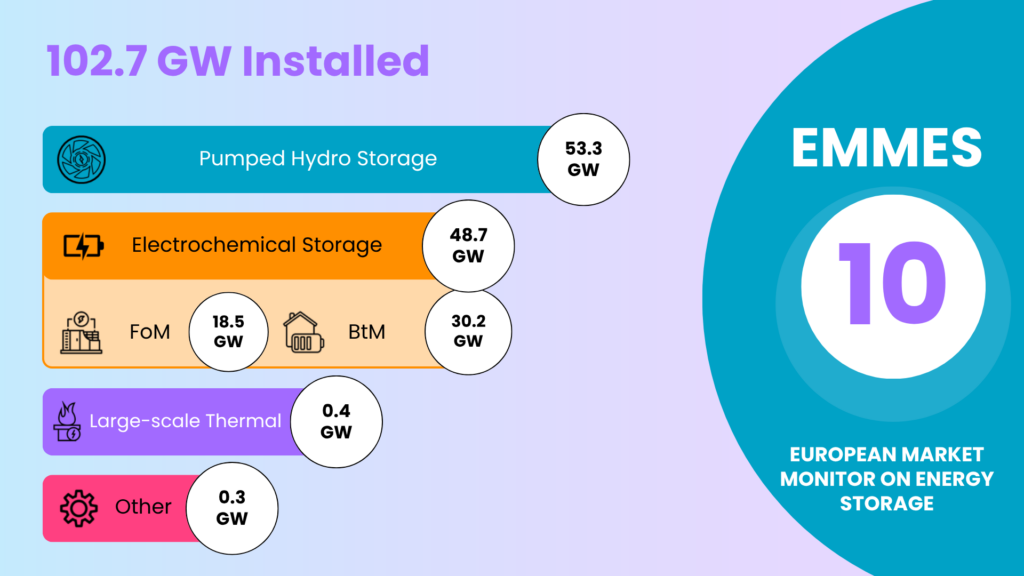
In 2025, Europe surpassed 100 GW of installed storage capacity for the first time, and by Q2 2026 storage overtook nuclear as a source of installed power capacity. With electrochemical storage forecast to grow by a further 153 GW by 2030, energy storage is becoming a core pillar of Europe's future electricity system.