EASE, together with the European industry and research organisations RECHARGE Batteries, AVERE - The European Association for Electromobility, Cycling Industries Europe, EMIRI and BATTERY 2030 published a joint statement calling upon policymakers at European and national level to continue to demonstrate their climate leadership ambitions amid the global COVID-19 crisis.
19.11.2020 / Press Releases
Mr David Post, Enel X, Elected as EASE President Starting 1 January 2021
On 18 November 2020, the General Assembly of EASE - the European Association for Storage of Energy – representing 56 organisations active across the energy storage value chain, elected Mr David Post, Head of Energy Storage Solutions at Enel X, to serve as the new EASE President. Mr Post is an expert in business development for renewable, conventional energy and energy storage projects and previously occupied the position of EASE Vice-President and served as head of the association’s Technology and Value Assessment Committee.
“In the past years, EASE experienced a strong growth and became a reference in the European energy storage business. My goal is to continue this path and support the association in its active role of representing its members in the fast-evolving energy storage landscape” declared Mr Post after his election. “Over the last years, energy storage has become more and more a European reality, and in the next 5 years we expect to see a very substantial growth, making this technology a key element of our power network.”
On 1 January 2021, Mr David Post will officially take over the presidential torch from Ms Eva Chamizo Llatas, Director of European Affairs and Head of the Iberdrola Brussels Office. Mr Post will be supported in his new function three Vice-Presidents: Mr Corneliu Barbu (Assistant Professor, Electrical and Computer Engineering Department at Aarhus University), Mr Michael Lippert (Director Innovation and Solutions for Energy at Saft), and Mr Holger Wolfschmidt (Market Applications Director EMEA at Fluence). Additionally Mr Etienne Briere (Executive Vice President R&D Program on Renewable Energy, Storage Environment) will cover the position of Treasurer.
EASE Secretary General Mr Patrick Clerens thanked Ms Chamizo Llatas for her commitment and the significant progress achieved during the past three years and welcomed the selection of Mr David Post as new President, wishing him success in his new position and in addressing the challenges that energy storage will be facing in the coming years.
EASE, together with the European industry and research organisations RECHARGE Batteries, AVERE - The European Association for Electromobility, Cycling Industries Europe, EMIRI and BATTERY 2030 published a joint statement calling upon policymakers at European and national level to continue to demonstrate their climate leadership ambitions amid the global COVID-19 crisis.
Energy Storage Europe welcomes the European Commission's growing focus on cybersecurity in the energy sector and supports the direction of travel across the Cyber Resilience Act (CRA), the Network Code on Cybersecurity, and the proposed Cybersecurity Act (CSA) 2.0. Yet raises concerns that require targeted corrections to ensure these frameworks deliver on their security objectives without inadvertently slowing battery storage deployment.
Energy Storage Europe replies to the European Commission’s public consultation on the Methodology for the Calculation of the recycled content of industrial and EV batteries. Under the Batteries Regulation, several categories of batteries, including industrial batteries, will have to contain a certain percentage of recycled metals to be allowed to be placed on the EU market.
Energy Storage Europe welcomes the proposed revision of the Network Code for generators and the explicit integration of storage, including grid-forming capabilities. Further clarity is needed on requirements for bidirectional storage and the treatment of existing projects.
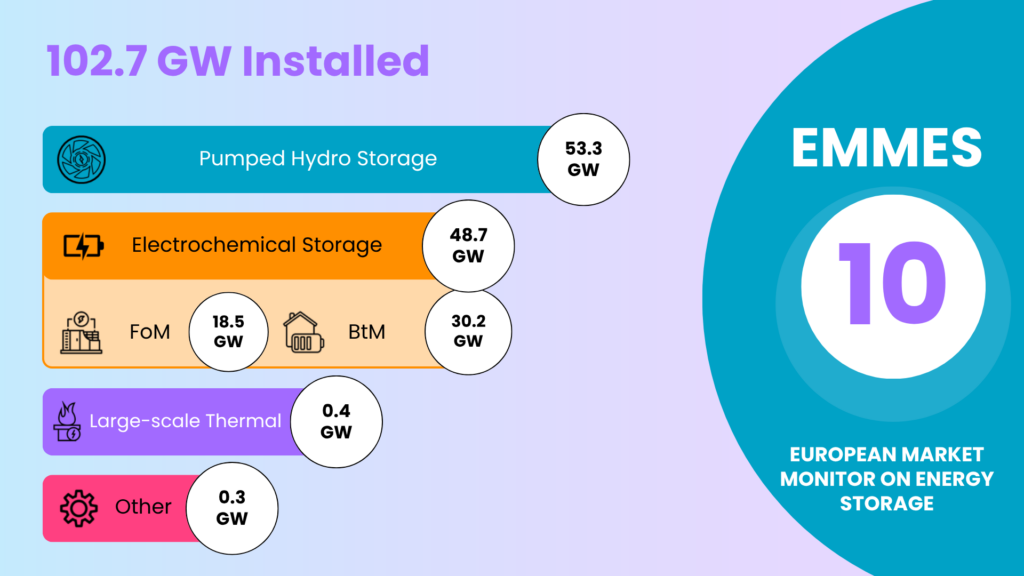
In 2025, Europe surpassed 100 GW of installed storage capacity for the first time, and by Q2 2026 storage overtook nuclear as a source of installed power capacity. With electrochemical storage forecast to grow by a further 153 GW by 2030, energy storage is becoming a core pillar of Europe's future electricity system.