EASE is very pleased that the European Commission has published its Communication on Accelerating Clean Energy Innovation which lays out a framework for action to increase public and private investments in low-carbon technologies and pushes for the development of clean energy business models.
13.12.2016 / News
EASE's 2016 Overview
We have come to the end of the year, making this the time to reflect on what we have achieved and also to thank our members, team and colleagues who have contributed to spreading EASE messages in support of energy storage throughout 2016.
Here are some of our 2016 highlights:
Welcoming the Clean Energy for All Europeans package, published by the European Commission in end-November, with three main goals: putting energy efficiency first, achieving global leadership in renewable energies, and providing a fair deal for consumers. The recast of the Electricity Directive (to read EASE's press release, please click here), a key element of the package, establishes a legal definition for energy storage. The package also includes a Communication on Accelerating Clean Energy Innovation (to read EASE's press release, please click here), which lays out a framework for action to increase public and private investments in low-carbon technologies and pushes for the development of clean energy business models. The Communication recognises the importance of energy storage by designating it as a priority area for clean energy research and innovation, alongside electro-mobility, decarbonisation of the building stock, and the integration of renewables.
Energy Storage Global Conference 2016: on 27-29.09.2016, EASE organised in Brussels the second Energy Storage Global Conference in Brussels. More than 220 delegates attended the Conference, which saw 49 speakers from the industry, research centres and international bodies from the electricity, renewables and storage sectors, as well as representatives from the European Commission, the European Parliament and national administrations.
End of the Grid+Storage project: EASE was part of a consortium supporting the European Commission in defining an integrated R&D strategy in smart grids and energy storage. The roadmap was approved by the ETIP SNET on 9 December 2016.
European Technology and Innovation Platform for Smart Networks for the Energy Transition (ETIP SNET): EASE was nominated Vice-Chair of the ETIP SNET Governing Board and will play an active role in the Working Group on energy storage. EASE is also a member of the INTESYS4EU consortium, which will manage the ETIP SNET activities.
EASE Members and team had the chance to visit Terna’s Storage Lab in Sardinia, a unique project that is designed to analyse the performance of selected battery technologies when used to provide essential grid services such as frequency regulation, secondary regulation, and voltage regulation. In addition to testing various services, the Lab is tasked with putting the most popular energy storage technology providers (e.g., Samsung, LG, BYD, SAFT, Toshiba, GE and FIAMM) through their paces in order to prove their performance when working in real case scenarios.
For the latest news and updates on EASE and energy storage, you can also follow us on Twitter (@EASE_ES).
Thank you again to all those who contributed to our activities this year. We are excited to see what 2017 will bring for EASE and for the larger energy storage community!
EASE is very pleased that the European Commission has published its Communication on Accelerating Clean Energy Innovation which lays out a framework for action to increase public and private investments in low-carbon technologies and pushes for the development of clean energy business models.
Energy Storage Europe welcomes the European Commission's growing focus on cybersecurity in the energy sector and supports the direction of travel across the Cyber Resilience Act (CRA), the Network Code on Cybersecurity, and the proposed Cybersecurity Act (CSA) 2.0. Yet raises concerns that require targeted corrections to ensure these frameworks deliver on their security objectives without inadvertently slowing battery storage deployment.
Energy Storage Europe replies to the European Commission’s public consultation on the Methodology for the Calculation of the recycled content of industrial and EV batteries. Under the Batteries Regulation, several categories of batteries, including industrial batteries, will have to contain a certain percentage of recycled metals to be allowed to be placed on the EU market.
Energy Storage Europe welcomes the proposed revision of the Network Code for generators and the explicit integration of storage, including grid-forming capabilities. Further clarity is needed on requirements for bidirectional storage and the treatment of existing projects.
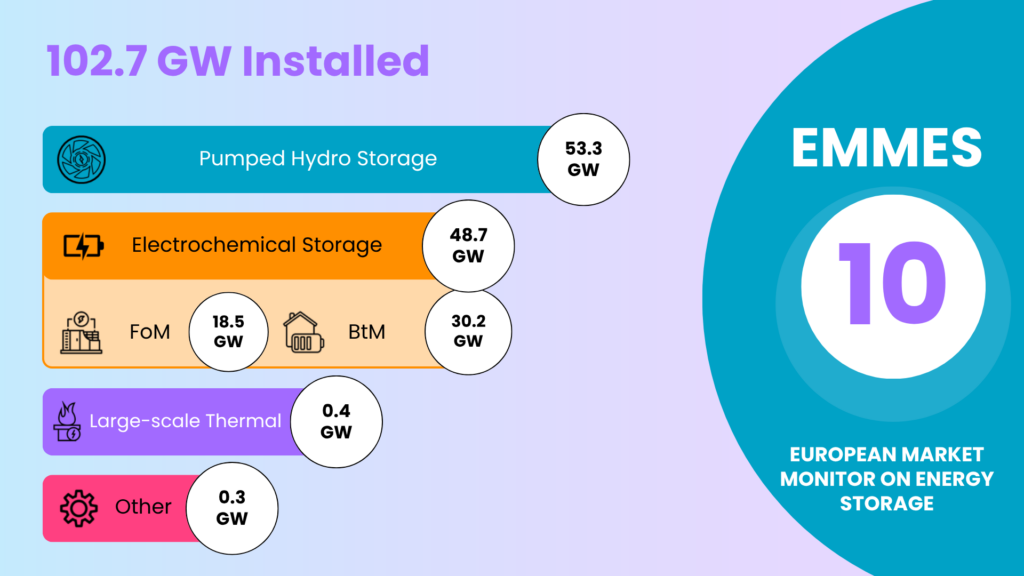
In 2025, Europe surpassed 100 GW of installed storage capacity for the first time, and by Q2 2026 storage overtook nuclear as a source of installed power capacity. With electrochemical storage forecast to grow by a further 153 GW by 2030, energy storage is becoming a core pillar of Europe's future electricity system.