EASE, together with 16 European business organisations, calls Frans Timmermans, Executive Vice-President for the European Green Deal, and Kadri Simson, Energy Commissioner, to increase system efficiency through the activation of the demand-side flexibility of end-users in the Fit for 55 Package.
19.05.2021 / News
EU-funded project HEROES kicked off in May 2021
The EU-funded project “Hybrid EneRgy stOragE Stations” (HEROES) has officially kicked off on 1st May 2021.
100% funded under EU Horizon 2020 Research and Innovation programme with €4,1 MN, HEROES aims at supporting the increased uptake of electric vehicles in Europe, thanks to the development and implementation of more efficient charging stations.
The overall objective of the HEROES project is to develop and demonstrate an innovative Li-ion capacitor (LiCs) based hybrid high-power/energy stationary storage system for fast charging of electrical vehicles (17.5 min for a state of the art 93 kWh electrical vehicle) that can be connected to widespread LV grids, without the need to invest in improving the grid power.
“The HEROES system will be a key enabler for the widespread need for fast charging of electrical vehicles, cost effective and without the need for a major investment in the grid. Given the huge increase in electrical vehicles and their expected importance towards a decarbonised transport system to reduce environmental emissions, the potential impact of the innovation is considerable.
The innovation will take advantage of storage technologies to be suitable for both high power and high energy applications in a way that could not be achieved cost effectively and with acceptable lifetime if the technologies were used independently.
The consortium covers the full value chain of energy storage from technology providers to system integrators and end-users, placing the consortium in an excellent position to develop scientific and technological breakthroughs in the field, as well as seeing market opportunities that arise from novel users” says Dr. Turi Kvame Lorentzen, project coordinator from Beyonder AS.
Given the travel restrictions currently in place in Europe, the kick-off took place on an online basis on 11 May, nevertheless setting the scene for a fruitful collaboration and outstanding results in the coming years.
The HEROES Consortium includes 10 different partners coming from Denmark, Belgium, Germany, Spain and Norway. Organisations include Universities, research centres, associations, technology providers and consultancies.
EASE, together with 16 European business organisations, calls Frans Timmermans, Executive Vice-President for the European Green Deal, and Kadri Simson, Energy Commissioner, to increase system efficiency through the activation of the demand-side flexibility of end-users in the Fit for 55 Package.
Energy Storage Europe welcomes the European Commission's growing focus on cybersecurity in the energy sector and supports the direction of travel across the Cyber Resilience Act (CRA), the Network Code on Cybersecurity, and the proposed Cybersecurity Act (CSA) 2.0. Yet raises concerns that require targeted corrections to ensure these frameworks deliver on their security objectives without inadvertently slowing battery storage deployment.
Energy Storage Europe replies to the European Commission’s public consultation on the Methodology for the Calculation of the recycled content of industrial and EV batteries. Under the Batteries Regulation, several categories of batteries, including industrial batteries, will have to contain a certain percentage of recycled metals to be allowed to be placed on the EU market.
Energy Storage Europe welcomes the proposed revision of the Network Code for generators and the explicit integration of storage, including grid-forming capabilities. Further clarity is needed on requirements for bidirectional storage and the treatment of existing projects.
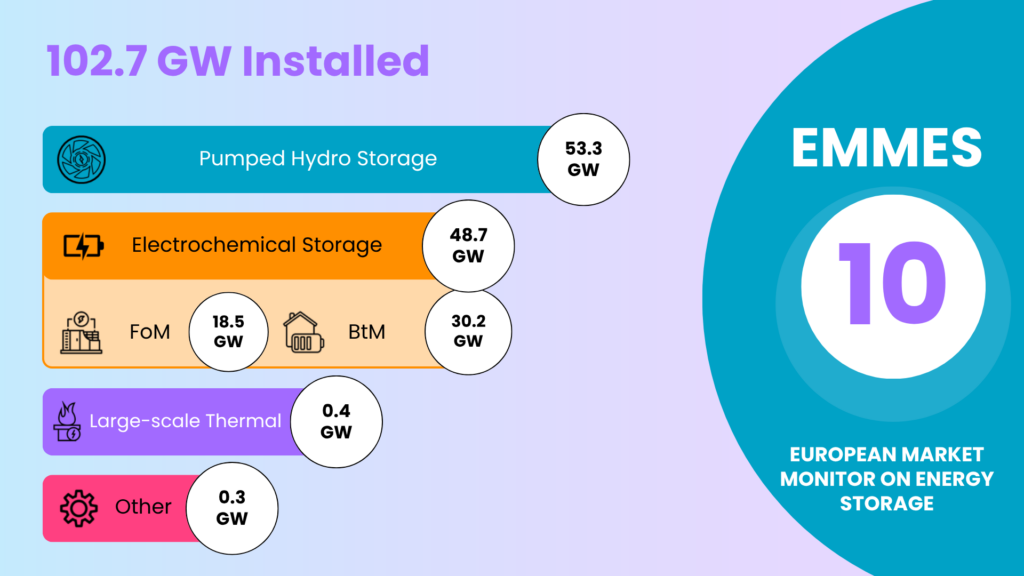
In 2025, Europe surpassed 100 GW of installed storage capacity for the first time, and by Q2 2026 storage overtook nuclear as a source of installed power capacity. With electrochemical storage forecast to grow by a further 153 GW by 2030, energy storage is becoming a core pillar of Europe's future electricity system.