EASE, together with the European industry and research organisations RECHARGE Batteries, AVERE - The European Association for Electromobility, Cycling Industries Europe, EMIRI and BATTERY 2030 published a joint statement calling upon policymakers at European and national level to continue to demonstrate their climate leadership ambitions amid the global COVID-19 crisis.
03.04.2020 / News
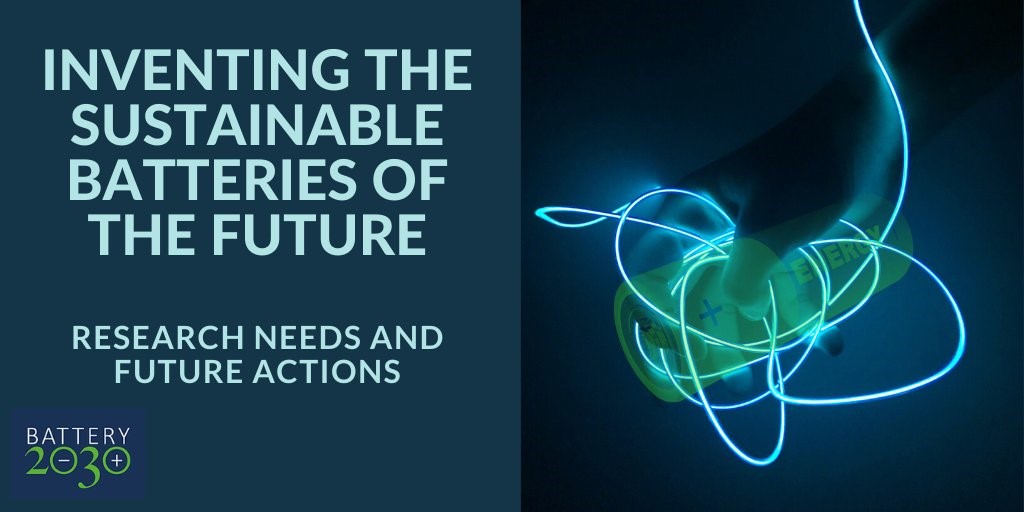
Inventing the Sustainable Batteries of the Future: BATTERY 2030+ Presents its Research Roadmap
The transformation to a climate-neutral society requires fundamental changes in the way we generate and use energy. Batteries are a key enabler to reach this goal, if they can be made sustainable, safe and affordable with ultra-high performance at the same time.
EASE is a partner of the EU-funded project BATTERY 2030+, which has recently released a Research Roadmap outlining the long-term actions needed to foster the sustainable batteries of the future. The Roadmap has been developed through a European-wide consultation process and identifies three main research directions, based on a chemistry neutral approach, that will accelerate the development of the next generation of batteries, taking into account the technological developments brought by digitalisation, new materials and reciclability.
“BATTERY 2030+ is not about developing a specific battery chemistry, but rather about exploiting the power of digital technologies like artificial intelligence […] With BATTERY 2030+, battery design and development are entering the digital age”, says Kristina Edström, Director of BATTERY 2030+ and Professor of Inorganic Chemistry at Uppsala University.
The three major research themes identified in the Roadmap are:
I: Accelerated discovery of battery interfaces and materials II: Integration of smart functionalities III: Manufacturability and recyclability as cross-cutting areas
Moreover, the development of breakthrough technologies will require immense multi-disciplinary and cross-sectorial research efforts. Europe has the potential to take the lead thanks to thriving research and innovation communities. Coordination and joint efforts coming from the European battery value chain are essential in this process.
“To invent the batteries of the future in Europe, we must join forces and find a coordinated, collaborative approach that unites industry, researchers, policy makers and the public behind a common vision […]”, says Simon Perraud, Deputy Director of BATTERY 2030+ and Deputy Director at CEA-Liten.
EASE, together with the European industry and research organisations RECHARGE Batteries, AVERE - The European Association for Electromobility, Cycling Industries Europe, EMIRI and BATTERY 2030 published a joint statement calling upon policymakers at European and national level to continue to demonstrate their climate leadership ambitions amid the global COVID-19 crisis.
Energy Storage Europe welcomes the European Commission's growing focus on cybersecurity in the energy sector and supports the direction of travel across the Cyber Resilience Act (CRA), the Network Code on Cybersecurity, and the proposed Cybersecurity Act (CSA) 2.0. Yet raises concerns that require targeted corrections to ensure these frameworks deliver on their security objectives without inadvertently slowing battery storage deployment.
Energy Storage Europe replies to the European Commission’s public consultation on the Methodology for the Calculation of the recycled content of industrial and EV batteries. Under the Batteries Regulation, several categories of batteries, including industrial batteries, will have to contain a certain percentage of recycled metals to be allowed to be placed on the EU market.
Energy Storage Europe welcomes the proposed revision of the Network Code for generators and the explicit integration of storage, including grid-forming capabilities. Further clarity is needed on requirements for bidirectional storage and the treatment of existing projects.
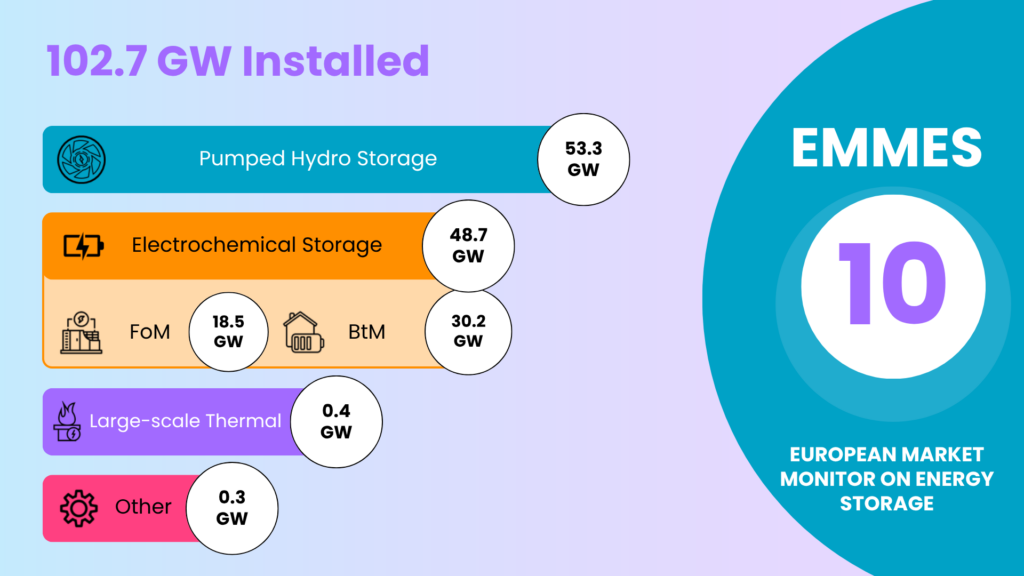
In 2025, Europe surpassed 100 GW of installed storage capacity for the first time, and by Q2 2026 storage overtook nuclear as a source of installed power capacity. With electrochemical storage forecast to grow by a further 153 GW by 2030, energy storage is becoming a core pillar of Europe's future electricity system.