EASE has prepared a short summary on one of the last energy storage application group - Services to Support Behind the Meter Providing Customer Energy Management.
November 2021 / Reports and Studies
Ancillary Services
The Task Force on Segmentation of Applications has developed The Ancillary Services Report, among other application descriptions. This work builds on the Summary of Energy Storage Applications published in June 2020.
This overview provides a summary of different energy storage applications that support the efficient operation of the power grid. Ancillary Services are generally tendered by transmission and distribution system operators to ensure reliable power supply. These services can be provided by a variety of technologies as well as the already commonly tendered ones on the market, and provided by storage operators.
Services to Distribution Infrastructure are composed of nine key systems:
Frequency Containment Reserve (FCR): primary frequency - maintains a balance between generation and consumption within the Synchronous Area. Aims to maintain the operational reliability of the power system of the Synchronous Area and stabilises the system frequency at a stationary value.
Automatic Frequency Restoration Reserve (aFRR): Secondary frequency - adjusts the active power production of the generating units to restore the frequency and the interchanges with other systems to their target values following an imbalance, and brings the frequency back to its target value.
Manual Frequency Restoration Reserve (mFRR): Tertiary frequency - restores primary and secondary frequency control reserves, manages congestion in the transmission network, and brings frequency and interchanges back to their target value.
Replacement Reserve (RR): restoring or supporting the required level of frequency restoration reserve (FRR) and system imbalances, including generation reserves through active power reserves
Load Following: serves as load following capacity that adjusts its output to balance the generation and the load within a specific region or area.
Frequency Stability of Weak Grids: maintaining the frequency stability by helping avoid load shedding in islands due to the feasible very prompt response of distributed energy storage systems (DESS).
Black Start: contributes to the process of recovering a power station to operation without relying on an external power network.
Voltage Support: maintains voltage by injecting or absorbing reactive power by means of synchronous or static compensation. Different kinds of voltage control are implemented by individual TSOs, based on their own policies: primary, secondary and tertiary voltage.
New Ancillary Services: delivers a reactive current response for voltage dips in excess and supplies the reactive current with a specific rise time.
EASE has prepared a short summary on one of the last energy storage application group - Services to Support Behind the Meter Providing Customer Energy Management.
Not a member yet ?
Explore the benefits of joining Energy Storage Europe
Energy Storage Europe replies to the European Commission’s public consultation on the Methodology for the Calculation of the recycled content of industrial and EV batteries. Under the Batteries Regulation, several categories of batteries, including industrial batteries, will have to contain a certain percentage of recycled metals to be allowed to be placed on the EU market.
Energy Storage Europe welcomes the proposed revision of the Network Code for generators and the explicit integration of storage, including grid-forming capabilities. Further clarity is needed on requirements for bidirectional storage and the treatment of existing projects.
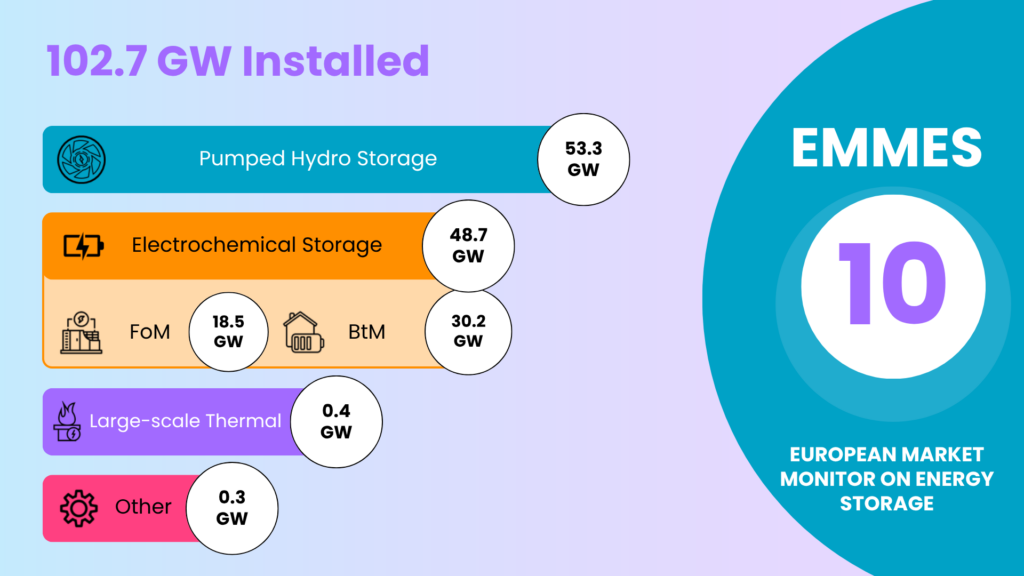
In 2025, Europe surpassed 100 GW of installed storage capacity for the first time, and by Q2 2026 storage overtook nuclear as a source of installed power capacity. With electrochemical storage forecast to grow by a further 153 GW by 2030, energy storage is becoming a core pillar of Europe's future electricity system.
In 2025, Europe surpassed 100 GW of installed storage capacity for the first time, and by Q2 2026 storage overtook nuclear as a source of installed power capacity. With electrochemical storage forecast to grow by a further 153 GW by 2030, energy storage is becoming a core pillar of Europe's future electricity system.