The Energy Storage Europe Association (previously EASE) has prepared a position paper on the proposal of the Energy Market Design revision, by outlining the key position of the Energy Storage Europe Association on how to enhance the proposal and make non-fossil flexibility a central component of the new decarbonised energy system. On March 14, 2023, the European Commission released a proposed reform of the Electricity Market Design, which has the potential to significantly impact the energy storage sector.
July 2023 / Consultations & Advocacy
Call for Evidence Feedback on the EU Climate Target for 2040
The Energy Storage Europe Association (previously EASE) has prepared a reply to the European Commission's Public Consultation on the EU Climate Targets for 2040 that aims to gather inputs on the EU’s intermediary climate targets for 2040 by 24 June 2023. The Call for Evidence Feedback will inform a detailed impact assessment in view of drafting a law proposal.
The EU Climate Law requires the European Commission to propose a 2040 climate target in 2024. The Commission recognises that the 2030 and 2050 targets need to be supported by an intermediary target to improve their chances of being met. The objective is to provide certainty for stakeholders to meet the requirements and inform their strategic and investment decisions in light of a reaffirmed EU commitment to the fight against climate change. With the COP29 of 2025 closing in, European policymakers and Member States are keen to communicate their renewed climate ambitions, and to strengthen the regulatory framework for consistent measures to be implemented towards achieving the EU’s climate goals.
The Energy Storage Europe Association (previously EASE) believes it is paramount to support the highest-ambition climate targets for 2040 (“more than -90% emissions reduction”). This should be done for two reasons.
Firstly, by adopting very high targets, the EU will strengthen its fight against climate change and smoothen the transition to a sustainable, decarbonised energy system. Such targets attract investments that facilitate the deployment of renewables and energy storage solutions necessary for a decarbonised Europe.
Secondly, the adoption of a high-ambition intermediary 2040 target will effectively provide greater incentives for Member States to achieve the 2030 and 2050 climate targets. A low-ambition intermediary 2040 target may potentially be used as a reason to delay needed investments to meet the 2030 targets.
Importantly, these intermediary targets must be rooted in scientific evidence and take into account the potential economic, social, and technological implications. Conducting thorough research and impact assessments is necessary to ensure citizens’ and Industry’s trust in European Union policymakers.
The Energy Storage Europe Association (previously EASE) has prepared a position paper on the proposal of the Energy Market Design revision, by outlining the key position of the Energy Storage Europe Association on how to enhance the proposal and make non-fossil flexibility a central component of the new decarbonised energy system. On March 14, 2023, the European Commission released a proposed reform of the Electricity Market Design, which has the potential to significantly impact the energy storage sector.
Not a member yet ?
Explore the benefits of joining Energy Storage Europe
Energy Storage Europe replies to the European Commission’s public consultation on the Methodology for the Calculation of the recycled content of industrial and EV batteries. Under the Batteries Regulation, several categories of batteries, including industrial batteries, will have to contain a certain percentage of recycled metals to be allowed to be placed on the EU market.
Energy Storage Europe welcomes the proposed revision of the Network Code for generators and the explicit integration of storage, including grid-forming capabilities. Further clarity is needed on requirements for bidirectional storage and the treatment of existing projects.
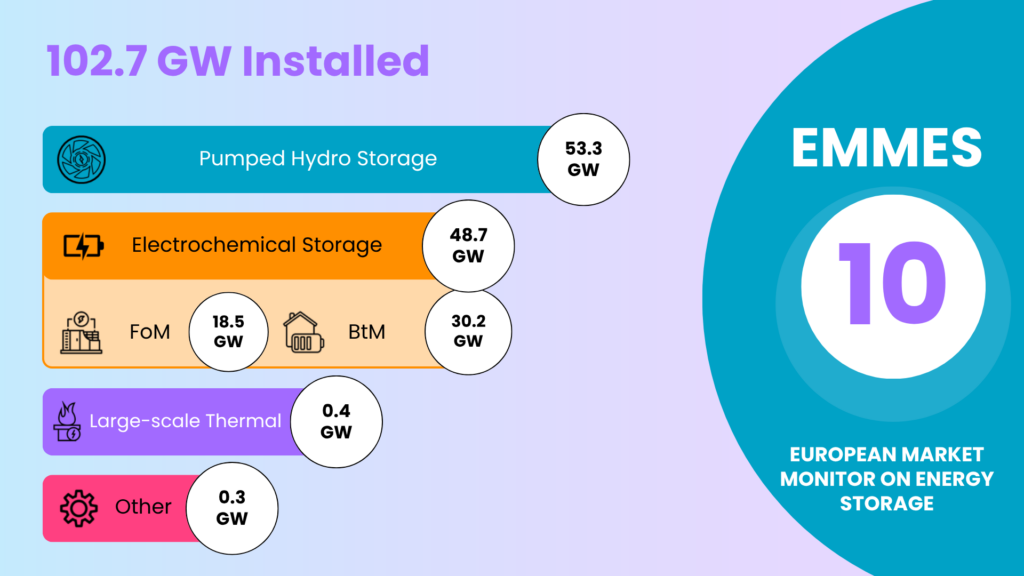
In 2025, Europe surpassed 100 GW of installed storage capacity for the first time, and by Q2 2026 storage overtook nuclear as a source of installed power capacity. With electrochemical storage forecast to grow by a further 153 GW by 2030, energy storage is becoming a core pillar of Europe's future electricity system.
In 2025, Europe surpassed 100 GW of installed storage capacity for the first time, and by Q2 2026 storage overtook nuclear as a source of installed power capacity. With electrochemical storage forecast to grow by a further 153 GW by 2030, energy storage is becoming a core pillar of Europe's future electricity system.