March 2021 / Policy Papers - Responses to Public Consultations
Reply to the Public Consultation on the Batteries Regulation Proposal
EASE has provided a response to the European Commission's Public Consultation on the new Batteries Regulation proposed on 10 December 2020. This Regulation aims to ensure that batteries placed in the EU market are sustainable and safe throughout their entire life cycle.
EASE prepared a reply to this consultation to further improve the Batteries Regulation in a way that is favourable to the energy storage sector. EU law aims to minimise batteries' harmful effects on the environment. The rules cover their full life cycle, from design & production to reuse & recycling. In line with the Green Deal and other sustainability-related policies, this initiative would update EU rules to ensure:
all batteries are produced sustainably (i.e. with low resource consumption and little waste generated) and can be easily recycled
any batteries used in the growing market for electric vehicles are sustainable.
EASE welcomes the proposal for the Batteries Regulation: although several criticalities are present, it is a step forward to tackle several of the barriers that currently hinder the battery market. EASE believes creating a level-playing field is key. Some of the Proposal provisions go in this sense - e.g., the recognition that different types of batteries are needed. In other articles, the focus seemed to lie on specific battery solutions, e.g. the ones currently leading the market, therefore not adopting a technology-neutral approach, with the risk of hampering innovation and competition.
Energy Storage Europe welcomes the European Commission's growing focus on cybersecurity in the energy sector and supports the direction of travel across the Cyber Resilience Act (CRA), the Network Code on Cybersecurity, and the proposed Cybersecurity Act (CSA) 2.0. Yet raises concerns that require targeted corrections to ensure these frameworks deliver on their security objectives without inadvertently slowing battery storage deployment.
Energy Storage Europe replies to the European Commission’s public consultation on the Methodology for the Calculation of the recycled content of industrial and EV batteries. Under the Batteries Regulation, several categories of batteries, including industrial batteries, will have to contain a certain percentage of recycled metals to be allowed to be placed on the EU market.
Energy Storage Europe welcomes the proposed revision of the Network Code for generators and the explicit integration of storage, including grid-forming capabilities. Further clarity is needed on requirements for bidirectional storage and the treatment of existing projects.
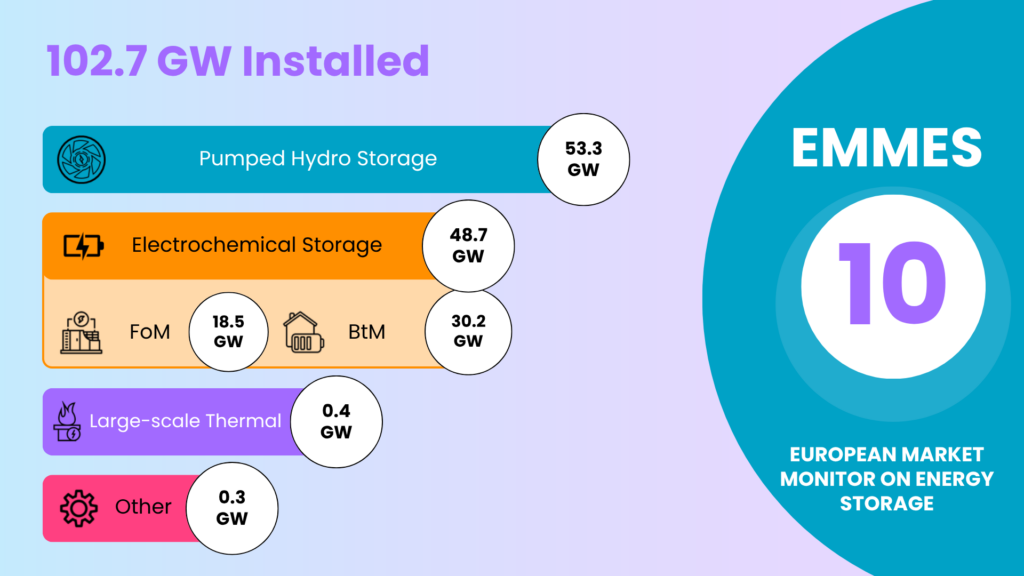
In 2025, Europe surpassed 100 GW of installed storage capacity for the first time, and by Q2 2026 storage overtook nuclear as a source of installed power capacity. With electrochemical storage forecast to grow by a further 153 GW by 2030, energy storage is becoming a core pillar of Europe's future electricity system.