EASE has prepared an overview of the upcoming and existing key policy and actions of Spain, the Netherlands and Germany to support the uptake of hydrogen and Power-to-Gas solutions.
March 2021 / Market Analyses
EMMES 5.0 - March 2021
EASE and Delta-ee are pleased to announce the publication of the fifth edition of the European Market Monitor on Energy Storage (EMMES).
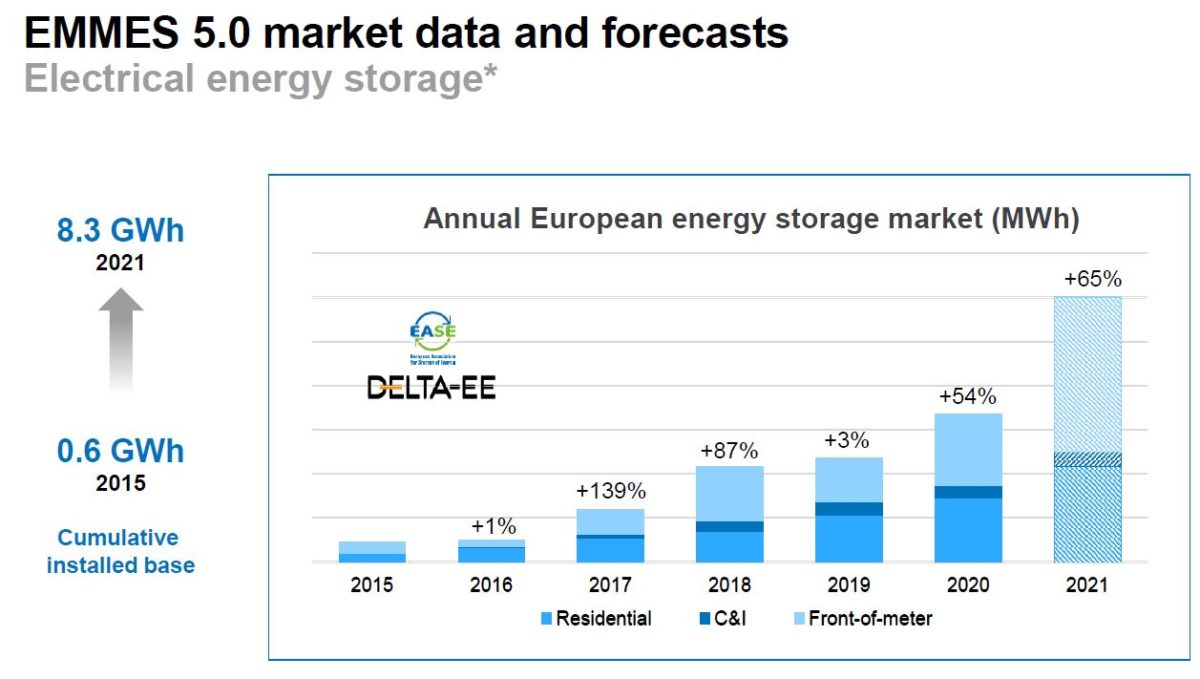
The report reveals the effects of the pandemic on the energy storage market, with lockdown affecting commercial and industrial, and behind-the-meter segments, while front-of-meter projects proved more resilient. Looking ahead, 2021 looks particularly strong for the sector with new ancillary services opening across Europe and national targets further supporting regional projects.
EMMES 5.0 shows that:
The European annual energy storage market grew to 1.7 GWh in 2020, with a cumulative installed base of 5.4 GWh across all segments.
The total annual energy storage market in Europe is expected to reach 3,000 MWh in 2021, almost double the annual storage deployments seen in 2020.
EASE has prepared an overview of the upcoming and existing key policy and actions of Spain, the Netherlands and Germany to support the uptake of hydrogen and Power-to-Gas solutions.
Not a member yet ?
Explore the benefits of joining Energy Storage Europe
Energy Storage Europe replies to the European Commission’s public consultation on the Methodology for the Calculation of the recycled content of industrial and EV batteries. Under the Batteries Regulation, several categories of batteries, including industrial batteries, will have to contain a certain percentage of recycled metals to be allowed to be placed on the EU market.
Energy Storage Europe welcomes the proposed revision of the Network Code for generators and the explicit integration of storage, including grid-forming capabilities. Further clarity is needed on requirements for bidirectional storage and the treatment of existing projects.
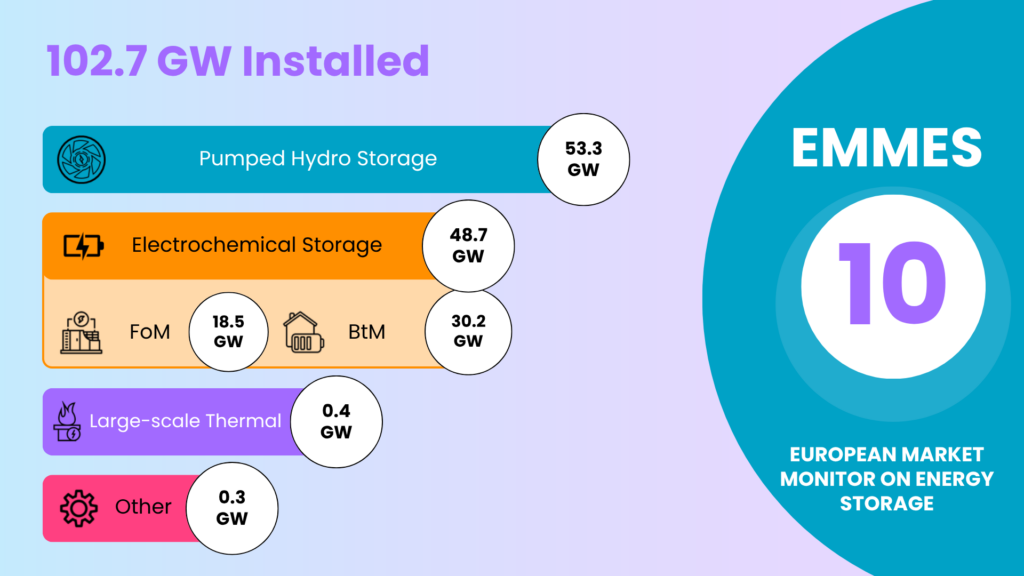
In 2025, Europe surpassed 100 GW of installed storage capacity for the first time, and by Q2 2026 storage overtook nuclear as a source of installed power capacity. With electrochemical storage forecast to grow by a further 153 GW by 2030, energy storage is becoming a core pillar of Europe's future electricity system.
In 2025, Europe surpassed 100 GW of installed storage capacity for the first time, and by Q2 2026 storage overtook nuclear as a source of installed power capacity. With electrochemical storage forecast to grow by a further 153 GW by 2030, energy storage is becoming a core pillar of Europe's future electricity system.