EASE has compiled analyses of measures for energy storage in the draft updated NECPs to point out their strengths and weaknesses, based upon the Commission’s Recommendations for Energy Storage.
March 2024 / Market Analyses
EMMES 8.0 - March 2024
EASE and LCP-Delta are pleased to announce the publication of the eighthedition of the European Market Monitor on Energy Storage (EMMES).
The Market Monitor is an interactive database that tracks over 3,000 energy storage projects. With information on assets in over 29 countries, it is the largest and most detailed archive of European storage. The database is accompanied by a report which outlines key EU legislation, drivers and barriers for 14 core countries. The report looks at the electrical energy storage market, providing data and analysis across 3 market segments (residential, commercial & industrial and Front of the Meter) with updated project data based on StoreTrack database and a forecast towards 2030.
Key takeaways from the EMMES 8.0:
Demand for storage is bigger than ever: about 10GW of new installations in 2023, of which 7GW are BtM and 3GW are FoM storage power capacity.
EMMES assess that the installed base will grow 6 times in terms of power capacity.
Both, the support schemes and improved market conditions are the drivers behind the impressive deployment results. Interestingly, the average storage duration of projects is also rising - 2-hour projects have become more common, and 4-hour durations are expected in the short-term future across Europe.
The UK, Germany and Italy are once more the leading markets for both BtM and FoM storage capacity. The situation is expected to remain unchanged in the years to come.
Recording of the EMMES 8.0 launch webinar "Europe's Energy Storage Ambition: Charging Towards 2030 Targets" is available here.
EASE has compiled analyses of measures for energy storage in the draft updated NECPs to point out their strengths and weaknesses, based upon the Commission’s Recommendations for Energy Storage.
Not a member yet ?
Explore the benefits of joining Energy Storage Europe
Energy Storage Europe replies to the European Commission’s public consultation on the Methodology for the Calculation of the recycled content of industrial and EV batteries. Under the Batteries Regulation, several categories of batteries, including industrial batteries, will have to contain a certain percentage of recycled metals to be allowed to be placed on the EU market.
Energy Storage Europe welcomes the proposed revision of the Network Code for generators and the explicit integration of storage, including grid-forming capabilities. Further clarity is needed on requirements for bidirectional storage and the treatment of existing projects.
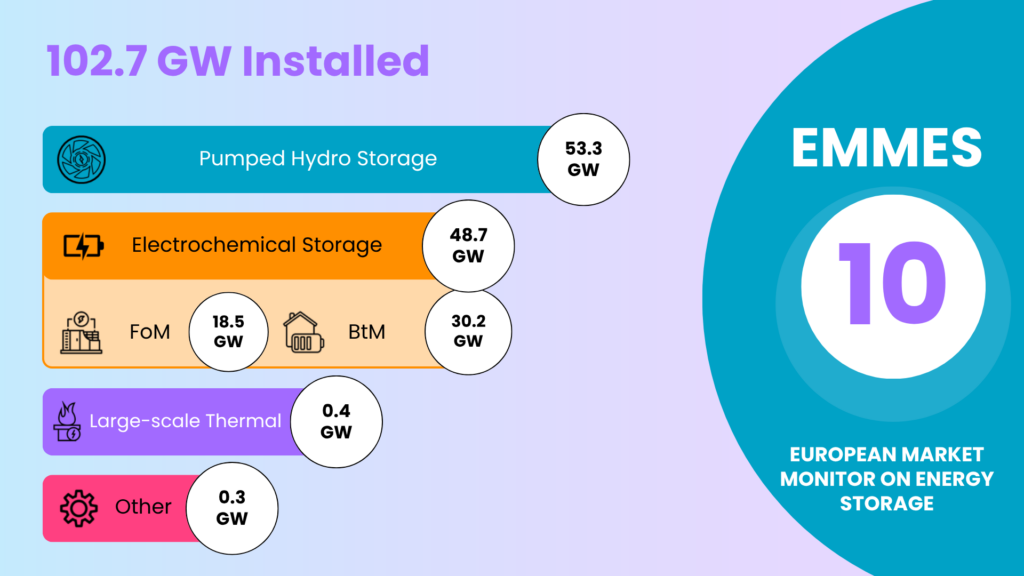
In 2025, Europe surpassed 100 GW of installed storage capacity for the first time, and by Q2 2026 storage overtook nuclear as a source of installed power capacity. With electrochemical storage forecast to grow by a further 153 GW by 2030, energy storage is becoming a core pillar of Europe's future electricity system.
In 2025, Europe surpassed 100 GW of installed storage capacity for the first time, and by Q2 2026 storage overtook nuclear as a source of installed power capacity. With electrochemical storage forecast to grow by a further 153 GW by 2030, energy storage is becoming a core pillar of Europe's future electricity system.