Energy Storage Europe Association reply to ENTSO-E’s Public Consultation on the 10-Year Network Development Plan (TYNDP) calls for a more balanced consideration of energy storage technologies and a clearer breakdown of the economic impacts and costs of proposed scenarios.
March 2025 / Market Analyses
EMMES 9.0 - March 2025
The ninth edition of the European Market Monitor on Energy Storage (EMMES) by the European Association for Storage of Energy (EASE) and LCP Delta, is now available, highlighting Europe's rapid expansion in energy storage capacity, which reached 89 gigawatts (GW) by the end of 2024. The report also projects continued strong growth through 2030, driven by technological advancements, policy support, and other key factors.
The Market Monitor is an interactive database that tracks over 3,000 energy storage projects. With information on assets from over 27 countries, making it the most comprehensive archive of European storage. The database is continuously updated, with the latest project data accessible online via the StoreTrack dashboard, featuring forecasts extending to 2030. Covering all storage technologies, this edition introduces fully revamped datasets for battery storage, thermal energy storage, and pumped hydro storage.
Accompanying the database is a detailed report offering in-depth market and policy analysis for 15 core countries. The report provides insights into the energy storage landscape, with data and analysis across 3 market segments: residential, commercial & industrial, and utility-scale storage.
Key takeaways from the EMMES 9.0:
2024 has been a record year for energy storage deployment.
89 GW of energy storage capacity is currently installed across various technologies in Europe.
In 2024, new installations led to 60% MW/ 280% MWh increase in Front-of-the-Meter storage capacity.
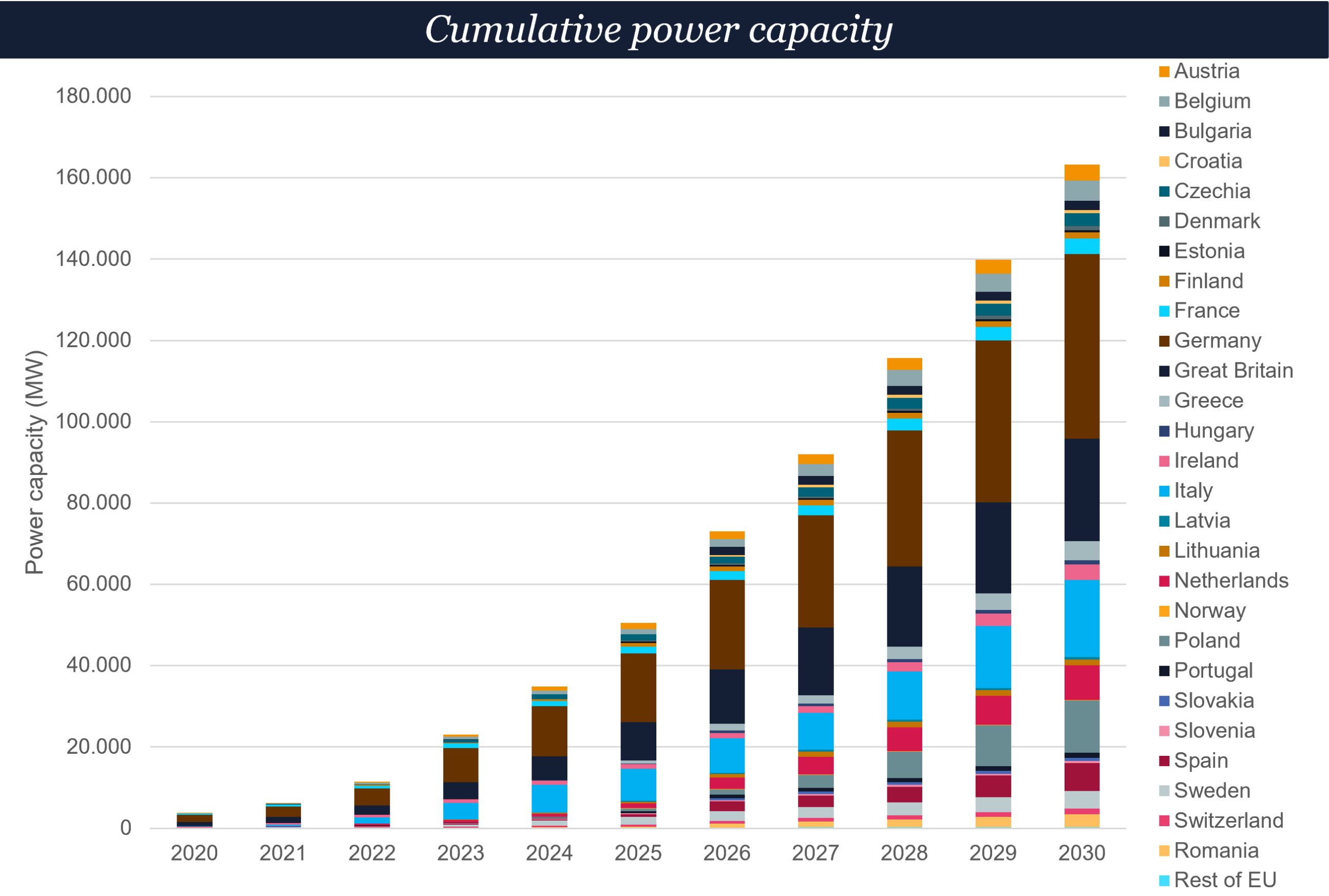
By 2030, an additional 128 GW / 300 GWh of electrochemical storage is projected to be added to European grids.
Co-location with renewables is on the rise, with strong capacity growth expected by 2030.
Recording of the EMMES 9.0 launch webinar "Between New State Aid and More Rules: The Clean Industrial Deal and Energy Storage" is available here.
Energy Storage Europe Association reply to ENTSO-E’s Public Consultation on the 10-Year Network Development Plan (TYNDP) calls for a more balanced consideration of energy storage technologies and a clearer breakdown of the economic impacts and costs of proposed scenarios.
Not a member yet ?
Explore the benefits of joining Energy Storage Europe
Energy Storage Europe replies to the European Commission’s public consultation on the Methodology for the Calculation of the recycled content of industrial and EV batteries. Under the Batteries Regulation, several categories of batteries, including industrial batteries, will have to contain a certain percentage of recycled metals to be allowed to be placed on the EU market.
Energy Storage Europe welcomes the proposed revision of the Network Code for generators and the explicit integration of storage, including grid-forming capabilities. Further clarity is needed on requirements for bidirectional storage and the treatment of existing projects.
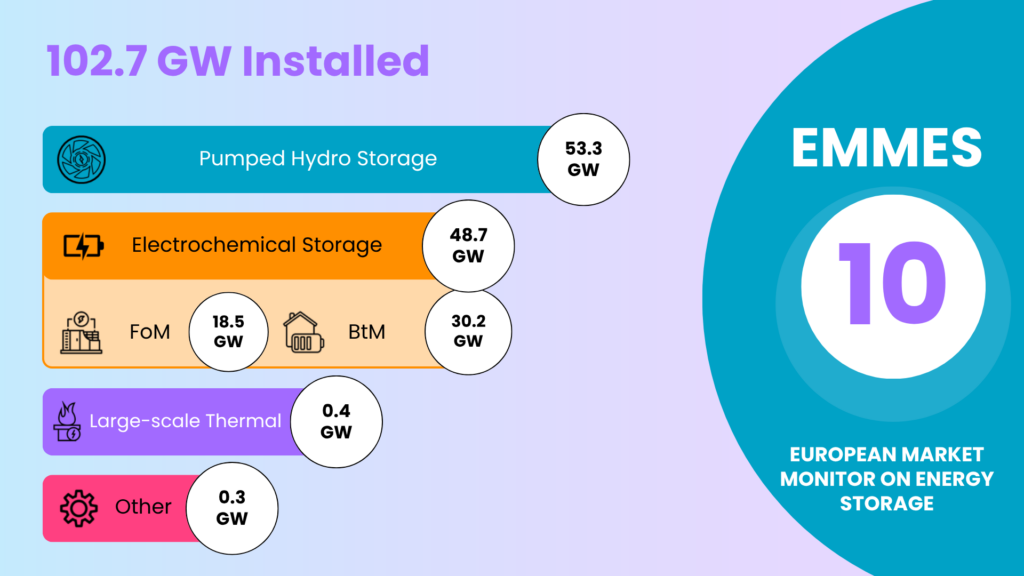
In 2025, Europe surpassed 100 GW of installed storage capacity for the first time, and by Q2 2026 storage overtook nuclear as a source of installed power capacity. With electrochemical storage forecast to grow by a further 153 GW by 2030, energy storage is becoming a core pillar of Europe's future electricity system.
In 2025, Europe surpassed 100 GW of installed storage capacity for the first time, and by Q2 2026 storage overtook nuclear as a source of installed power capacity. With electrochemical storage forecast to grow by a further 153 GW by 2030, energy storage is becoming a core pillar of Europe's future electricity system.