How can Europe simultaneously ensure energy security, embrace the sustainability challenge, and lead in innovation?
What if there's a key to unlocking a resilient future for our Union?
This spring, European citizens are called to shape the vision of the next 5 years.
Against the backdrop of importing nearly 60% of its energy, Europe has yet to achieve true strategic autonomy. Recent geopolitical events, particularly Russia's invasion of Ukraine, have led to soaring energy prices, calling for a revaluation of energy markets and a strengthening of Europe’s energy security.
The energy price spikes in 2021 and 2022 have shown that industrial competitiveness and economic growth are interlinked with energy policy. European industries were confronted with elevated and volatile prices, whereas competitors abroad enjoyed the advantage of lower electricity costs. Regrettably, energy expenses for consumers have also surged, causing further economic strain across society.
The European Union, despite its ambitious initiatives like the European Green Deal, faces challenges in meeting its 2030 climate targets. Without stronger policies encouraging investments in cleantech, the EU risks missing its climate objectives.
In light of these interconnected challenges, such as energy security, economic growth, consumer protection, and climate change, energy storage emerges as a crucial tool to address these issues. This manifesto outlines four key goals and corresponding actions that prioritise energy storage, positioning it at the forefront of Europe’s energy system.
1.
Accelerate regulatory changes in Member States to eliminate persistent barriers. Ensure ambitious National Energy and Climate Plans, in line with EU’s Recommendations on storage.
Fully implement the Clean Energy Package, and swiftly transpose the Electricity Market Design.
Address the legal ambiguities in the Clean Energy Package. For example, clarify that the same energy storage facility can be used by different actors for different services, stacking revenues and improving social welfare.
2.
Develop an energy storage strategy to underscore political commitment and stimulate investments.
Address the coherence and complementarity of the tools and support schemes for storage that are leveraged by Member States – e.g. Auctions, Contract for Differences, and Capacity Markets.
Clarify how state aid for manufacturing and deployment of energy storage should be aligned in terms of policy priorities.
3.
Align the EU Heating and Cooling Strategy with the climate and energy security imperatives. This incentivises renewable and clean technologies such as energy storage for households and Industry.
4.
Accelerate the transition to climate neutrality by swiftly writing into law the proposed emissions reduction target by 2040 – therefore catalysing investments that facilitate the deployment of renewables and energy storage.
5.
Introduce new market products and develop local flexibility markets. This integrates new renewable sources, limits curtailment, and solves network constraints and congestion in a cost-efficient manner.
6.
Ensure fair grid fees, charges and eliminate double taxation for energy storage. Energy storage’s positive effects to the grid should be taken into account.
Conclusion
In closing, this manifesto underscores the critical role of energy storage in shaping a resilient future for Europe. The transformative power of energy storage emerges as the key to simultaneously ensuring a carbon-free planet, bolstering energy security, lowering energy bills, and enhancing competitiveness for industries.
In essence, this manifesto calls for a comprehensive EU strategy on energy storage. Vital for independence and security, energy storage not only fortifies our grid against climate challenges but also emerges as a practical and cost-effective solution to replace polluting capacity and use more home grown renewables. By accelerating decarbonisation through innovative storage solutions, we ensure a cleaner, more flexible, and secure energy future for Europe.
Let's accelerate decarbonisation with innovative storage solutions, leading Europe toward a resilient future!
Energy Storage Europe replies to the European Commission’s public consultation on the Methodology for the Calculation of the recycled content of industrial and EV batteries. Under the Batteries Regulation, several categories of batteries, including industrial batteries, will have to contain a certain percentage of recycled metals to be allowed to be placed on the EU market.
Energy Storage Europe welcomes the proposed revision of the Network Code for generators and the explicit integration of storage, including grid-forming capabilities. Further clarity is needed on requirements for bidirectional storage and the treatment of existing projects.
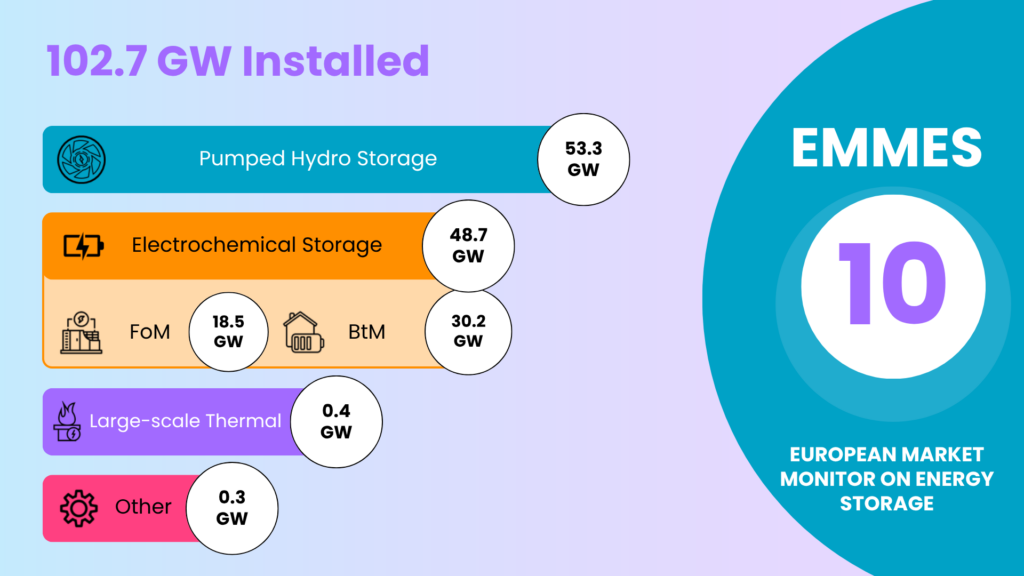
In 2025, Europe surpassed 100 GW of installed storage capacity for the first time, and by Q2 2026 storage overtook nuclear as a source of installed power capacity. With electrochemical storage forecast to grow by a further 153 GW by 2030, energy storage is becoming a core pillar of Europe's future electricity system.
In 2025, Europe surpassed 100 GW of installed storage capacity for the first time, and by Q2 2026 storage overtook nuclear as a source of installed power capacity. With electrochemical storage forecast to grow by a further 153 GW by 2030, energy storage is becoming a core pillar of Europe's future electricity system.