EASE has responded to the European Commission's Public Consultation on 'Renewable Energy Projects - Permit-Granting Processes & Power Purchase Agreements . This initiative aims to facilitate renewable energy production projects. It will focus on the key barriers to implementing renewable energy projects and outline good practices addressing the identified barriers and good practices to facilitate power-purchase agreements, including across borders.
June 2022 / Reports and Studies
Energy Storage Targets 2030 and 2050
EASE has published an extensive review study for estimating Energy Storage Targets for 2030 and 2050which will drive thenecessary boost in storage deployment urgently needed today. Current market trajectories for storage deployment are significantly underestimating the system needs for energy storage. If we continue at historic deployment rates Europe will not be able to integrate the rapidly growing renewables and will fall short of its 2030 and 2050 climate targets.
In this report we highlight a number of areas in which storage needs are underestimated and find that many studies do not address all key energy storage technologies and durations, often undervaluing low emission technologies and energy shifting resources and overvaluing the use of fossil fuel plants especially in the 2030-time horizon. Furthermore, storage needs must be aligned with existing climate targets today especially as storage is a key enabler for the accelerated renewable buildout foreseen in Europe.
We account for these points in our target estimates for 2030 and 2050 and based on our analysis storage deployment needs to ramp-up to at least 14 GW/year in order to meet a target of approx. 200 GW by 2030.By 2050 at least 600 GW storage will be needed in the energy system, with over two-thirds of this being provided by energy shifting technologies (power-to-X-to-power). Our report is an important source of information for informing key assumptions for storage in future energy system planning.
Energy storage needs to become a political priority alongside renewables, without a parallel storage strategy and scaling up of market-ready energy storage technologies, the EU will be unable to achieve a net-zero power system, risking continued exposure to volatile fossil energy markets. We emphasisethese key priorities for storage:
A clear political commitment from the European Commission on an energy storage strategy including energy storage targets replicating in scope and ambition the Hydrogen strategy.
Promote the uptake of energy storage technologies, providing clear signals to investors and the energy storage industry to drive the necessary scale-up of storage solutions and a commitment to remove still existing barriers to their deployment and operation.
Mainstream energy storage in the European Commission’s implementation of the REPowerEU action plan and in the ongoing review of the Electricity Market Design.
EASE has responded to the European Commission's Public Consultation on 'Renewable Energy Projects - Permit-Granting Processes & Power Purchase Agreements . This initiative aims to facilitate renewable energy production projects. It will focus on the key barriers to implementing renewable energy projects and outline good practices addressing the identified barriers and good practices to facilitate power-purchase agreements, including across borders.
Not a member yet ?
Explore the benefits of joining Energy Storage Europe
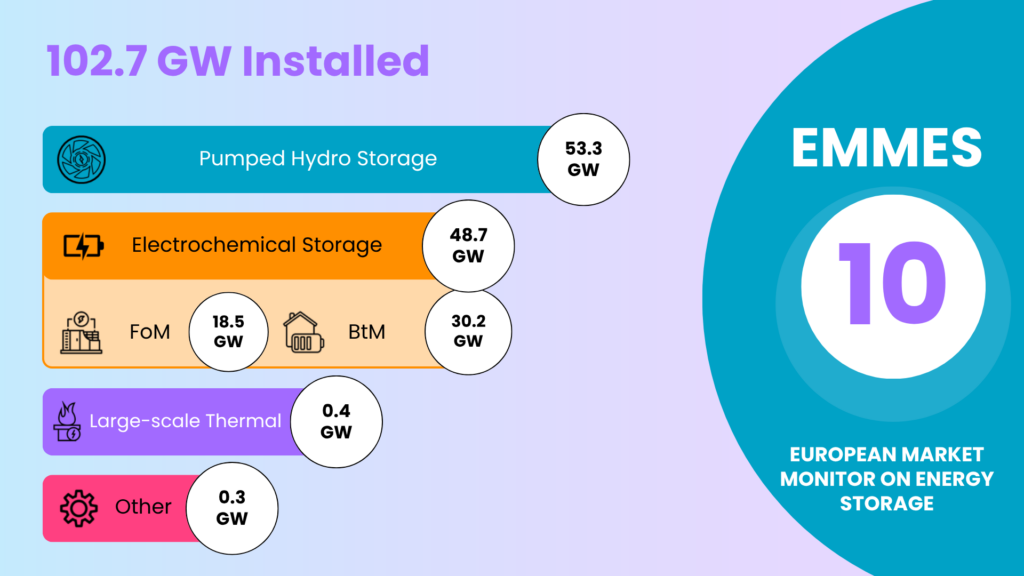
In 2025, Europe surpassed 100 GW of installed storage capacity for the first time, and by Q2 2026 storage overtook nuclear as a source of installed power capacity. With electrochemical storage forecast to grow by a further 153 GW by 2030, energy storage is becoming a core pillar of Europe's future electricity system.
In 2025, Europe surpassed 100 GW of installed storage capacity for the first time, and by Q2 2026 storage overtook nuclear as a source of installed power capacity. With electrochemical storage forecast to grow by a further 153 GW by 2030, energy storage is becoming a core pillar of Europe's future electricity system.
Thermal Energy Storage can help European industry decarbonise, reduce costs, and access new revenue streams. Yet significant regulatory, economic, and financial barriers continue to limit its deployment.
Energy Storage Europe welcomes the proposal for an Industrial Accelerator Act (IAA) and supports its overall objective of strengthening industrial capacity, accelerating decarbonisation, and creating stronger lead markets for strategic clean technologies in the European Union.