EASE welcomes the proposal for the new Batteries Regulation proposed by the European Commission on 10 December 2020. Although several criticalities are present, the new Regulation is a step forward to tackle several of the barriers that currently hinder the battery market.
May 2021 / Event Reports
The Role of Energy Storage in the Renovation Wave
On 22 April 2021, over 90 participants attended the workshop on the role of energy storage in the Renovation Wave. In October 2020, the European Commission launched its Renovation Wave strategy, to increase the energy renovation rate of buildings and significantly improve the overall energy performance of the EU building sector. This strategy brings opportunities for the energy storage sector, considering the invaluable role of energy storage for energy efficiency.
The workshop was kicked off with a presentation giving a comprehensive overview of the Renovation Wave from Nina Neumann – Legislative Development and Enforcement Team Leader in DG Energy Unit B3 in the European Commission.
Energy community and thermal energy storage are two of the solutions contributing to the goal of the Renovation Wave and were presented in the workshop. For the first presentation showcasing projects from the energy storage industry, Luigi Lanuzza, Head of B2C and B2B Innovation Factory at Enel X, presented an overview of Enel’s projects on Energy Communities. Mr Lanuzza described how the energy sector is changing towards decarbonisation from the utility’s point of view, and how value is shifting from commodity to services. The second presentation from the energy storage industry was given by Ruud Cuypers, Senior Scientist and Program Manager for Thermal Energy Storage at TNO, who provided 2 examples of TNO’s projects on thermal energy storage based on thermochemical materials.
The key takeaways of the event were presented by Ms Beatriz Sinobas, Energy Security and Electricity Team Leader at DG Energy Unit B4, the European Commission, concluding that the Renovation Wave is now in full rollout, and its success is necessary to meet EU climate targets.
EASE welcomes the proposal for the new Batteries Regulation proposed by the European Commission on 10 December 2020. Although several criticalities are present, the new Regulation is a step forward to tackle several of the barriers that currently hinder the battery market.
Not a member yet ?
Explore the benefits of joining Energy Storage Europe
Energy Storage Europe replies to the European Commission’s public consultation on the Methodology for the Calculation of the recycled content of industrial and EV batteries. Under the Batteries Regulation, several categories of batteries, including industrial batteries, will have to contain a certain percentage of recycled metals to be allowed to be placed on the EU market.
Energy Storage Europe welcomes the proposed revision of the Network Code for generators and the explicit integration of storage, including grid-forming capabilities. Further clarity is needed on requirements for bidirectional storage and the treatment of existing projects.
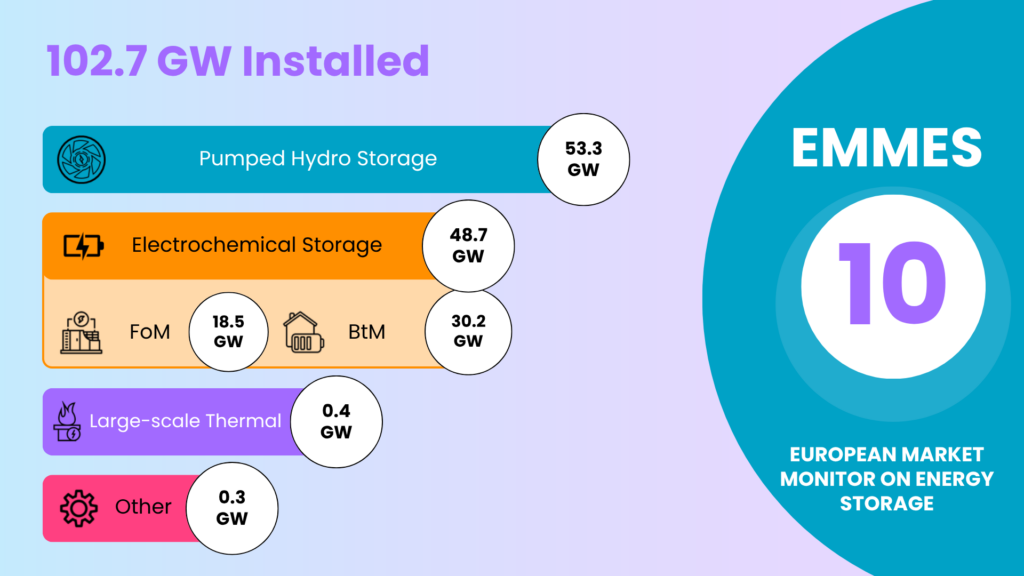
In 2025, Europe surpassed 100 GW of installed storage capacity for the first time, and by Q2 2026 storage overtook nuclear as a source of installed power capacity. With electrochemical storage forecast to grow by a further 153 GW by 2030, energy storage is becoming a core pillar of Europe's future electricity system.
In 2025, Europe surpassed 100 GW of installed storage capacity for the first time, and by Q2 2026 storage overtook nuclear as a source of installed power capacity. With electrochemical storage forecast to grow by a further 153 GW by 2030, energy storage is becoming a core pillar of Europe's future electricity system.