The European Commission announced in its 2021 Working Programme that the Third Gas Package will be revised to regulate competitive decarbonised gas markets: EASE believes that energy storage solutions as Hydrogen and Power-to-Gas will play a key role in the transition of the gas system, and sees the proposed revision as a great opportunity to enhance sector integration as well as the deployment of renewable carbon gases.
November 2021 / Campaigns
#EnergyStorageMadeEasy
EASE believes that energy storage is an essential enabler of the energy transition and recognises all technologies that support this transition. The #EnergyStorageMadeEasy Campaign aimed to raise awareness on the variety of energy storage technologies available and present inthe EASE technology sheets.
The Association's members represent different aspects of the energy storage sector and they ultimately work together to support different energy storage solution development and deployment across the EU in order to provide flexibility in different locations and at different timescales. It is important to recognise that different energy storage systems consider different technological possibilities, which EASE organises in 5 energy storage classes:
Chemical
Electrochemical
Electrical
Mechanical
Thermal
Over the period of five weeks, a variety of information on all technology groups was shared with the public through EASE's Twitter and LinkedIn platforms. By sharing different information materials, videos, images and articles on technology groups, the #EnergyStorageMadeEasy campaign successfully interacted with EASE's followers and reached new audiences.
The European Commission announced in its 2021 Working Programme that the Third Gas Package will be revised to regulate competitive decarbonised gas markets: EASE believes that energy storage solutions as Hydrogen and Power-to-Gas will play a key role in the transition of the gas system, and sees the proposed revision as a great opportunity to enhance sector integration as well as the deployment of renewable carbon gases.
Not a member yet ?
Explore the benefits of joining Energy Storage Europe
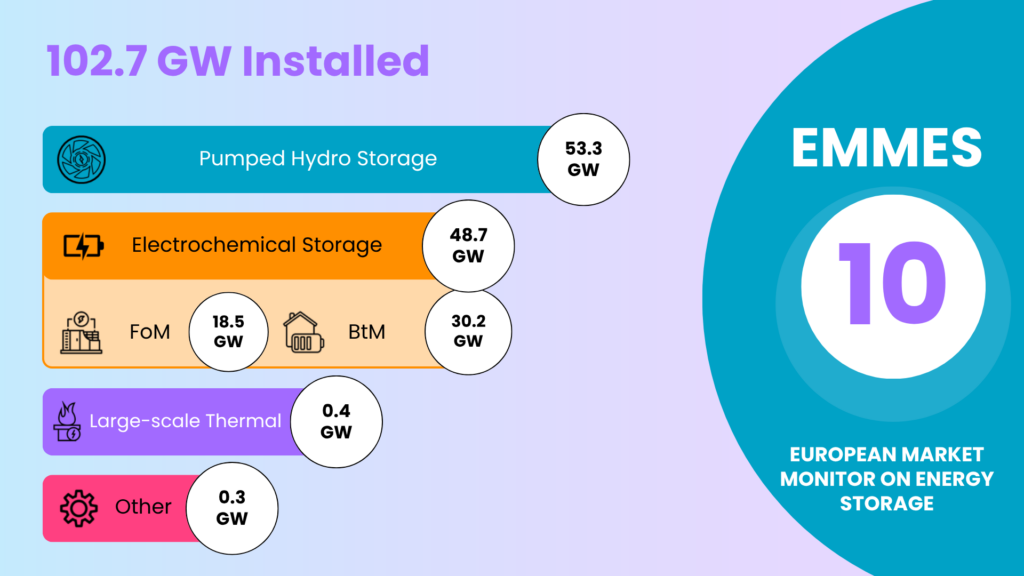
In 2025, Europe surpassed 100 GW of installed storage capacity for the first time, and by Q2 2026 storage overtook nuclear as a source of installed power capacity. With electrochemical storage forecast to grow by a further 153 GW by 2030, energy storage is becoming a core pillar of Europe's future electricity system.
In 2025, Europe surpassed 100 GW of installed storage capacity for the first time, and by Q2 2026 storage overtook nuclear as a source of installed power capacity. With electrochemical storage forecast to grow by a further 153 GW by 2030, energy storage is becoming a core pillar of Europe's future electricity system.
Thermal Energy Storage can help European industry decarbonise, reduce costs, and access new revenue streams. Yet significant regulatory, economic, and financial barriers continue to limit its deployment.
Energy Storage Europe welcomes the proposal for an Industrial Accelerator Act (IAA) and supports its overall objective of strengthening industrial capacity, accelerating decarbonisation, and creating stronger lead markets for strategic clean technologies in the European Union.