EASE submitted a response to the to ENTSO-E stakeholder consultation on the "All CE and Nordic TSOs’ results of CBA in accordance with Art.156(11) of the Commission Regulation (EU) 2017/1485 of 2 August 2017" report.
May 2020 / Policy Papers - Responses to Public Consultations
Future EU Strategy for Smart Sector Integration
EASE submitted a response to the European Commission Public Consultation on Future EU Strategy for Smart Sector Integration.
EASE believes energy storage is a key instrument enabling a smart sector integration. In order to meet the climate objectives, while also guaranteeing secure and affordable energy for consumers, it is paramount to link up the energy system with other sectors and exploit the synergies enabled through an integrated energy system.
EASE submitted a response to the to ENTSO-E stakeholder consultation on the "All CE and Nordic TSOs’ results of CBA in accordance with Art.156(11) of the Commission Regulation (EU) 2017/1485 of 2 August 2017" report.
Not a member yet ?
Explore the benefits of joining Energy Storage Europe
Energy Storage Europe replies to the European Commission’s public consultation on the Methodology for the Calculation of the recycled content of industrial and EV batteries. Under the Batteries Regulation, several categories of batteries, including industrial batteries, will have to contain a certain percentage of recycled metals to be allowed to be placed on the EU market.
Energy Storage Europe welcomes the proposed revision of the Network Code for generators and the explicit integration of storage, including grid-forming capabilities. Further clarity is needed on requirements for bidirectional storage and the treatment of existing projects.
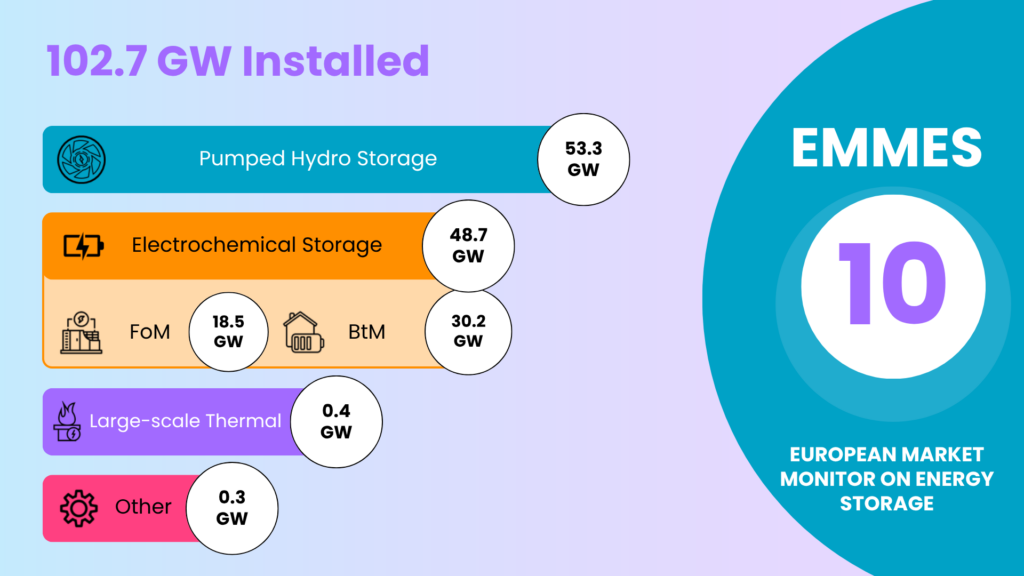
In 2025, Europe surpassed 100 GW of installed storage capacity for the first time, and by Q2 2026 storage overtook nuclear as a source of installed power capacity. With electrochemical storage forecast to grow by a further 153 GW by 2030, energy storage is becoming a core pillar of Europe's future electricity system.
In 2025, Europe surpassed 100 GW of installed storage capacity for the first time, and by Q2 2026 storage overtook nuclear as a source of installed power capacity. With electrochemical storage forecast to grow by a further 153 GW by 2030, energy storage is becoming a core pillar of Europe's future electricity system.