Energy Storage Europe Association shares key overviews on the latest publication of the European Commission’s assessment of the Member States’ updated National Energy and Climate Plans.
June 2025 / Policy Papers
Grid Fees and Network Tariffs
Energy storage is a key enabler of the European Union’s decarbonisation and energy security objectives, yet current grid fee structures often act as barriers to its deployment. This position paper outlines critical challenges related to network tariffs and charges that create market distortions and discourage much-needed investments in flexibility.
Energy Storage Europe Association calls on policymakers and regulators to urgently address these issues by ensuring a level playing field for energy storage. In particular, the paper advocates for:
The application of non-discriminatory, cost-reflective grid tariffs and levies that reflect the system benefits of flexibility providers, such as energy storage, with a preference for Time-of-Use tariffs where feasible, given their simplicity, predictability, and implementation.
The design of Time-of-Use tariffs should place particular emphasis on accurately capturing system peak periods, ensuring that storage and flexibility providers are incentivised to respond where their value is highest.
A coordinated approach to setting injection and withdrawal charges — ensuring they are designed and aligned in relation to each other in a consistent and proportionate manner — to avoid undue penalisation of flexibility providers, such as storage facilities.
Clear EU-level design of tariff methodologies for electricity network charges for Member States to improve consistency and facilitate integration of storage into the grid.
These recommendations build on existing EU commitments. The outlined reforms to grid fee structures accelerate the energy transition, unlock the full potential of energy storage and reduce network costs.
Energy Storage Europe Association shares key overviews on the latest publication of the European Commission’s assessment of the Member States’ updated National Energy and Climate Plans.
Not a member yet ?
Explore the benefits of joining Energy Storage Europe
Energy Storage Europe welcomes the European Commission's growing focus on cybersecurity in the energy sector and supports the direction of travel across the Cyber Resilience Act (CRA), the Network Code on Cybersecurity, and the proposed Cybersecurity Act (CSA) 2.0. Yet raises concerns that require targeted corrections to ensure these frameworks deliver on their security objectives without inadvertently slowing battery storage deployment.
Energy Storage Europe replies to the European Commission’s public consultation on the Methodology for the Calculation of the recycled content of industrial and EV batteries. Under the Batteries Regulation, several categories of batteries, including industrial batteries, will have to contain a certain percentage of recycled metals to be allowed to be placed on the EU market.
Energy Storage Europe welcomes the proposed revision of the Network Code for generators and the explicit integration of storage, including grid-forming capabilities. Further clarity is needed on requirements for bidirectional storage and the treatment of existing projects.
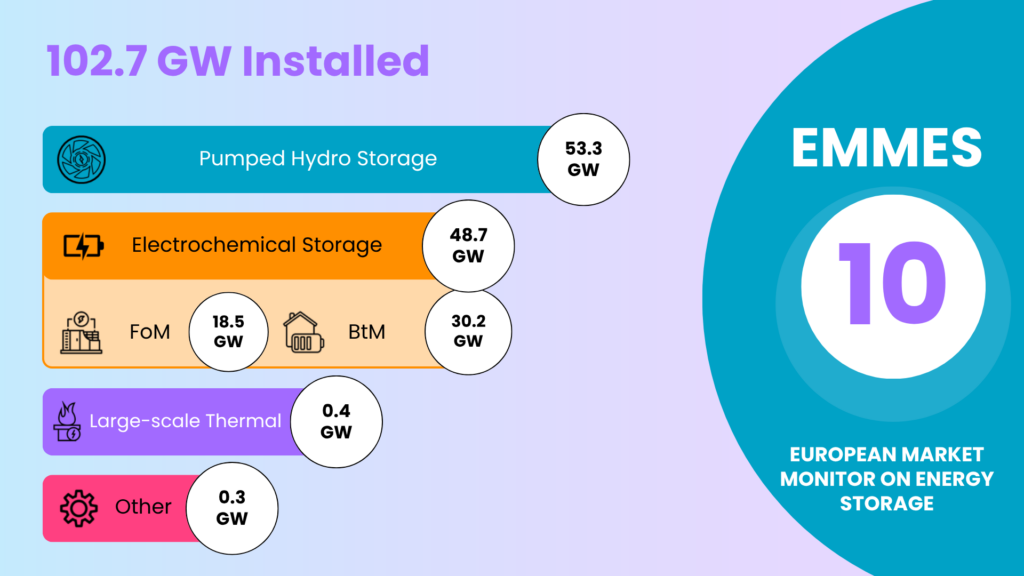
In 2025, Europe surpassed 100 GW of installed storage capacity for the first time, and by Q2 2026 storage overtook nuclear as a source of installed power capacity. With electrochemical storage forecast to grow by a further 153 GW by 2030, energy storage is becoming a core pillar of Europe's future electricity system.