On 27 May 2025, over 200 participants attended the webinar on the "EASE Guidelines on Safety Best Practices for Battery Energy Storage Systems". The Guidelines are designed to support the safe deployment of outdoor, utility-scale lithium-ion (Li-ion) BESS across Europe.
July 2025 / Consultations & Advocacy
Guidance on Grid Connections
The European Commission launched a stakeholder consultation to gather input from stakeholders on its upcoming guidance regarding grid connections in situations where capacity constraints exist. In response, Energy Storage Europe Association submitted its feedback, emphasising the growing issue of speculative and stalled projects ("ghost" or "zombie" projects) hoarding grid capacity. These projects, often immature or inactive, prevent more viable and ready-to-build projects - particularly energy storage - from connecting to the grid, slowing down the clean energy transition.
Energy Storage Europe Association supports transitioning from a “first-come, first-served” approach to a “first-ready, first-served” model, prioritising projects based on objective maturity criteria like land rights, permits, and financial closure. To further improve grid access, Energy Storage Europe Association calls for:
Milestone-based progress tracking and a use-it-or-lose-it principle to clear inactive projects from the queue.
Greater flexibility for energy storage assets and simplified modification processes for existing connections when capacity doesn’t increase.
Transparent capacity maps and queue data to improve planning and investment.
Flexible Connection Agreements (FCAs) to enable connections in congested areas, provided they are fairly designed and backed by regulatory oversight.
Energy Storage Europe Association concludes that a smarter, more transparent, and storage-friendly grid connection framework is essential to accelerate Europe’s energy transition and optimise infrastructure use.
On 27 May 2025, over 200 participants attended the webinar on the "EASE Guidelines on Safety Best Practices for Battery Energy Storage Systems". The Guidelines are designed to support the safe deployment of outdoor, utility-scale lithium-ion (Li-ion) BESS across Europe.
Not a member yet ?
Explore the benefits of joining Energy Storage Europe
Energy Storage Europe replies to the European Commission’s public consultation on the Methodology for the Calculation of the recycled content of industrial and EV batteries. Under the Batteries Regulation, several categories of batteries, including industrial batteries, will have to contain a certain percentage of recycled metals to be allowed to be placed on the EU market.
Energy Storage Europe welcomes the proposed revision of the Network Code for generators and the explicit integration of storage, including grid-forming capabilities. Further clarity is needed on requirements for bidirectional storage and the treatment of existing projects.
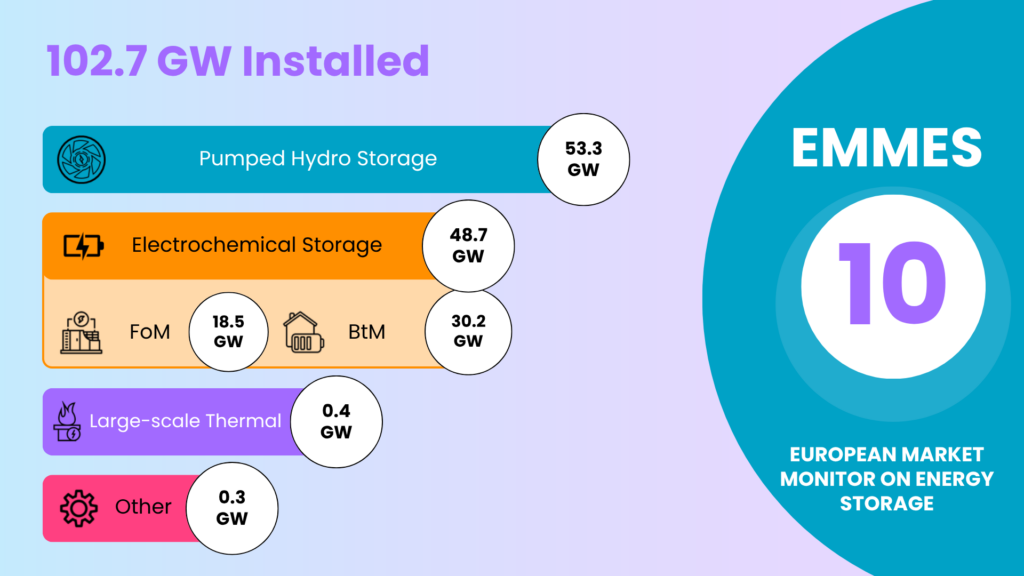
In 2025, Europe surpassed 100 GW of installed storage capacity for the first time, and by Q2 2026 storage overtook nuclear as a source of installed power capacity. With electrochemical storage forecast to grow by a further 153 GW by 2030, energy storage is becoming a core pillar of Europe's future electricity system.
In 2025, Europe surpassed 100 GW of installed storage capacity for the first time, and by Q2 2026 storage overtook nuclear as a source of installed power capacity. With electrochemical storage forecast to grow by a further 153 GW by 2030, energy storage is becoming a core pillar of Europe's future electricity system.