EASE reply to European Commission’s Public Consultation on the EU’s energy security architecture, highlights energy storage as key to a secure and resilient energy transition.
February 2025 / Consultations & Advocacy
Implementing Act on Non-Price Criteria for Renewable Energy Auctions
pre-qualification criteria on responsible business conduct, cybersecurity and data security, and the ability to deliver projects fully and on time; and
pre-qualification or award criteria to assess the auction’s sustainability and resilience contribution.
The Energy Storage Europe Association welcomes the opportunity to provide feedback on the draft Implementing Act for non-price criteria in renewable energy auctions.
EASE reply to European Commission’s Public Consultation on the EU’s energy security architecture, highlights energy storage as key to a secure and resilient energy transition.
Not a member yet ?
Explore the benefits of joining Energy Storage Europe
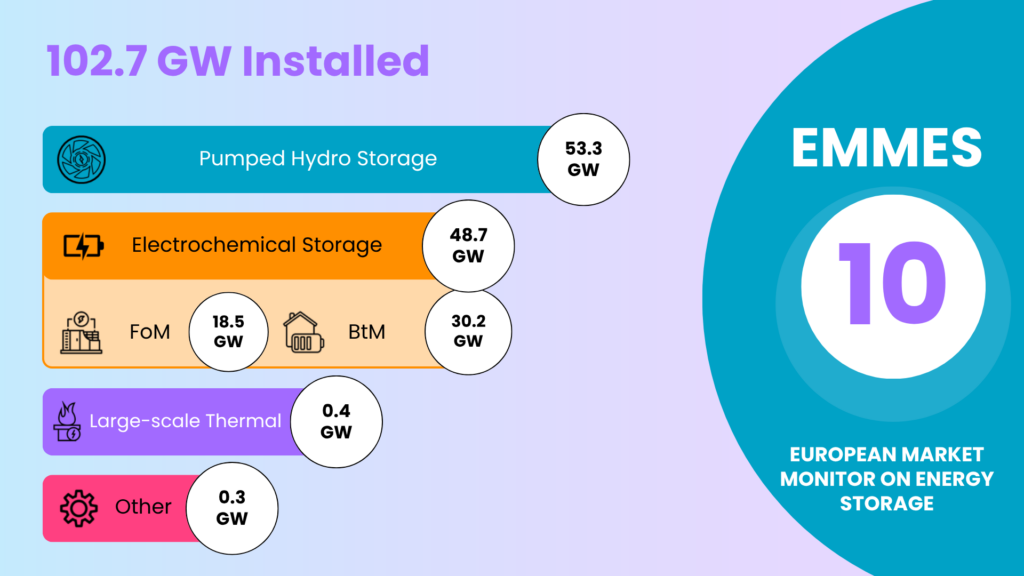
In 2025, Europe surpassed 100 GW of installed storage capacity for the first time, and by Q2 2026 storage overtook nuclear as a source of installed power capacity. With electrochemical storage forecast to grow by a further 153 GW by 2030, energy storage is becoming a core pillar of Europe's future electricity system.
In 2025, Europe surpassed 100 GW of installed storage capacity for the first time, and by Q2 2026 storage overtook nuclear as a source of installed power capacity. With electrochemical storage forecast to grow by a further 153 GW by 2030, energy storage is becoming a core pillar of Europe's future electricity system.
Thermal Energy Storage can help European industry decarbonise, reduce costs, and access new revenue streams. Yet significant regulatory, economic, and financial barriers continue to limit its deployment.
Energy Storage Europe welcomes the proposal for an Industrial Accelerator Act (IAA) and supports its overall objective of strengthening industrial capacity, accelerating decarbonisation, and creating stronger lead markets for strategic clean technologies in the European Union.