EASE published a position paper explaining the multi-service business case approach whereby multiple stakeholders are together involved in the ownership, development, management, and/or operation of an energy storage facility in order to maximise its social welfare by fully deploying all services storage can deliver.
May 2019 / Campaigns
How to Kick-Start Energy Storage Deployment
Over the past several years, EU policymakers have taken important steps towards creating a regulatory framework that is supportive of energy storage. Advocacy by EASE and players from across the energy storage sector has led energy storage to be widely recognised as a key enabling technology for the energy transition.
With the upcoming EU elections, EASE would like to ensure that the European institutions continue to foster the development and deployment of energy storage technologies across Europe. Especially with the recent approval of the Clean Energy for All Europeans Package and the ongoing discussions about the EU’s 2050 Greenhouse Gas Emissions Reduction Strategy, it is crucial to build on what has been achieved so far.
To this end, EASE members have developed a list of 10 points to kick-start energy storage in Europe, translated into all major European languages. The list reflects the expectations of energy storage stakeholders on the progress that still needs to be made if we want to reach the levels of storage deployment that will be needed to achieve the 2030 and 2050 renewable and decarbonisation targets. This action list is directed at everyone, specialists and non-specialists alike, with the goal of increasing awareness and knowledge about the importance of energy storage and stating what needs to be further improved in terms of policy.
EASE would like to thank all of its members who participated in the internal consultation directed at drafting – and sometimes translating - this document, and looks forward to working with EU policymakers and other stakeholders to achieve a flexible, secure, and efficient energy system.
Here are the 10 points:
EASE would like to thank all of its members who participated in the internal consultation directed at drafting –and sometimes translating– this document, and looks forward to work towards the achievement of all these actions.
EASE published a position paper explaining the multi-service business case approach whereby multiple stakeholders are together involved in the ownership, development, management, and/or operation of an energy storage facility in order to maximise its social welfare by fully deploying all services storage can deliver.
Not a member yet ?
Explore the benefits of joining Energy Storage Europe
Energy Storage Europe replies to the European Commission’s public consultation on the Methodology for the Calculation of the recycled content of industrial and EV batteries. Under the Batteries Regulation, several categories of batteries, including industrial batteries, will have to contain a certain percentage of recycled metals to be allowed to be placed on the EU market.
Energy Storage Europe welcomes the proposed revision of the Network Code for generators and the explicit integration of storage, including grid-forming capabilities. Further clarity is needed on requirements for bidirectional storage and the treatment of existing projects.
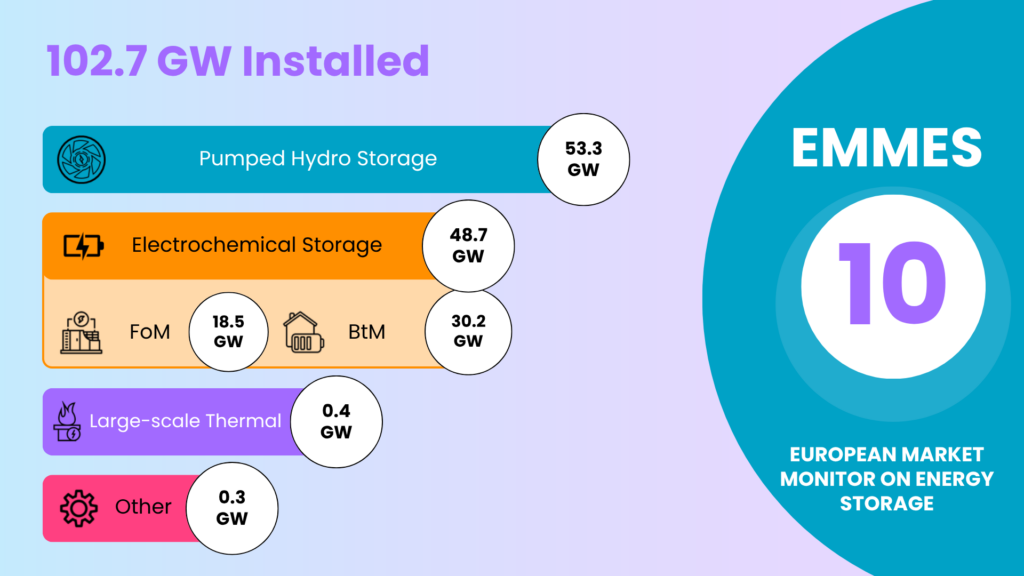
In 2025, Europe surpassed 100 GW of installed storage capacity for the first time, and by Q2 2026 storage overtook nuclear as a source of installed power capacity. With electrochemical storage forecast to grow by a further 153 GW by 2030, energy storage is becoming a core pillar of Europe's future electricity system.
In 2025, Europe surpassed 100 GW of installed storage capacity for the first time, and by Q2 2026 storage overtook nuclear as a source of installed power capacity. With electrochemical storage forecast to grow by a further 153 GW by 2030, energy storage is becoming a core pillar of Europe's future electricity system.