On 9 September 2020, over 200 participants attended an EASE webinar presenting the European Parliament’s ITRE Committee Own-Initiative Report on energy storage. The webinar gave valuable insights into the work behind the report from the perspective of the Members of the European Parliament who led the drafting of the report: Claudia Gamon (rapporteur), Maria Spyraki (shadow-rapporteur), Ville Niinistö (shadow-rapporteur), and Niels Fuglsang (shadow-rapporteur). This was complemented by the European Commission, which presented its vision and policies for energy storage.
October 2020 / Policy Papers
Open Letter on the Revision of the TEN-E Regulation
Following on from the European Commission’s proposed revision of the TEN-E Regulation in the latter half of 2020, EASE put forward a set of recommendations aiming at improving the legislative framework, better support renewable-based solutions, and contribute to the decarbonisation of the energy system.
The TEN-E Regulation should be significantly revised to better address the challenges and seize the opportunities in light of the European Union’s decarbonisation strategy. Flexibility solutions, and in particular energy storage, can play a key role: the regulation should recognise it and properly favour their uptakes.
On 9 September 2020, over 200 participants attended an EASE webinar presenting the European Parliament’s ITRE Committee Own-Initiative Report on energy storage. The webinar gave valuable insights into the work behind the report from the perspective of the Members of the European Parliament who led the drafting of the report: Claudia Gamon (rapporteur), Maria Spyraki (shadow-rapporteur), Ville Niinistö (shadow-rapporteur), and Niels Fuglsang (shadow-rapporteur). This was complemented by the European Commission, which presented its vision and policies for energy storage.
Not a member yet ?
Explore the benefits of joining Energy Storage Europe
Energy Storage Europe welcomes the European Commission's growing focus on cybersecurity in the energy sector and supports the direction of travel across the Cyber Resilience Act (CRA), the Network Code on Cybersecurity, and the proposed Cybersecurity Act (CSA) 2.0. Yet raises concerns that require targeted corrections to ensure these frameworks deliver on their security objectives without inadvertently slowing battery storage deployment.
Energy Storage Europe replies to the European Commission’s public consultation on the Methodology for the Calculation of the recycled content of industrial and EV batteries. Under the Batteries Regulation, several categories of batteries, including industrial batteries, will have to contain a certain percentage of recycled metals to be allowed to be placed on the EU market.
Energy Storage Europe welcomes the proposed revision of the Network Code for generators and the explicit integration of storage, including grid-forming capabilities. Further clarity is needed on requirements for bidirectional storage and the treatment of existing projects.
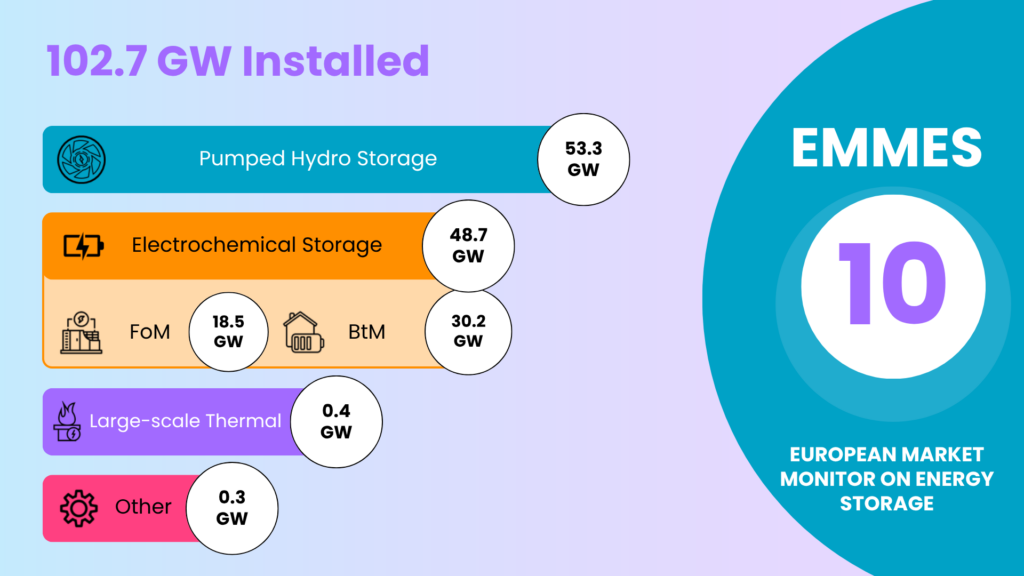
In 2025, Europe surpassed 100 GW of installed storage capacity for the first time, and by Q2 2026 storage overtook nuclear as a source of installed power capacity. With electrochemical storage forecast to grow by a further 153 GW by 2030, energy storage is becoming a core pillar of Europe's future electricity system.