Energy Storage Europe welcomes the proposal for an Industrial Accelerator Act (IAA) and supports its overall objective of strengthening industrial capacity, accelerating decarbonisation, and creating stronger lead markets for strategic clean technologies in the European Union.
June 2026 / Policy Papers
Dual-Value Electrification: Affordable Energy & New Revenues for EU Industries
Energy Storage Europe highlights the important role of Industrial Thermal Energy Storage (TES) in accelerating industrial electrification, reducing fossil fuel consumption, and supporting EU decarbonisation objectives. By providing low-carbon heat and grid flexibility, TES can significantly reduce industrial emissions while creating new revenue opportunities for industrial consumers.
Despite its potential, the deployment of Industrial TES remains limited due to a range of legislative, market, and financial barriers. The paper identifies key challenges, including regulatory uncertainty, grid connection and permitting delays, non-cost-reflective network charges, restricted access to electricity and system services markets, and limited access to financing.
The paper therefore sets out a targeted set of recommendations aimed at removing these barriers, improving the investment framework for Industrial TES, and accelerating industrial electrification across the European Union.
Energy Storage Europe welcomes the proposal for an Industrial Accelerator Act (IAA) and supports its overall objective of strengthening industrial capacity, accelerating decarbonisation, and creating stronger lead markets for strategic clean technologies in the European Union.
Not a member yet ?
Explore the benefits of joining Energy Storage Europe
Energy Storage Europe replies to the European Commission’s public consultation on the Methodology for the Calculation of the recycled content of industrial and EV batteries. Under the Batteries Regulation, several categories of batteries, including industrial batteries, will have to contain a certain percentage of recycled metals to be allowed to be placed on the EU market.
Energy Storage Europe welcomes the proposed revision of the Network Code for generators and the explicit integration of storage, including grid-forming capabilities. Further clarity is needed on requirements for bidirectional storage and the treatment of existing projects.
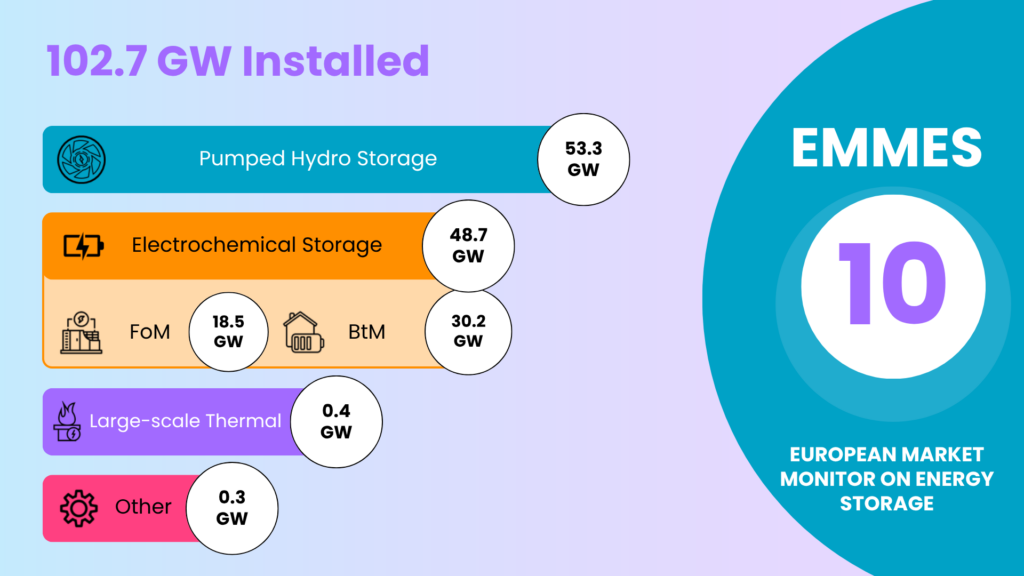
In 2025, Europe surpassed 100 GW of installed storage capacity for the first time, and by Q2 2026 storage overtook nuclear as a source of installed power capacity. With electrochemical storage forecast to grow by a further 153 GW by 2030, energy storage is becoming a core pillar of Europe's future electricity system.
In 2025, Europe surpassed 100 GW of installed storage capacity for the first time, and by Q2 2026 storage overtook nuclear as a source of installed power capacity. With electrochemical storage forecast to grow by a further 153 GW by 2030, energy storage is becoming a core pillar of Europe's future electricity system.