EASE has submitted a technical contribution to the European Chemicals Agency’s Public Consultation on the Annex XV Restriction Report for PFAS. In January 2023, a group of EU member states collectively submitted a proposal for restrictions to the European Chemicals Agency (ECHA) concerning per- and polyfluoroalkyl substances (PFAS).
September 2023 / Policy Papers
Thermal Energy Storage
EASE has prepared a paper that aims to shed light on the numerous benefits of thermal energy storage (TES) by providing an overview of technologies, inspiring projects, business cases, and revenue streams. Policy recommendations are also discussed.
With renewable energy projected to constitute 69% of the EU's electricity mix by 2030, TES emerges as a crucial solution to address energy demand, grid stability, and decarbonization challenges. As Europe steers towards a carbon-neutral future, TES is positioned to bridge the gap between the current energy landscape and the renewable energy targets set for 2030 and 2050.
TES technologies are set to play an integral role in Europe's transition to renewable energy dominance, offering longer-duration storage solutions and reducing reliance on fossil fuels. As the EU pursues climate neutrality and energy security, TES deserves greater recognition and integration into energy policy to support the EU long-term energy goals.
EASE has submitted a technical contribution to the European Chemicals Agency’s Public Consultation on the Annex XV Restriction Report for PFAS. In January 2023, a group of EU member states collectively submitted a proposal for restrictions to the European Chemicals Agency (ECHA) concerning per- and polyfluoroalkyl substances (PFAS).
Not a member yet ?
Explore the benefits of joining Energy Storage Europe
Energy Storage Europe replies to the European Commission’s public consultation on the Methodology for the Calculation of the recycled content of industrial and EV batteries. Under the Batteries Regulation, several categories of batteries, including industrial batteries, will have to contain a certain percentage of recycled metals to be allowed to be placed on the EU market.
Energy Storage Europe welcomes the proposed revision of the Network Code for generators and the explicit integration of storage, including grid-forming capabilities. Further clarity is needed on requirements for bidirectional storage and the treatment of existing projects.
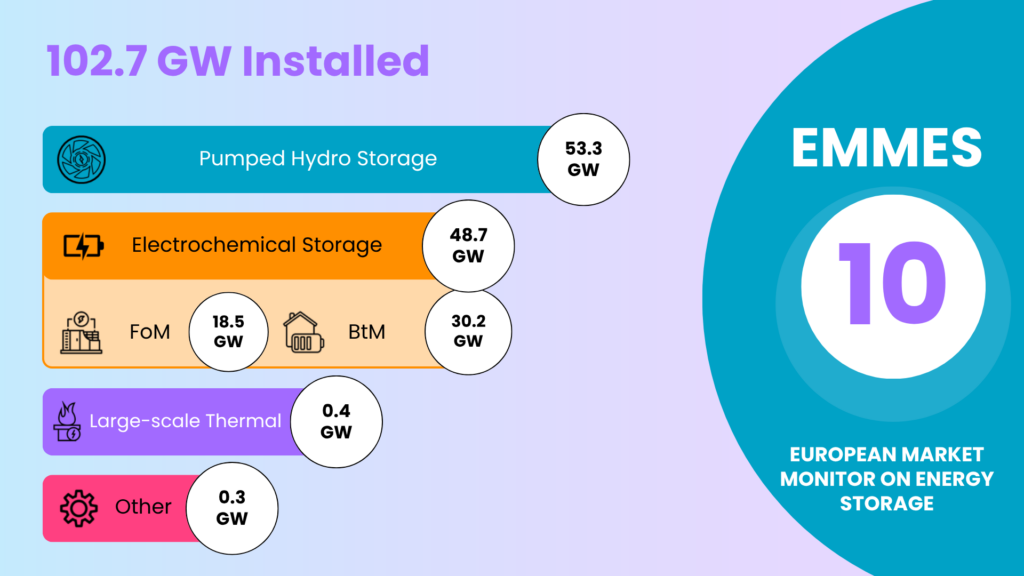
In 2025, Europe surpassed 100 GW of installed storage capacity for the first time, and by Q2 2026 storage overtook nuclear as a source of installed power capacity. With electrochemical storage forecast to grow by a further 153 GW by 2030, energy storage is becoming a core pillar of Europe's future electricity system.
In 2025, Europe surpassed 100 GW of installed storage capacity for the first time, and by Q2 2026 storage overtook nuclear as a source of installed power capacity. With electrochemical storage forecast to grow by a further 153 GW by 2030, energy storage is becoming a core pillar of Europe's future electricity system.