Islands face unique challenges in terms of ensuring a secure and cost-effective energy supply. On 21 November, over 80 participants met during the EASE Energy Storage on Islands Workshop to learn about the latest advances in energy storage technologies and propose policy recommendations to ensure a faster roll-out of innovative solutions to support the island decarbonisation agenda.
02.12.2019 / News
CoFBAT: Cobalt Free Solutions for Batteries
The CoFBAT project “Advanced Material Solutions for Safer and Long-lasting High Capacity Cobalt Free Batteries for Stationary Storage Applications” has kicked off on 12 November in Brussels, Belgium.
EASE is participating in the project that aims to develop novel solutions for battery storage with a modular technology, suitable for different applications fulfilling the increasing need of decentralised energy production and supply for private households and industrial robotised devices. CoFBAT will strengthen the EU competitiveness in advanced materials and the related battery value chain by developing a cobalt-free solution and safe polymer electrolytes.
The project seeks to involve stakeholders from the whole battery value chain: from materials to battery manufacturing, including electrochemical characterisation and life cycle assessment. CoFBAT is the result of a collaboration 19 partners from 9 different countries. EASE will be in charge of developing and carrying communication activities for this project, and is looking forward to work within this innovative initiative.
For more information, please contact the coordinator of the project Mr Carlos Concepcion.
Islands face unique challenges in terms of ensuring a secure and cost-effective energy supply. On 21 November, over 80 participants met during the EASE Energy Storage on Islands Workshop to learn about the latest advances in energy storage technologies and propose policy recommendations to ensure a faster roll-out of innovative solutions to support the island decarbonisation agenda.
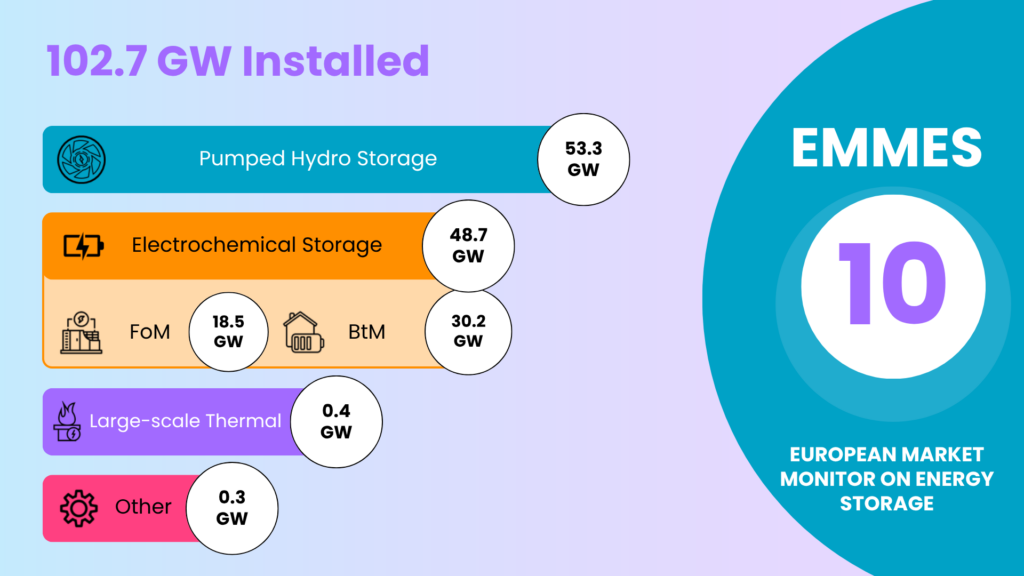
In 2025, Europe surpassed 100 GW of installed storage capacity for the first time, and by Q2 2026 storage overtook nuclear as a source of installed power capacity. With electrochemical storage forecast to grow by a further 153 GW by 2030, energy storage is becoming a core pillar of Europe's future electricity system.
In 2025, Europe surpassed 100 GW of installed storage capacity for the first time, and by Q2 2026 storage overtook nuclear as a source of installed power capacity. With electrochemical storage forecast to grow by a further 153 GW by 2030, energy storage is becoming a core pillar of Europe's future electricity system.
Thermal Energy Storage can help European industry decarbonise, reduce costs, and access new revenue streams. Yet significant regulatory, economic, and financial barriers continue to limit its deployment.
Energy Storage Europe welcomes the proposal for an Industrial Accelerator Act (IAA) and supports its overall objective of strengthening industrial capacity, accelerating decarbonisation, and creating stronger lead markets for strategic clean technologies in the European Union.