EASE submitted a response to the European Commission Public Consultation on the Sustainable and Smart Mobility Strategy outlining the need for an EU strategy that appropriately value the role of energy storage in relation to mobility.
September 2020 / Event Reports
A comprehensive European Approach to Energy Storage
Following the rapid deployments of energy storage solutions around Europe, energy storage is gaining momentum across various initiatives from the European Parliament and European Commission. On 9 September 2020, over 200 participants attended an EASE webinar presenting the European Parliament’s ITRE Committee Own-Initiative Report on energy storage.
The webinar gave valuable insights into the work behind the report from the perspective of the Members of the European Parliament (MEPs) who led the drafting of the report: Claudia Gamon (rapporteur, Renew Europe), Maria Spyraki (shadow-rapporteur, EPP), Ville Niinistö (shadow-rapporteur, Greens/EFA), and Niels Fuglsang (shadow-rapporteur, S&D). This was complemented by the European Commission, which presented its vision and policies for energy storage.
The report provides a comprehensive analysis of the solutions that EASE, as the voice of the energy storage industry, considers essential for the integration of renewables and for transitioning to an energy system in which people will have both clean energy and security of supply. EASE is happy to see that the report has taken a technology-neutral approach to ensure a level playing field for all energy storage solutions. This will allow market forces to foster innovation and to drive the choice of technology.
EASE submitted a response to the European Commission Public Consultation on the Sustainable and Smart Mobility Strategy outlining the need for an EU strategy that appropriately value the role of energy storage in relation to mobility.
Not a member yet ?
Explore the benefits of joining Energy Storage Europe
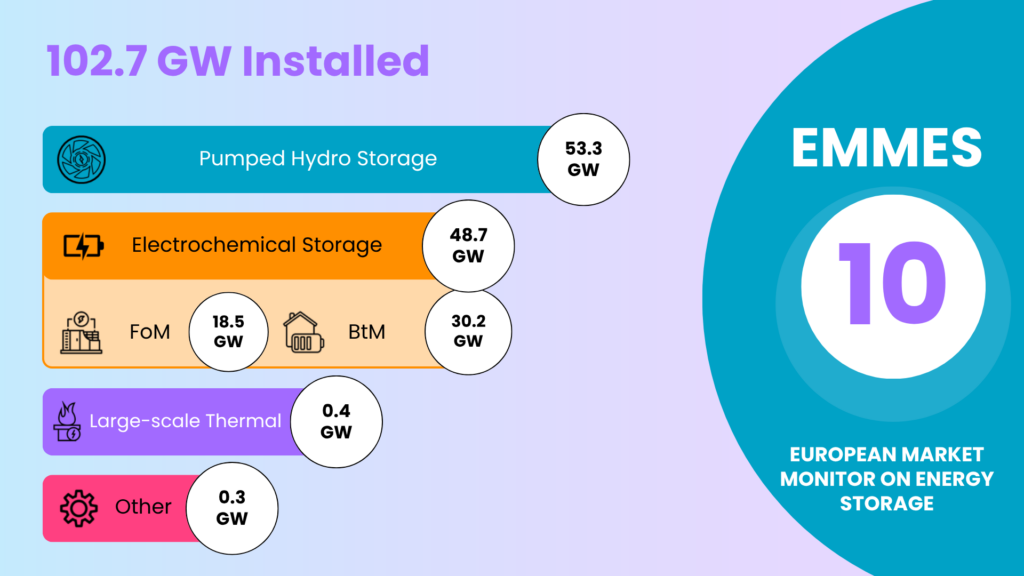
In 2025, Europe surpassed 100 GW of installed storage capacity for the first time, and by Q2 2026 storage overtook nuclear as a source of installed power capacity. With electrochemical storage forecast to grow by a further 153 GW by 2030, energy storage is becoming a core pillar of Europe's future electricity system.
In 2025, Europe surpassed 100 GW of installed storage capacity for the first time, and by Q2 2026 storage overtook nuclear as a source of installed power capacity. With electrochemical storage forecast to grow by a further 153 GW by 2030, energy storage is becoming a core pillar of Europe's future electricity system.
Thermal Energy Storage can help European industry decarbonise, reduce costs, and access new revenue streams. Yet significant regulatory, economic, and financial barriers continue to limit its deployment.
Energy Storage Europe welcomes the proposal for an Industrial Accelerator Act (IAA) and supports its overall objective of strengthening industrial capacity, accelerating decarbonisation, and creating stronger lead markets for strategic clean technologies in the European Union.