EASE welcomes the revision of the Energy Performance of Buildings Directive to boost building renovation and emphasizes its support for the energy efficiency first principle to be applied in its measures. However, EASE believes that energy storage should have a stronger focus in the Energy Performance of Buildings Directive, considering energy systems integration and the widespread deployment of Smart Readiness Indicators are key to increasing energy efficiency.
June 2021 / Policy Papers - Responses to Public Consultations
EASE Reply to the Revision of the Hydrogen and Gas Market Decarbonisation Package
EASE has provided a reply to the European Commission’s Public Consultation on the revision of the EU gas networks rules on market access addressing the Hydrogen and Gas Market Decarbonisation Package. As the Commission points out, a fully functioning internal energy market is key to ensuring security of supply, industry competitiveness and affordable energy for all consumers. It also contributes to achieving the emissions goals of the European Green Deal.
The key proposals from this initiative foresee the review of gas rules in order to:
facilitate the market entry of renewable and low-carbon gases
remove any undue regulatory barriers.
Costs for renewable energies have decreased significantly in the last ten years. In the relevant scenarios used by the Climate Target Plan Impact Assessment, biogas, renewable and low-carbon hydrogen and synthetic fuels would represent two-thirds of the gaseous fuels in the 2050 energy mix, with fossil gas used in combination with CCU/S representing the remainder. The areas where renewable and low-carbon gaseous fuels are expected to come into play include today’s industrial sectors (e.g. refineries, fertilisers, steel making, glass, ceramics) and certain heavy duty transport sectors (ships, aviation, long distance heavy vehicles). They are also expected to continue serving the needs of the electricity system as flexible power production. The role of gas in heating depends on the competition with other technologies, including heat pumps. The process to decarbonise the gas supply and to shift demand for gases to most needed uses must start already now. Achieving the 2030 renewable, energy efficiency and greenhouse-gas reduction targets in time is an important step in this process.
EASE is preparing a response to this consultation to improve the Hydrogen and Gas Market Directive and Regulation proposal in a way that is favourable to the energy storage sector.
EASE welcomes the revision of the Energy Performance of Buildings Directive to boost building renovation and emphasizes its support for the energy efficiency first principle to be applied in its measures. However, EASE believes that energy storage should have a stronger focus in the Energy Performance of Buildings Directive, considering energy systems integration and the widespread deployment of Smart Readiness Indicators are key to increasing energy efficiency.
Not a member yet ?
Explore the benefits of joining Energy Storage Europe
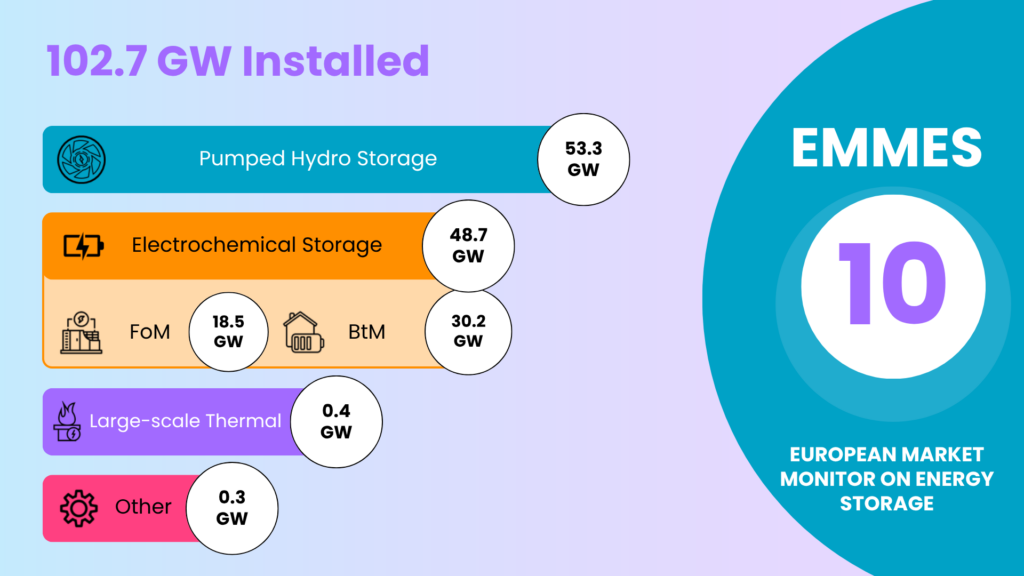
In 2025, Europe surpassed 100 GW of installed storage capacity for the first time, and by Q2 2026 storage overtook nuclear as a source of installed power capacity. With electrochemical storage forecast to grow by a further 153 GW by 2030, energy storage is becoming a core pillar of Europe's future electricity system.
In 2025, Europe surpassed 100 GW of installed storage capacity for the first time, and by Q2 2026 storage overtook nuclear as a source of installed power capacity. With electrochemical storage forecast to grow by a further 153 GW by 2030, energy storage is becoming a core pillar of Europe's future electricity system.
Thermal Energy Storage can help European industry decarbonise, reduce costs, and access new revenue streams. Yet significant regulatory, economic, and financial barriers continue to limit its deployment.
Energy Storage Europe welcomes the proposal for an Industrial Accelerator Act (IAA) and supports its overall objective of strengthening industrial capacity, accelerating decarbonisation, and creating stronger lead markets for strategic clean technologies in the European Union.